



If you grew up believing that the most magical train journey in the world belonged to a bespectacled boy headed to Hogwarts, Switzerland may quietly challenge
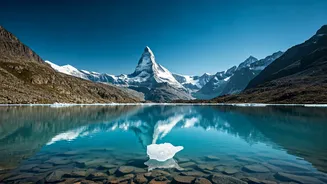
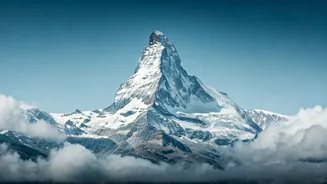
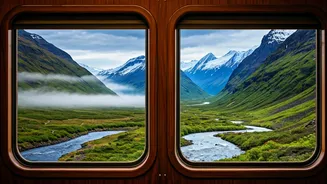
that idea—without spells, owls or platform numbers. Long before Instagram reels and bucket-list hashtags, a scarlet train began threading its way through the Swiss Alps, moving slowly, deliberately, almost stubbornly, as if daring passengers to look away from the windows. The Glacier Express is not in a hurry. It does not pretend to be. And that, perhaps, is its greatest luxury. Running between Zermatt and St. Moritz, the Glacier Express offers an eight-hour passage through what feels like a moving postcard—glaciers clinging to mountain faces, villages tucked into valleys, and bridges that appear to float mid-air. It is often called the slowest express train in the world, a nickname worn with pride. In an age obsessed with speed, this train invites you to do something radical: sit still, eat well, and watch the Alps unfold at their own pace. But here is the question that stops most people mid-scroll—would you really pay close to Rs 1 lakh for a train journey?
A Railway Born Out Of Alpine Ambition
The story of the Glacier Express begins long before luxury menus and panoramic domes. The tracks that now carry wide-eyed tourists were laid in the early 20th century, at a time when building railways through the Alps was considered an engineering gamble. Opened in 1904, the line connected remote mountain regions and stood as a symbol of Swiss precision and persistence.
Interestingly, while the railway line existed earlier, the first Glacier Express as a named service did not run until June 1930. That inaugural train consisted of passenger coaches, saloon cars and a dining carriage—an early hint that this journey was never meant to be merely functional.
For decades, winter travel posed a serious challenge. Heavy snowfall and the constant threat of avalanches along the Furka route meant operations had to be suspended from October. It was only in 1982, with the opening of the Furka Base Tunnel, that the Glacier Express truly became a year-round experience, allowing travellers to witness both summer greens and winter whites without interruption.
In 2008, the railway line earned global recognition when it was declared a UNESCO World Heritage Site, cementing its place not just as a tourist attraction but as a feat of human ingenuity.
The Numbers That Make This Journey Legendary
The Glacier Express does not rely on adjectives alone to impress. It prefers numbers. Over the course of its eight-hour journey, the train crosses 291 bridges and passes through 91 tunnels, each one a quiet reminder of the challenges engineers once faced in carving rail lines through unforgiving terrain.
One of the most photographed sections is the Landwasser Viaduct, a dramatic limestone bridge that curves gracefully into a tunnel carved straight into a cliff. Blink, and you miss it. Stay alert, and you get one of the most iconic railway visuals in the world.
Why The Windows Matter More Than The Speed
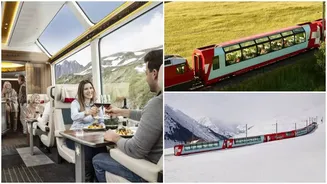
In 1993, the Glacier Express introduced panoramic carriages, a move that changed the way passengers experienced the Alps. The idea was simple but effective—if the landscape is the star, why limit the view? Oversized windows curved into the ceiling, dissolving the boundary between inside and outside.
By 2005, marking the train’s 75th anniversary, 24 panoramic cars had been introduced across all travel classes. Meals began to be served directly at seats, turning the journey into a rolling restaurant with alpine views. Today’s à la carte menu reflects Switzerland’s culinary confidence, offering everything from regional specialities to refined desserts, all plated with the understanding that your eyes are already full.
Excellence Class: Where The Price Tag Climbs With The Altitude
Luxury on rails reached a new level in 2019 with the launch of Excellence Class. This is where the Glacier Express leans unapologetically into indulgence. Inspired by mountain hotels, the interiors feature wide seats, personal concierge service and curated dining experiences. Gold-plated domes above the Glacier Bar add a subtle flourish, just enough to remind you that this is not ordinary train travel.
First and second class compartments were also refurbished in 2021, ensuring that even those not splurging on Excellence Class still experience a polished, modern journey.
How Much Does It Really Cost To Ride The Glacier Express?
Travelling on the Glacier Express is not a casual hop-on affair. Unlike Indian Railways, a ticket alone does not guarantee your place. You must purchase both a travel ticket and a mandatory seat reservation.
Here is what the journey roughly costs:
Second Class requires a seat reservation of CHF 54 (around Rs 6,463) and a ticket priced at CHF 159 (approximately Rs 19,030), bringing the total to CHF 213, or about Rs 25,493.
First Class involves the same seat reservation fee of CHF 54, but the ticket itself costs CHF 272 (roughly Rs 32,555), taking the total to CHF 326, or around Rs 39,018.
Excellence Class is where the numbers rise sharply. The seat reservation alone costs CHF 540 (about Rs 64,631), with the ticket priced at CHF 272. The final total comes to CHF 812, translating to nearly Rs 97,186.
Yes, that is almost Rs 1 lakh—for a train journey.
Who Is Riding This Train Today?
Despite the price, demand has only grown. According to a statement on the official Glacier Express website, “Alongside loyal guests from Switzerland, Germany, and the USA, more and more Asian passengers are discovering the legendary train journey on ‘the slowest express train in the world’.”
The appeal is easy to understand. In winter, the Alps transform into a snow-draped wonderland, while summer brings wildflowers, emerald valleys and clear mountain air. Every season offers a different personality, and repeat travellers swear no two journeys feel the same.
Is It Worth Rs 1 Lakh?
The Glacier Express is not selling speed, convenience or even transport. It is selling time—time to look, time to eat slowly, time to notice how light shifts across mountains. For some, Rs 1 lakh may feel extravagant for a train ride. For others, it is a once-in-a-lifetime experience that replaces the need for a dozen rushed itineraries.
If nothing else, the Glacier Express proves one thing beyond doubt: sometimes, the slowest way forward is also the most unforgettable.