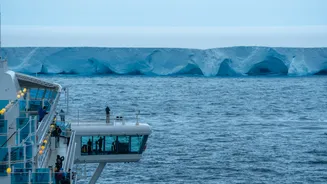








For nearly four decades, a colossal slab of ice known as A23a drifted slowly through Antarctic waters like a frozen continent. Once the largest iceberg
on Earth, the massive “megaberg” is now breaking apart and fading into the ocean, a dramatic end to one of the most extraordinary ice journeys ever recorded. Scientists say its slow death is more than just a spectacle of nature; it could reshape ecosystems across parts of Antarctica and the Southern Ocean. A23a’s story began in 1986, when it broke away from the Filchner–Ronne Ice Shelf in Antarctica. The iceberg was enormous, covering roughly 3,500–4,000 square kilometres, nearly three times the size of New York City, and weighing close to a trillion metric tonnes. For decades, however, it barely moved. Its base became stuck on the seabed in the Weddell Sea, anchoring it in place like a grounded island.
When It Finally Happened
Only in 2020 did the giant finally break free. Satellite imagery showed the iceberg slowly lifting off the ocean floor as its base thinned over time, gaining just enough buoyancy to drift away under the push of ocean currents and winds. Once adrift, A23a began a long journey northward through the Southern Ocean, guided by the powerful Antarctic Circumpolar Current, a massive ocean current that circles the continent. Scientists expected it to follow a familiar path known as “iceberg alley,” where many giant Antarctic icebergs eventually drift into warmer waters and begin to break apart.That prediction is now becoming reality.
The Recent Developments
Recent satellite images show A23a rapidly shrinking as it fractures into multiple pieces. At one point it had already lost around 80% of its mass, breaking into huge fragments as it travelled near South Georgia Island, a remote wildlife sanctuary in the South Atlantic.
The iceberg is also visibly changing. Meltwater pooling on its surface has turned sections of it a striking deep blue — a sign that warming temperatures and internal fractures are accelerating its collapse. These melt pools push water deep into cracks in the ice, forcing the iceberg to splinter faster. Yet the breakup of such a massive iceberg does not simply disappear into the ocean without consequences.
Gigantic icebergs like A23a can influence entire marine ecosystems. As they melt, they release vast amounts of freshwater and mineral-rich sediments into the sea. This can fertilize phytoplankton, microscopic plants that form the base of the ocean food chain, potentially boosting marine productivity in surrounding waters.
But the effects are not always beneficial.
If large fragments become grounded near islands, they can disrupt feeding routes used by penguins, seals, and seabirds, forcing animals to travel farther to find food. Scientists previously feared that A23a might block crucial foraging paths around South Georgia, home to millions of marine animals.
Antarctica’s Future
Beyond its local impacts, A23a’s story also highlights a bigger question about Antarctica’s future. The continent’s ice shelves are slowly weakening due to rising ocean temperatures and shifting currents. When large ice shelves fracture and release giant icebergs, the glaciers behind them can accelerate toward the sea, indirectly contributing to long-term sea-level rise. In other words, the death of this giant iceberg is part of a much larger planetary process.
After nearly 40 years at sea, A23a, once the “queen of icebergs,” is now expected to completely disintegrate into smaller fragments within weeks or months as it drifts into warmer waters. For scientists watching from satellites and research vessels, its disappearance marks the end of an extraordinary natural journey, and a reminder that Antarctica itself is quietly changing.