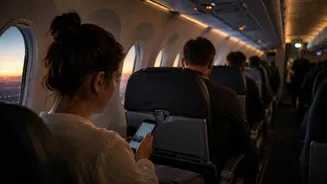









You have settled into your seat, stowed your bag and are somewhere between scrolling your phone and deciding whether to order a drink or not. Then, as
the plane begins its final preparations for takeoff, the cabin lights dim. It is a ritual so familiar that most passengers barely register it. But little did we know that there is a precise, safety-driven reason for it - and once you know it, you will never board a flight quite the same way again. The explanation begins with something as basic as human biology. It is a fact that your eyes take time to adjust to darkness. In bright light, your pupils contract and your eyes rely on cone cells to process what you see. In low or absent light, they switch to rod cells. Now, the problem is that this transition is not instant. It takes the human eye anywhere from 10 to 30 minutes to fully adapt to darkness, a process called dark adaptation. Also Read: The Viral Garba Video From A Vietnam Airport Tarmac Has Reignited A Debate About Indian Tourists’ Behaviour Now, take the case of an emergency during takeoff or landing. Statistically speaking, it is the most dangerous phases of any flight. If the cabin were brightly lit and the power suddenly failed, passengers would be plunged into darkness with eyes completely unadopted to it. The result would be momentary but critical blindness, precisely when people need to move quickly, locate exits, and evacuate. So basically, dimming the lights beforehand, airlines give your eyes a head start. Should the worst happen, passengers already have some degree of night vision.
So Why Takeoff And Landing Specifically?
The dimming has been deliberately timed to these two phases because they carry the highest statistical risk. According to aviation safety data, the vast majority of serious accidents occur during takeoff, initial climb, approach, and landing. This is a window, which is sometimes referred to in aviation as the "plus three, minus eight" rule. Meaning, the first three minutes after takeoff and the last eight minutes before landing account for a disproportionate share of accidents.It is during these windows that an emergency evacuation is most likely to be required. Preparing the cabin - and its passengers - accordingly is simply sound safety logic.
Also Read: Shenaz Treasury Says India Is “Dirty” But The World Still Travels Here For Something Rare
It is for the same reason that flight attendants ask you to pull up your shades during takeoff and landing. Basically, it provides passengers and crew with better situational awareness. It allows flight attendants to monitor external conditions and helps passengers feel more comfortable during these critical phases of flight. Additionally, natural light can aid in a smoother and less disorienting evacuation both at night and during the day if needed.