
Some places do not announce themselves with drama. They arrive quietly, settle into your senses, and linger long after you’ve left. For Sachin Tendulkar,
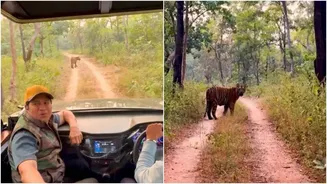
whose life has unfolded under floodlights, applause and relentless public gaze, that place is the forested heart of eastern Maharashtra — the Tadoba Andhari Tiger Reserve. Just like any traveller, India’s sportspersons and celebrities collect destinations — cities conquered, hotels checked into, countries stamped in passports. Yet almost everyone has that one place they keep returning to, not out of habit but instinct. For Tendulkar, Tadoba is that rare constant. Recently, the cricket icon shared glimpses from yet another visit, offering followers a refreshingly unguarded look at his time in the wild. In the video, he smiles and quips, “Tadoba jaane ke liye itna hi traffic milta hai normally,” gesturing at what passes for congestion here — a lone vehicle and a small herd of cows. Seated beside the driver during an early morning safari, he points out the forest slowly waking up, the mist lifting, the quiet punctuated only by bird calls. Then comes the moment every wildlife lover waits for: a tiger sighting. Tendulkar spots Bijli — one of Tadoba’s celebrated big cats — and his excitement is unmistakable. Posting the clip, he spoke of a calm so deep that language fails it. He admitted he returns often, unable to fully articulate what draws him back. “I find myself coming back to Tadoba quite often. There’s just something about it that I can’t put my finger on,” he wrote, adding that perhaps he keeps returning to understand what the forest is trying to tell him. For many viewers, the urge was instant: plan a trip, now.
Why Tadoba Holds Such a Powerful Pull
Tadoba Andhari Tiger Reserve is not merely another dot on India’s wildlife map. Spread across nearly 1,727 square kilometres in the Chandrapur district, it is one of Maharashtra’s largest and most biologically rich protected areas. Unlike manicured safari destinations, Tadoba retains a rawness that feels refreshingly untouched by excess tourism.
Its landscape is a compelling mix — dense teak forests give way to bamboo thickets, open meadows stretch unexpectedly, and the Tadoba River threads quietly through the reserve. This varied terrain is precisely why the park supports such diverse wildlife.
Tadoba is best known for its thriving population of Bengal tigers, which makes sightings more frequent here than in many Indian reserves. The forest has produced several well-known tigers, each with their own territory and temperament, followed closely by photographers and wildlife enthusiasts. But even if stripes remain elusive, the forest rarely disappoints. Leopards, sloth bears, Indian bison (gaur), nilgai, wild dogs, marsh crocodiles, and a remarkable variety of birds and reptiles ensure that every safari carries its own quiet drama.
The Forest That Changes with Every Drive
One of Tadoba’s most understated charms is how different it feels from zone to zone. The core areas and buffer zones offer varied safari experiences — some thick with vegetation, others more open, allowing long-range views. Early morning safaris are particularly prized, when animals are active and the light lends itself to striking photography.
What sets Tadoba apart is its lack of over-polish. There are no unnecessary theatrics, no artificial attempts at spectacle. The forest operates on its own rhythm, rewarding patience rather than expectation. It is this honesty — this refusal to perform — that perhaps keeps pulling Tendulkar back.
Flora That Shapes the Experience
Tadoba’s vegetation is dominated by teak, bamboo, mahua and tendu trees. Mahua flowers, in particular, play a significant ecological role, attracting wildlife during certain seasons. Tendu leaves, meanwhile, have long supported local livelihoods. This interdependence between forest and community is visible everywhere, lending the reserve a lived-in authenticity rather than a curated feel.
When to Go and What to Expect
The reserve remains open to visitors from October 1 to June 30, closing during the monsoon months to allow the forest to regenerate. Summer, though hot, often offers excellent wildlife sightings as animals gather near water sources. Winters are cooler and pleasant, ideal for those who prefer longer, more comfortable safaris.
How to Plan Your Tadoba Visit
Safari timings:
Morning safaris typically run from 6 am to 10 am, while afternoon safaris operate between 2.30 pm and 6.30 pm, varying slightly by season.
Location:
Chandrapur district, Maharashtra — well connected by road and rail, with Nagpur serving as the nearest major city.
Cost:
Jeep safaris generally cost around ₹5,000, depending on zone, season and availability.
Advance bookings are strongly recommended, especially during peak months, as Tadoba’s popularity has steadily grown.