





What is the story about?
According to Curly Tales, only 1 per cent of Indians have seen these stunning hidden gems scattered across the country. These are places that remain untouched,
less crowded and far away from typical tourist circuits. From floating islands in Manipur to basalt rock beaches in Karnataka, and from snow-lined valleys in Kashmir to remote Himalayan villages, each spot offers a rare experience. If you love peaceful landscapes and quiet experiences, these destinations deserve a place on your travel list.
Loktak Lake, Manipur
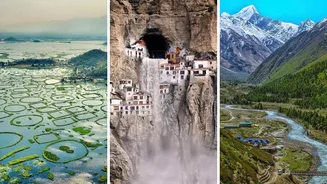
Loktak Lake is a freshwater lake in northeast India. It is famous for its floating islands called 'phumdis'—large mats of vegetation, soil and organic matter that drift on the water. On some phumdis, people live in small huts called 'phumshangs,' and fishing communities make their living on the lake. Inside Loktak lies Keibul Lamjao National Park—the world’s only floating national park. This park is the last natural home of the rare Sangai deer, also known as the dancing deer of Manipur.
Phugtal Monastery, Zanskar
Perched high on a cliff in the remote Lungnak Valley of Zanskar, Phugtal Monastery is built around a natural cave. It belongs to the Gelug school of Tibetan Buddhism and dates back to the 12th century. The monastery’s honeycomb-like structure juts into the mountainside, with monks living and studying inside. Earlier, it could be reached only by foot (or mule) along a rugged trail and hanging bridge.
St. Mary's Island, Karnataka
St. Mary’s Island, also called Thonsepar, is actually a group of four small islands surrounded by the Arabian Sea. The islands are famous for their unusual geological formations: perfectly shaped hexagonal basalt rock columns. These were formed millions of years ago when molten lava cooled and cracked in a geometric pattern. The place feels magical—you see rocks rising out of the sea, clear shallow water, coconut trees, and a seashore covered with shells rather than regular sand. You can reach the islands by a short ferry ride (about 20–30 minutes) from Malpe harbour. A walk on the basalt rocks, sun, sea breeze and open sky—it’s a different experience from typical beaches. Swimming may not always be safe, but the natural beauty and geological wonder make it a must-see.
Aru Valley, Jammu & Kashmir
Aru Valley lies about 12 km from Pahalgam in Jammu & Kashmir. It is known for its lush meadows, high mountains, dense forests and alpine scenery. Many trekkers use Aru as the base camp to explore nearby places like the Kolahoi Glacier. In winter, Aru transforms—snow blankets the meadows and hills, turning it into a winter wonderland. If you love mountain air, open fields, green meadows, and adventure treks, Aru Valley is a hidden gem in Kashmir’s natural beauty.
Wikipedia
Chitkul, Himachal Pradesh
Chitkul is a remote village in the Kinnaur district of Himachal Pradesh. It sits at around 3,450 metres above sea level. For many, it is the last inhabited village on the old Hindustan–Tibet trade route, near the Indo-Tibetan border. The village lies beside the gentle flow of the Baspa River, with the mighty Himalayas as its backdrop. Snow-capped peaks, pine forests, apple and barley farms, wooden-roofed houses and traditional temples give Chitkul a timeless, untouched charm. For trekkers and hikers, it is the starting point for challenging treks like the Lamkhaga Pass trek. Strolling along the Baspa River, exploring simple mountain village life, or camping under Himalayan stars—Chitkul is a peaceful escape far removed from crowded tourist spots.
Dzükou Valley, Nagaland
Dzükou Valley lies on the border of Nagaland and Manipur, tucked away in the hills near Mount Japfü. The air is fresh and thick forests stretch out as far as you can see. There is a calm about the place that’s hard to find anywhere else. If you visit during the wildflower season, the whole valley lights up with colour—especially when the rare Dzükou Lily blooms. It’s a sight that pulls in trekkers and nature lovers from all over. If you love trekking, you’ll find quiet trails, endless green hills, and a real escape from city life. The valley feels remote and untouched, which makes it stand out as one of northeast India’s best-kept secrets.