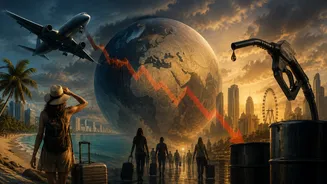








The Middle East crisis has had its ripple effects spread far and wide to the world over, especially when it comes to global oil and fuel reserves, now
being tapped into scantily owing to the blocked Strait of Hormuz which, as per a BBC report, accounts for 20% of the global oil supply and a significant portion of international kerosene exports. Closer back home, Prime Minister Narendra Modi recently also appealed to the public to actively contribute in making India energy-independent - a primary suggestion being curbing foreign travel for the immediate future. With jet fuel shortage plaguing not just India, but the world, one cannot help but wonder about the impact on the tourist-led GDPs and economies. A new Visual Capitalist report charts it out clearly.
Tourist-Led Economies that Fly Under the Radar
Not to say these countries don't efficiently pull tourist footfall, but they typically aren't the first rush of names that come to mind when planning a summer getaway. But their economies are still majorly tourist-dependent, accounting for a significant chunk of their GDPs. Andorra tops the list with 71.8% of their revenue dependent on tourism. Aruba follows at 70.3%. Maldives and Seychelles are potentially the only mainstream names on this list coming in at 68% and 55.4% tourism-dependency respectively. Next is St. Lucia at 51%, followed by Antigua & Barbuda, The Bahamas, Cabo Verde, Grenada and Belize at 39.9%, 34.1%, 27.9%, 26.2% and 25.9% respectively. Then there is Samoa at 20.4%, Albania at 20%, St. Vincent & The Grenadines at 19.9%, Jamaica at 19.5% and finally, Montenegro at 19.4%.
Larger Tourist Economies are Being Hit Too
The UAE, has 10.3% of its GDP account for tourism - something which may dip this year owing to the war collateral situation. The same holds true for popular vacation destinations like Portugal, Morocco, Greece and Dominican Republic with 9.6%, 9.2%, 9.1% and again, 9.1%, accounting for their total respective GDPs. Next in line is Thailand standing at 8.5%, Spain at 6.2%, Malaysia at 6.1% and Singapore at 5%. Austria comes in last in this regard with tourism accounting for 4% of its GDP.
Is there a Solution?
For the larger economies, sectors like technology, manufacturing, finance and in-country spending play a big role in building up their GDP - so the hit though marked, isn't enough to destabilise the mentioned GDPs.
As for the smaller economies that are more seriously tourism-led, diversification is the name of the game, as outlined in the Visual Capitalist report. But while measures like higher-value tourism and nurturing digital industries may make a dent in the board, countries with say, limited natural resources and small populations can only scale up to a certain extent with tourism still being the backbone of their GDP, clears the report.