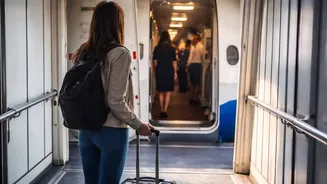








You have cleared security. You have scanned your boarding pass. You have also walked down that long aerobridge which always smells of jet fuel and recycled
air. The aircraft door is right there! And then, you decide not to board, for some reason. Dramatic, right? But it happens with more travellers than we can think of. Sometimes it is last-minute panic. Sometimes it is illness or just an instinct. Recently, travel creator Kamiya Jani spoke encountered a similar situation, which sparked the larger question: what really happens if you change your mind after entering the aerobridge? The answer is not what you expect! First things first, lets understand the setting. The aerobridge - an enclosed tunnel which connects the terminal to the aircraft. It is technically a controlled security zone. One you have crossed into it, you are no longer just a passenger who is waiting at the gate, you are someone who is about to board. Not many of us know but airlines operate on strict headcounts. Every passenger who checks in and clears security is mapped against baggage loaded into the aircraft. So, if you suddenly decide not to board after entering the aerobridge, the crew is bound to initiate a protocol. Also Read: The Only Country With No Currency And Airport! If boarding is still ongoing, you can inform the ground staff immediately. They will escort you back. But here is the catch: If your checked-in luggage has already been loaded, it must be offloaded before the aircraft can depart. This is not optional, it is a global aviation security role. Why? Because unaccompanied baggage is considered a security risk. Airlines cannot fly with checked-in bags if the passenger is not on board. That means your suitcase has to be located in the cargo hold, identified and removed. On a full flight, that can take a lot of time. And if you step off after final boarding, then the captain is informed. Ground staff coordinates with baggage handlers and other passengers remain seated, often unaware of what is happening. Depending on how quickly your luggage is found, the flight could be delayed anywhere from 10 minutes to over half an hour. In some cases, especially if the doors are already closed and pushback clearance has been granted, the aircraft may have to return to the bay. That becomes even more complicated and expensive.
Are There Any Financial Consequences?
- Most airlines treat this as a voluntary no-show. This means:
- Your ticket may be marked as "flown" or "no-show".
- You might lose the fare.
- Refund eligibility becomes complicated.
If the delay is substantial and directly attributed to your decision, airlines can also impose penalties. While this is not common in everyday cases, it is within their rights under aviation rules and conditions of carriage.
What If You Don't Inform Anyone?
Lets say someone enters the aerobridge but simply turns around quietly before the final boarding scan.If your boarding pass has noy been scanned at the aircraft door, you may still be recorded as "not boarded." In that case, your baggage will be removed automatically once reconciliation happens.
But again, that takes time.
In extreme cases, if a passenger disappears after security clearance and does not report back, airport authorities may conduct multiple checks to ensure safety compliance.
So, Can You Change Your Mind?
Yes, physically, you can.Logistically, it is messy.
If you are feeling unwell or panicked, inform staff immediately at the gate - before entering the aerobridge. That is the cleanest exit.
Once you are in the tunnel, things only get complicated.