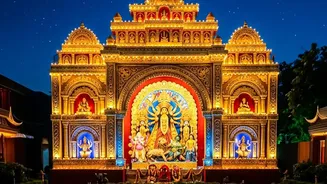
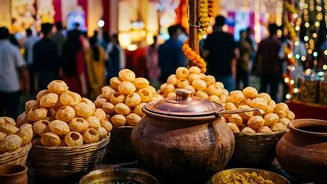
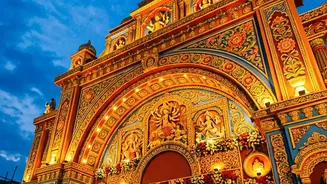
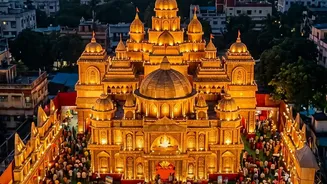
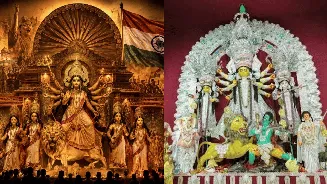
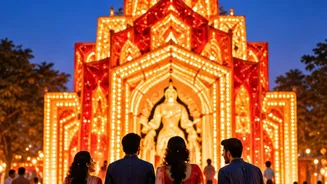
Over the years, Gurugram and Noida have developed their own vibrant Durga Puja traditions, with pandals organised largely by Bengali families who moved
to these cities for work and built communities around the festival. Much of this growth has followed the expansion of the two cities, as more Bengali families settled in Gurugram’s sectors and Noida’s residential pockets, establishing local community pujas instead of travelling to Delhi every year. With both cities seeing packed crowds through the festival this year, here are six pandals worth visiting across Gurugram and Noida.
Gurgaon Bengalee Association, Sector 9
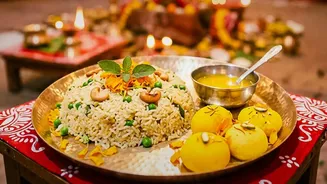
Set up at the HUDA Community Centre, this is the oldest Durga Puja in Gurugram. Founded in 1982, it recently celebrated its milestone 45th year. The pandal stays open around the clock from Panchami to Dashami, offering free entry, parking, and bhog through most of the festival. Visitors can also enjoy the evening aarti and cultural programmes that begin shortly after.
Bangiya Parishad Gurgaon, Sector 56
Marking its 20th year, this pandal is one of the largest in the NCR. It features its own dedicated Pujo theme song and brings in guest artists for live performances throughout the festival days. The celebrations also include a beautiful Mahalaya event and an Anandomela food fair that draws massive crowds from across the city.
Sahashrabdi Durga Puja Samity, Sector 46
Now in its 27th year of celebrations since its inception in 2000, this pandal leans into a traditional, old-school atmosphere and regularly draws upward of 20,000 visitors over the festival. Alongside the usual food and retail stalls, the celebrations include a vibrant Dandiya night, pulling in visitors from well beyond the Bengali community.
Noida Kalibari, Sector 26
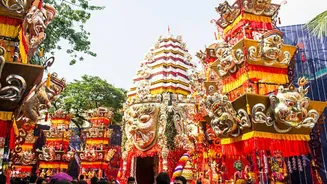
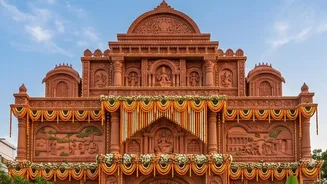
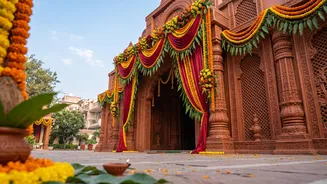
Among the oldest Durga Pujas in Noida, this one traces its roots back to 1983 and is currently observing its 44th year. The idol is traditionally dressed in elegant daaker saaj, and the pandal has previously modelled its grand entrance on Bishnupur’s historic Shyam Rai temple. Bhog is served free of charge, and the Anando Mela features local food stalls, community competitions, and cultural programmes throughout the week.
Balaka Durgotsav, Sector 61
This popular pandal is famous for its massive replica structures. It recently recreated Kolkata’s Victoria Memorial at a towering 63 feet high, built entirely out of bamboo, cloth, and sculpted foam, following the previous year's spectacular replica of Madrid’s Palacio de Cibeles. The pandal also proudly displayed the final Durga idol completed by famed sculptor Salil Bhattacharya before his passing, alongside musical acts featuring celebrity singers.
Jalvayu Vihar Sanskritik Kalyan Samiti, Sector 25
Run by one of Noida’s oldest Bengali cultural organisations, this pandal has built a strong reputation for using eco-friendly materials and sustainable decorations while actively supporting local artists and performers. Its Sandhi Puja on Ashtami and evening cultural showcases typically draw large crowds, and a portion of the festival's proceeds goes toward disaster relief funds.
Planning Your Visit
Gurugram’s pandals are spread across sectors like 9, 46, and 56, so mapping out a route along the same stretch of road makes for an easier evening than crisscrossing the city. In Noida, Sector 26 and Sector 61 are both well-connected by the metro, which is highly recommended given how limited parking gets around the bigger pandals during peak evenings. Crowds across both cities build steadily through the week and peak on Ashtami and Navami, so arriving earlier in the evening helps avoid the worst of the traffic. Most pandals on this list offer free bhog on at least a few days of the festival, so it’s worth timing a visit around that if a proper meal is part of the plan. A handful also run paid stalls selling snacks, sweets, and handicrafts well into the night, which makes it easy to turn a single pandal visit into a longer evening out rather than a quick stop for darshan.