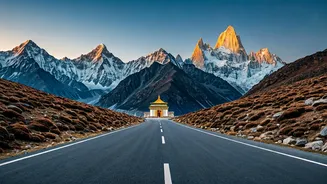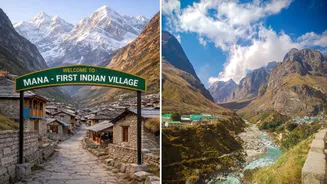





Mana feels like one of those rare Himalayan places where geography, mythology, and identity meet in the same frame. Tucked near the Indo-Tibetan border
in Uttarakhand’s Chamoli district, it was long known as India’s “last village” because of its remote location near the frontier. Today, that phrase has changed. With a new signboard by the Border Roads Organisation, Mana is now recognised as the “First Indian Village,” shifting the idea from a distant border settlement to a symbolic gateway into India. Located around 3 km from Badrinath and set at roughly 3,200 metres above sea level, Mana is small in size but rich in character. It sits near the Saraswati River, surrounded by sharp Himalayan views, stone houses, narrow lanes, and a landscape that feels both spiritual and dramatic. For many travellers, Mana becomes a natural extension of the Badrinath pilgrimage, but the village has enough history, myth, culture, and mountain beauty to stand on its own.
From “Last Village” to “First Indian Village”
Mana’s rebranding is more than just a change in wording. For years, tourists knew it as the last village of India, a phrase that made it sound like the edge of the country. Calling it the “First Indian Village” changes that perspective. It places Mana at the beginning rather than the end, especially when seen from the direction of the border. The BRO signboard placed at the village entrance made this identity official and gave the village renewed attention among travellers. It is a small change, but symbolically powerful for a border community.Mythology Around Vyas Gufa and Ganesh Gufa
Mana’s links to Hindu mythology, particularly the Mahabharata, are profound. One of its most claimed sites is Vyas Gufa, where the Mahabharata was said to have been written by Sage Ved Vyasa, and close by is Ganesh Gufa, at which Ganesh wrote it down as Vyasa was reciting. Though not touristy in the usual sense, these caves are heavy with gravitas for the legends associated with them. For a devotee of mythology, Mana becomes a living page of India’s grand epic.
Bhim Pul and the Saraswati River
One of Mana’s most striking sights is Bhim Pul, a natural rock bridge over the rushing Saraswati River. According to legend, Bhima placed the massive stone so Draupadi could cross during the Pandavas’ final journey toward heaven. Incredible India describes Bheem Pul as a natural rock bridge over a narrow gorge of the Saraswati River, steeped in Mahabharata legend. The sound of the river, the force of the water, and the dramatic mountain setting make this one of the most memorable spots in the village.
The Bhotiya Community and Local Culture
Mana is also home to the Bhotiya community, whose culture reflects the village’s old connection with Himalayan trade and border life. Its location near Tibet shaped local traditions, architecture, food habits, woollen crafts, and seasonal movement. The village’s stone houses, handwoven products, and simple mountain lifestyle give visitors a glimpse of a culture built around survival, faith, and adaptation. Local foods like kidney beans and potatoes are often mentioned by travellers, and shopping for woollens or small souvenirs here supports the local economy.A Gateway for Treks and Mountain Views
Beyond mythology, Mana is a rewarding stop for nature lovers and trekkers. The village is connected with routes toward Vasudhara Falls, Satopanth Lake, Charan Paduka, and other high-altitude trails. Uttarakhand Tourism lists Mana’s best visiting window as May to early November, with the region becoming inaccessible from November to April due to heavy snowfall. That seasonal rhythm adds to its charm: Mana is not a place available all year, so visiting it feels tied to the short, precious window when the Himalayas open up.
How to Reach Mana
Mana is usually visited along with Badrinath. The nearest airport is Jolly Grant Airport in Dehradun, while Rishikesh is one of the nearest major railway points for onward road travel. From Rishikesh, Haridwar, Dehradun, or Joshimath, travellers generally continue by road toward Badrinath and then Mana. The village is accessible by road during the open season, but weather and road conditions matter a lot in the mountains. Since the region receives heavy snowfall in winter, planning around the right months is essential.Mana’s beauty lies in how much it holds within such a small space. It is a border village, a pilgrimage stop, a mythological landmark, a trekking base, and a cultural settlement all at once. Its new identity as the First Indian Village has only added another layer to its story. For travellers heading to Badrinath or exploring Uttarakhand’s high Himalayas, Mana is not just a quick detour. It is a place where India’s spiritual memory, mountain life, and frontier identity come together quietly but powerfully.