





What is the story about?
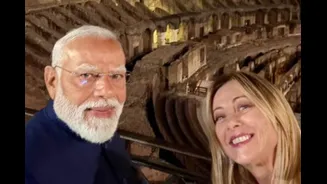
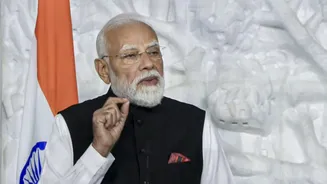
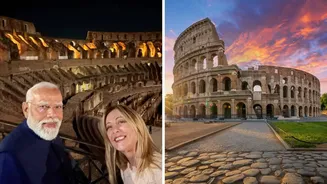
Giorgia Meloni's selfie with Prime Minister (PM) Narendra Modi is breaking the internet. The Italian PM shared a picture with PM Modi from the Colosseum
and captioned it, "Welcome to Rome, my friend!". While the selfie has taken over social media, the Colosseum itself remains Rome’s ultimate main character. Also known as the Flavian Amphitheatre, it is one of Italy’s most iconic attractions. It draws over 7 million visitors annually, with peak years reaching as many as 12 to 14 million tourists. It is recognised as one of the New 7 Wonders of the World and is the largest amphitheatre in the world.
History Of The Roman Colosseum
The Colosseum has been a part of Italy's history for more than 2,000 years. "From the times when it was used as a gladiatorial arena and witnessed staged hunts with thousands of wild beasts to today, it has seen the Roman Empire rise to its greatest splendour, dwindle and disappear. It is said that up to 400,000 people met their end on the sands of the arena, as did one million wild animals of many different species," states the website of the Colosseum.Sometime around 72 AD, the construction of the Flavian Amphitheatre began under Emperor Vespasian. For him, it was a gift to the people of Rome, who were unhappy after the reign of Emperor Nero. While Vespasian died before his dream project could be completed, his son Titus officially opened it and ordered 100 days of public games and entertainment for its inauguration. The Colosseum was finally completed under Titus' younger brother, Domitian, in 83 AD after he succeeded him.
Gladiator games and crowd-pleasing activities continued in the amphitheatre for five centuries. It was also used to celebrate important anniversaries and military victories. In the middle of the 5th century, gladiatorial combats were stopped, although animal shows continued. The floors were later used as a cemetery during the 6th century, and it was eventually converted into a fortified castle by the Frangipani family, a powerful Roman patrician clan of the time.
According to Lonely Planet, "More recently, pollution and traffic vibrations have taken a toll. To help counter this, it was given a major clean-up between 2014 and 2016, the first in its 2,000-year history. Even today, work continues on plans for a new service centre and the recreation of the arena's retractable floor."
The Colosseum was built using an estimated 100,000 cubic metres of travertine stone, along with a similar amount of Roman cement, bricks and tuff blocks. Travertine is a type of limestone that derives its name from Tibur, near modern-day Tivoli, where it was mined.
Attractions Inside The Roman Colosseum
Visiting the interior of the Colosseum offers a direct view into how ancient Roman entertainment functioned. Entry allows visitors to walk through different levels of the amphitheatre, including vaulted corridors, reconstructed seating areas and viewing platforms that overlook both the arena and the surrounding ruins of Rome.The area where gladiators once fought is one of the most important features. A portion of this floor has been reconstructed, giving a sense of the scale of the original structure and allowing visitors to stand in the space where major public spectacles once took place.
Below the arena lies the hypogeum, an underground network of tunnels, chambers and machinery. This area was once used to hold gladiators, animals and stage equipment before they were lifted into the arena through trapdoors. Today, guided tours reveal the remains of these corridors and the complex engineering that supported Roman spectacles.
The higher levels of the Colosseum provide panoramic views over Rome, including the Roman Forum and Palatine Hill. From these vantage points, visitors can better understand the scale of the structure and its integration into ancient Rome's urban landscape. It shows a functioning ancient arena system designed for large-scale public events and crowd control.
Overall, the interior visit showcases not just a monument, but a functioning ancient arena system designed for large-scale public events and crowd control.
Tickets And Tips
Tickets can be bought from the ticket office on Piazza del Colosseo. Visitors can also book them online at www.thecolosseum.org.The Colosseum can get crowded, so it is recommended to plan your visit in advance. There are various kinds of tour packages available for tourists that lasts between 1.5 to 3 hours.