







When UNESCO announced in Delhi that Deepavali had been added to the Representative List of the Intangible Cultural Heritage of Humanity, it marked a significant
milestone not just for the festival, but for India’s broader cultural diplomacy. The declaration came during the 20th session of the Intergovernmental Committee for the Safeguarding of Intangible Cultural Heritage, held for the first time in India and hosted at the Red Fort from December 8–13, 2025. The setting was symbolic as a historic fort representing India’s tangible past was the venue where its living traditions were globally acknowledged. The inscription of Deepavali (or Diwali as it is more popularly called) brings India’s tally of ICH elements to 16, placing the country among the nations actively documenting, safeguarding and promoting community traditions. As the announcement was made, delegates, practitioners and officials gathered at the Red Fort welcomed it as recognition of a festival that has long served as a cultural bridge across regions, religions and diasporas.
What Is 'Intangible Cultural Heritage' And How UNESCO Protects It
Unlike monuments or archaeological sites, intangible cultural heritage (ICH) refers to 'intangible' practices that people continue to pursue in their daily lives. These can be rituals, festivals, performing arts, knowledge systems, craft skills or oral traditions. These are transmitted informally, from parent to child, performer to apprentice. Their fragility lies in this very transmission: if a practice fades from everyday use, it rarely returns.UNESCO’s ICH Convention, adopted in 2003, aims to support communities in keeping traditions alive rather than freezing them in time. It encourages countries to identify cultural practices at risk, document them with the participation of local communities, and propose safeguarding plans that ensure their continuity. Recognition does not impose rules on how a tradition should be practised; instead, it affirms that communities themselves are the custodians of their heritage.
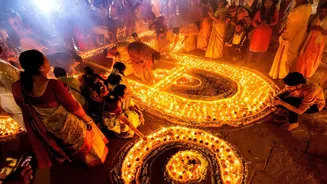
Deepavali fits this framework because its strength lies in its regional variation and community-led transmission. While its themes of light and victory of good over evil are widely known, the customs, right from diya making to rangoli designs, Naraka Chaturdashi to worship of Ravan in different temples across India, are as varied as India's culture. This is what makes this festival, arguably the best representation of India's cultural heritage, worthy of the inclusion.
India’s Intangible Heritage Landscape
With Deepavali added, India now has 16 ICH elements recognised by UNESCO. They also include:- Kumbh Mela
- Durga Puja of Kolkata
- Garba of Gujarat
- Yoga
- Vedic Chanting
- Ramlila
- Kalbelia Songs and Dances (Rajasthan)
- Chhau Dance
- Buddhist Chanting of Ladakh
- Sankirtana of Manipur
- Thatheras of Jandiala Guru
- Nawrouz
- Koodiyattam
- Mudiyettu
- Ramman Festival (Uttarakhand)
What Makes Diwali's Inclusion Special For India
Deepavali’s inscription comes at a time when many traditional practices, diya-making, regional sweet-making, and ritual crafts, face pressure from commercial mass production. UNESCO’s recognition is expected to bring attention to these smaller, community-driven traditions that form the festival’s foundation.The inscription may also help the festival’s practitioners access funding, research support, and collaboration opportunities. While UNESCO listings do not automatically guarantee financial assistance, they elevate visibility, encourage state-led safeguarding plans and often attract independent cultural investment.
For India, hosting the ICH session in Delhi also signals a growing commitment to shaping global cultural conversations. Deepavali’s recognition, announced on Indian soil, underlines that intangible heritage has become as diplomatically significant as monuments and museums.
How An Element Gets Inscribed On UNESCO’s ICH List
India’s nomination process for UNESCO’s ICH Representative List is structured and multi-layered:National Identification and Inventorying
To qualify for nomination, an element must first be included in India’s National Inventory of Intangible Cultural Heritage, maintained by the Sangeet Natak Akademi (SNA). This inventorying process involves documentation, community consultations, and expert evaluation.
Sangeet Natak Akademi as Nodal Agency
The SNA, an autonomous body under the Ministry of Culture, is the official nodal organisation for intangible cultural heritage.
Its responsibilities include:
- Coordinating with practitioners, scholars and cultural organisations.
- Leading field interactions and collecting community-verified information.
- Preparing the nomination dossier in accordance with UNESCO’s guidelines.
- Ensuring the element meets the criteria for representation and safeguarding.
The dossier submitted to UNESCO must include:
- A detailed description of the element and its cultural context.
- Its history, continuity and current modes of practice.
- Videos, photographs and testimonies from practitioners.
- A community-supported safeguarding plan outlining how the tradition will be preserved.
- Evidence of inclusion in the national ICH register, which is a mandatory requirement.
Government Oversight and Support
The Ministry of Culture oversees policy, coordination and long-term safeguarding. Key institutions involved in heritage preservation include:
- Sahitya Akademi, Lalit Kala Akademi, Sangeet Natak Akademi
- Indira Gandhi National Centre for the Arts (IGNCA)
- National School of Drama (NSD)
- Centre for Cultural Resources and Training (CCRT)
- Seven Zonal Cultural Centres
- Indira Gandhi Rashtriya Manav Sangrahalaya
- Anthropological Survey of India
Schemes and Financial Support
Alongside institutional support, the Ministry operates schemes offering financial assistance to artists and organisations.
Since 2013–14, the government has run the “Scheme for Safeguarding the Intangible Cultural Heritage and Diverse Cultural Traditions of India”, aimed at:
- Enhancing awareness and documentation.
- Supporting practitioners.
- Promoting sustainable transmission of traditions.
Once India submits the nomination, UNESCO's Evaluation Body reviews it and presents recommendations to the Intergovernmental Committee, which makes the final decision during its annual session.