






Embrace AI Adaptation
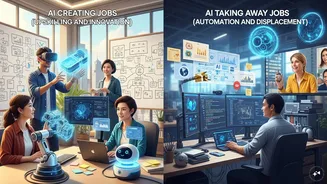
Concerns about artificial intelligence displacing human workers are widespread, but a consensus among technology leaders suggests a different approach:
proactive skill development. At the AI Impact Summit 2026, experts emphasized that adaptability will be the cornerstone of future job security. Rather than succumbing to fear, professionals are encouraged to view AI as a catalyst for change, one that will undoubtedly render certain tasks obsolete but simultaneously unlock novel career paths. Sanjeev Bikhchandani, founder of Info Edge, provided historical context by recalling the advent of computers in banking, where job losses were minimal, and productivity soared. His advice is straightforward: focus on personal readiness. He urged individuals to set tangible goals, such as mastering three AI platforms within three months, asserting that such proactive learning is the most effective defense against job obsolescence and a potent enabler of new employment opportunities. The message is clear: engage with AI, don't let it happen to you.
Lifelong Learning is Key
The accelerating pace of technological advancement, particularly with AI, necessitates a commitment to continuous learning. Sateesh Seetharamiah, CEO of EdgeVerve, described AI as a powerful 'capability multiplier' that significantly enhances productivity for businesses. While AI excels at tasks and processing, human oversight and accountability remain indispensable. This implies that jobs won't vanish entirely but will certainly evolve, requiring individuals to adapt their skill sets. Vineet Nayar, former CEO of HCL Technologies and founder of Sampark Foundation, posited that AI could potentially eliminate half of current jobs but create an equivalent number of new roles. The crucial task, he noted, is identifying and acquiring the specialized skills these new positions will demand. This perspective underscores the importance of reskilling and upskilling initiatives to navigate the evolving job market effectively. The future of employability hinges on our willingness to learn and adapt.
AI as a Productivity Enhancer
Contrary to widespread fears, the prevailing expert opinion is that AI will primarily serve to augment human capabilities, leading to increased productivity rather than widespread job elimination. Tejpreet Singh Chopra, Co-Chairman of the CII National AI Forum, articulated this viewpoint, suggesting that AI will usher in an era where humans focus on cognitive tasks and decision-making, while computers handle execution. This division of labor promises a more efficient and innovative work environment. Shashi Shekhar Vempati and Alok Agrawal, co-founders of AI4India, echoed this sentiment, highlighting India's growing AI prowess and the critical need for targeted upskilling programs. They emphasized that AI is an enduring technology, and the most significant action individuals can take is to enhance their AI-related skills. The fundamental shift is not about jobs disappearing but about their nature transforming, demanding a re-skilling effort from the workforce.
New Opportunities in Healthcare
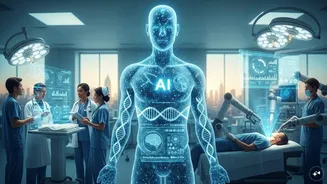
Beyond the general impact on the job market, specific sectors are poised to experience substantial growth due to AI integration. Anurag Mairal, an Adjunct Professor at Stanford University School of Medicine, pointed to the Indian healthcare sector as a prime example. He suggested that while AI's threat to jobs is most pronounced in routine and mundane tasks, it presents a significant opportunity to create new roles. Mairal estimated that India could potentially generate 10 million new jobs for healthcare professionals, driven by AI-powered advancements. This outlook suggests that AI can be a powerful engine for job creation, especially in fields that require human empathy, critical thinking, and specialized care. The 'AI Impact Summit' itself underscores the potential for using AI to positively impact people's lives, with India being a particularly promising landscape for such developments.