







A Celestial Collaboration
In a monumental stride for India's technological prowess, two pioneering entities, Pixxel and Sarvam, are joining forces to construct the nation's inaugural
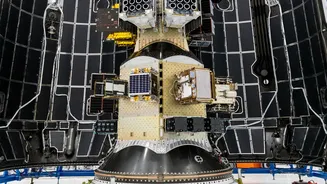
orbital data center. This ambitious venture merges cutting-edge Indian satellite engineering with domestically developed artificial intelligence models, all integrated into a single space mission. This initiative is more than just a satellite; it's a trailblazer, a pathfinder mission designed to reach Earth's orbit as early as the fourth quarter of 2026. Under the terms of their agreement, Pixxel will spearhead the design, construction, launch, and ongoing operation of a 200-kilogram class satellite. Meanwhile, Sarvam is entrusted with providing the crucial artificial intelligence framework, ensuring its sophisticated models can operate directly onboard the satellite for both training and performing complex analyses. The companies emphasize that this integrated approach will enable data processing to occur in orbit itself, thereby eliminating reliance on foreign cloud services or ground-based infrastructure, marking a significant step towards technological self-sufficiency.
AI's Ascent to Orbit
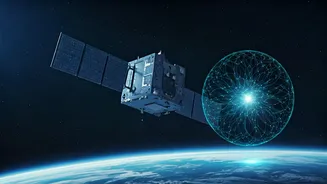
The pathfinder satellite is engineered to be a powerhouse, equipped with data center-grade Graphics Processing Units (GPUs) and Pixxel's advanced hyperspectral imaging camera. The overarching objective is to empower the satellite to capture incredibly detailed imagery of Earth's surface and immediately analyze this data in real-time, directly in space. This method marks a significant departure from the conventional satellite operational model. Typically, data is acquired in orbit, transmitted back to Earth, and subsequently processed using extensive ground-based systems. This sequential process can often introduce considerable delays. By positioning the computation capabilities closer to the data's origin, Pixxel and Sarvam aim to drastically reduce this latency. Such an advanced system could prove invaluable for critical applications like rapid wildfire detection, precise monitoring of crop health, tracking subtle environmental shifts over time, or promptly identifying pipeline leaks, all achieved much faster than systems that must await raw data transmission to Earth.
Strategic Importance Unveiled
This collaborative endeavor emerges at a pivotal moment when the infrastructure underpinning artificial intelligence has ascended to become a critical concern for businesses, policymakers, and national sovereignty. The demands of AI models for immense computational power are undeniable, and satellites are prolific generators of vast quantities of data. The capability to process this data while it's still in orbit presents compelling advantages for a diverse range of users, including governmental bodies, large enterprises, environmental monitoring organizations, and companies managing vital infrastructure. Pixxel's CEO, Awais Ahmed, highlighted the escalating challenges faced by terrestrial data centers, citing constraints related to energy consumption, land availability, regulatory hurdles, and scalability, deeming the current model increasingly unsustainable from an environmental perspective. He further articulated that orbital data centers unlock a novel frontier, enabling computations to harness solar energy, operate in close proximity to space-based data sources, and transcend many of the limitations inherent to Earth-bound operations. Complementing this, Sarvam's CEO, Pratyush Kumar, underscored the profound implications of AI infrastructure beyond mere software, stating it's fundamentally a matter of sovereignty. He explained that this partnership facilitates Sarvam's ambition to extend its sovereign AI ecosystem into the realm of space, with homegrown AI models running on a satellite constructed within India.
Future Trajectories and Next Steps
The upcoming pathfinder mission is designed as a comprehensive testing ground, meticulously evaluating various critical functionalities in the space environment. These include the effectiveness of AI inference, the efficiency of data processing pipelines, the management of power consumption, the control of thermal conditions, and the viability of real-time operational workflows. Pixxel has indicated that the development of this satellite will occur at its soon-to-be-established Gigapixxel facility, an upcoming advanced manufacturing site intended to scale up satellite production capacity to accommodate up to 100 units. For India's burgeoning AI and space industries, this mission represents a significant proof-of-concept. Should the mission achieve its intended objectives, it could fundamentally reshape perceptions of future satellite capabilities, demonstrating that these spacecraft can evolve beyond mere data collection to actively process, analyze, and deliver actionable insights at unprecedented speeds, marking a paradigm shift in space-based information gathering and utilization.