






AI's Workplace Reshaping
The rapid integration of artificial intelligence into various sectors is no longer a future prediction but a present reality, fundamentally altering how
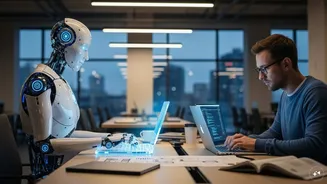
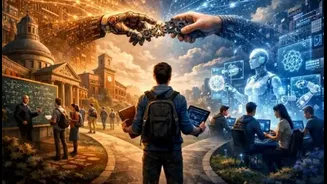
businesses operate and what skills are valued. AI tools are now capable of automating tasks that were once the domain of white-collar professionals, impacting fields such as coding, financial analysis, customer support, and content creation. This technological shift has understandably led to widespread apprehension regarding career stability, especially among new entrants to the workforce. However, leading voices in the field propose that AI's primary impact isn't the wholesale elimination of jobs, but rather a profound redefinition of the nature of work itself. History demonstrates that technological advancements, like the internet, have historically spurred the creation of entirely new industries and roles, a trajectory many believe AI will also follow, potentially giving rise to positions like AI trainers, ethics specialists, and experts in human-AI collaboration.
Human Judgment's Value
While artificial intelligence excels at data processing and automating routine activities, careers that hinge on profound human qualities are predicted to be more resilient. Skills such as emotional intelligence, ethical reasoning, creativity, and nuanced human judgment are considered difficult for AI to replicate. Ankush Sabharwal, founder and CEO of CoRover.ai, emphasizes that AI can analyze vast datasets but cannot duplicate lived experiences, moral frameworks, or genuine empathy. Consequently, professions like therapy, teaching, nursing, caregiving, and social work are often cited as less susceptible to full automation. Sonica Aron, founder and managing partner at Marching Sheep, notes that roles involving leadership, negotiation, crisis management, and relationship building rely heavily on interpersonal understanding that AI currently struggles to master. These fields often involve intricate human behaviors and social dynamics that are fluid and complex, suggesting AI may serve as a powerful assistive tool rather than a complete replacement for human professionals. Healthcare exemplifies this, where AI aids in diagnostics, but patient-facing roles require trust and empathy.
Resilient Professions Listed
Experts have identified several professional domains that appear comparatively safe from widespread AI automation. These include roles centered on mental health support, such as therapists and counselors, and those within healthcare that involve direct patient interaction like nurses, caregivers, and allied health workers. The field of education also remains robust, with teachers, trainers, and learning facilitators continuing to be in demand. Human resources and employee wellbeing professionals are also seen as less vulnerable due to their focus on human dynamics. Beyond the office, skilled trades requiring physical dexterity and on-site problem-solving, such as electricians, mechanics, and technicians, are also considered difficult for AI to fully replace. Furthermore, roles in user experience research, human-centered design, social work, community development, sustainability, ESG, and DEI (Diversity, Equity, and Inclusion) are expected to remain critical. Leadership and people management positions, along with creative strategy, storytelling, and communication roles, all tap into essential human capabilities that AI has yet to master.
Physical Dexterity's Edge
Professions requiring significant physical adaptability and hands-on problem-solving in unpredictable environments are also considered to be largely insulated from immediate AI disruption. Praphul Chandra, dean of research and director of the AI Centre of Excellence at Atria University, highlights that AI systems and robotics currently face major challenges in replicating the manual dexterity and real-world situational judgment needed for tasks like fixing complex machinery or navigating unpredictable physical spaces. Electricians, mechanics, plumbers, and technicians, for example, often deal with unique and dynamic conditions that demand quick thinking and physical coordination, which are difficult for current AI to replicate. Even surgical nurses, who work in high-pressure, rapidly changing environments, rely on physical skills and adaptive decision-making. Chandra suggests that the future workplace will likely value adaptability and practical intelligence over mere technical expertise, especially in scenarios where environments are less controlled and more prone to unexpected issues.
Adaptability Over Expertise
The most effective long-term strategy for navigating the evolving job market isn't necessarily seeking roles entirely untouched by AI. Instead, experts advocate for a synergistic approach that blends technical literacy with fundamentally human capabilities. Pooja Sharma Goyal, founding CEO of The Udaiti Foundation, stresses the importance of not only using AI tools but also understanding how to guide and oversee them responsibly. She asserts that the most resilient careers will be those that integrate technical fluency with strong human judgment, the ability to make context-aware decisions, and effective oversight. Goyal also points out an emerging gender disparity in AI leadership, noting that despite India's high AI skill penetration among women, their representation diminishes significantly in senior GenAI roles. This underscores the need for diverse perspectives in shaping AI's future. Chandra anticipates that AI will become more specialized, leading to new job categories and transforming existing ones, making continuous learning and human-AI collaboration paramount.