


Mission Climax Approaches
The Artemis II mission is reaching its most critical juncture, with the four-person crew preparing to re-enter Earth's atmosphere following a groundbreaking
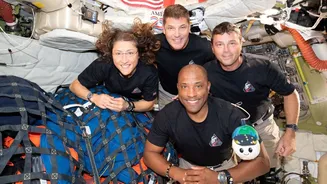
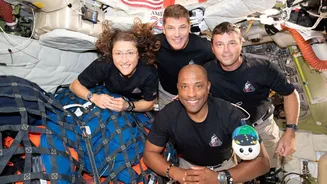
lunar flyby. This mission has already achieved significant milestones, contributing to scientific knowledge and proving essential technologies for future lunar expeditions. However, mission leaders and the astronauts themselves emphasize that the ultimate test remains the safe return to our planet. The crew, comprising Reid Wiseman, Victor Glover, Christina Koch, and Jeremy Hansen, is slated to complete their nearly 10-day voyage with a splashdown in the Pacific Ocean near San Diego. This event will signify the end of the first crewed mission to orbit the Moon since Apollo 17, marking a vital advancement in NASA's long-term Artemis program objectives.
Historic Lunar Journey
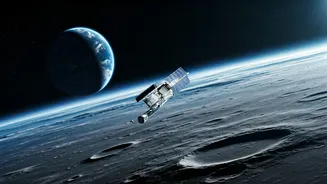
Artemis II has already cemented its place in spaceflight history. During its mission, the crew journeyed approximately 252,000 miles from Earth, surpassing the previous record held by Apollo 13 by several thousand miles. At its farthest point, the spacecraft reached about 252,760 miles (406,778 kilometers) from Earth, setting a new distance record for human exploration. The astronauts successfully completed a lunar flyby, traversing the far side of the Moon, a region perpetually hidden from direct view on Earth. From an altitude of about 4,000 miles above the surface, they conducted direct human observations of the lunar landscape, offering a perspective previously unavailable through remote sensing alone. Scientists at NASA's Mission Control in Houston actively monitored the crew's communications, analyzing live and recorded transmissions to gather insights and engage in discussions with the astronauts across the vast expanse.
The Free-Return Trajectory
A defining element of Artemis II's return is its reliance on a precisely calculated 'free-return trajectory.' This orbital path allows the Orion capsule, named Integrity by the crew, to circumnavigate the Moon and head back towards Earth primarily by harnessing gravitational forces, minimizing the need for continuous engine burns. The trajectory essentially forms a figure-eight pattern, with Earth and the Moon as its gravitational anchors. As the spacecraft neared the Moon, lunar gravity began to exert its influence, effectively guiding and redirecting the capsule back toward Earth. This maneuver is deeply rooted in orbital mechanics, particularly the complex 'three-body problem,' which accounts for the gravitational interplay between Earth, the Moon, and the spacecraft. While Earth's gravity initiates the journey, the Moon's gravitational pull becomes dominant in its sphere of influence, with even the Sun's gravity playing a subtle role that requires meticulous adjustments for course correction.
Re-entry: A Fiery Descent
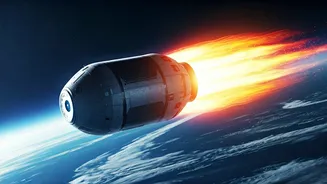
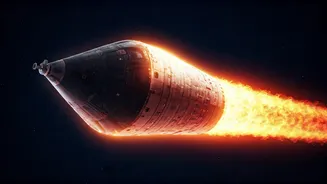
The process of re-entry involves the Orion capsule plunging into Earth's atmosphere at incredibly high velocities, generating immense heat and pressure. The spacecraft is anticipated to reach speeds of up to 23,839 miles per hour (38,365 kilometers per hour) as it encounters the upper atmospheric layers. At these extreme speeds, friction with atmospheric particles creates a superheated plasma sheath around the capsule, making it appear as a blazing fireball. Astronaut Victor Glover described the anticipation of this phase, noting its profound nature. The capsule's heat shield is engineered to withstand these intense thermal and mechanical forces, safeguarding the crew. This critical component is a key focus of testing during Artemis II, as it will be vital for future missions, including lunar landings and potential journeys to Mars. NASA officials project the re-entry sequence to last approximately 13 minutes, from initial atmospheric contact to splashdown.
Controlled Splashdown and Recovery
The final stages of Artemis II's descent are meticulously orchestrated for a safe landing. As the spacecraft decelerates, it will deploy drogue parachutes to stabilize its orientation, followed by pilot parachutes that assist in deploying the main parachutes. These main parachutes will significantly reduce the capsule's speed, bringing it down to approximately 25 feet per second just before impacting the ocean surface. NASA's recovery operations are highly detailed, with the U.S. Navy playing a crucial role. The USS John P Murtha is positioned in the designated Pacific Ocean splashdown zone to manage the retrieval of the crew and spacecraft. Divers will approach the capsule shortly after it lands to secure it and help the astronauts exit. The crew will be transferred to an inflatable platform before boarding the recovery vessel, a procedure extensively practiced to ensure efficiency and safety. The splashdown site near San Diego was chosen for practical reasons and mission requirements, fitting the natural trajectory toward the Pacific and offering favorable weather and proximity to naval support.
Crew Preparation and Future Vision
In the lead-up to their return, the Artemis II crew has been engaged in both technical and mental preparation for re-entry. NASA has outlined specific activities to ensure all systems are functioning optimally and the astronauts are ready for this final mission phase. They've conducted tests to confirm Orion's manual control capabilities, an essential skill for future missions involving orbital docking. Some planned activities were adjusted to prioritize re-entry preparations, such as canceling an exercise to build a radiation shelter to allow more time for configuring the spacecraft for descent. On the day before re-entry, the astronauts are set to perform final simulations and checks of critical systems. Mission officials express confidence in the spacecraft's performance but emphasize that Artemis II is a test flight, with each phase yielding valuable data for upcoming missions. Christina Koch likened the Artemis program to a relay, where each mission builds upon previous successes, with a focus on enabling future crews to achieve lunar landings and potentially journey to Mars.