




Ambitious Revenue Forecasts
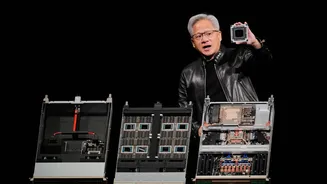
Nvidia's Chief Executive Officer, Jensen Huang, made a significant announcement at the company's GTC event, projecting that its cutting-edge Blackwell
and Rubin chip architectures are poised to collectively generate a monumental $1 trillion in revenue by the conclusion of 2027. This upward revision significantly surpasses the previously estimated $500 billion target for these same chip families by the end of 2026. This extraordinary financial outlook is a direct reflection of the explosive demand for specialized hardware essential for both the development and execution of sophisticated artificial intelligence models. While the cumulative revenue figure highlights the sheer scale of Nvidia's business, it doesn't necessarily signal an abrupt acceleration in sales growth rates compared to previous periods. The market's reaction was mixed, with initial share price increases moderating shortly after the announcement. Huang emphasized that the demand for Nvidia's solutions is exceptionally strong, coming from a diverse range of clients, from burgeoning startups to established corporate giants. He articulated that the primary constraint appears to be the availability of production capacity, suggesting that if more chips could be produced, clients could process more data (tokens) and consequently increase their own revenues.
Introducing the LPU Innovation
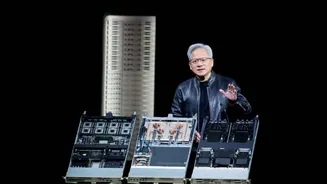
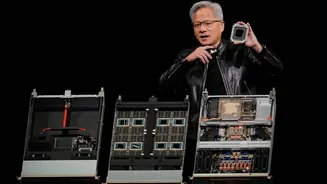
Further bolstering its technological portfolio, Huang introduced the Nvidia Groq 3 Language Processing Unit, or LPU. This marks a significant milestone as the company's inaugural chip stemming from a startup that Nvidia largely integrated through a substantial $20 billion asset acquisition in December, its largest transaction to date. The Groq 3 LPU is slated for shipment in the third quarter. Groq itself was founded by the original developers of Google's in-house tensor processing unit, a component that has gained considerable traction as a formidable competitor to Nvidia's established graphics processing units. The new Groq 3 LPU has been meticulously engineered to enhance this cutting-edge technology, featuring a specialized core optimized for accelerating graphics processing unit (GPU) performance. Huang also unveiled a comprehensive rack solution designed to house these new Groq accelerators. This 'Groq LPX rack' will accommodate 256 LPU units and is intended to be deployed alongside the Vera Rubin rack-scale system, which is scheduled for customer delivery later this year. According to Huang, the Groq LPX rack has the capability to boost the tokens-per-watt efficiency of its Rubin GPUs by an impressive 35 times, showcasing a remarkable leap in performance metrics.
Memory and Future Roadmaps
Huang further elaborated on the integration of these advanced processors, stating, "We united, unified two processors of extreme differences, one for high throughput, one for low latency." He acknowledged that despite this unification, the critical need for substantial memory capacity remains. To address this, Nvidia plans to integrate a significant number of Groq chips, thereby expanding the available memory resources. In recent years, Nvidia has significantly intensified its pace of technological development, with a strategic objective to refresh its entire product lineup on an annual basis while continuously introducing new components. The company's upcoming generation of flagship AI processors, anticipated to be available in systems during the latter half of 2026, has been named Vera Rubin, a tribute to the pioneering astronomer whose observational work provided crucial support for the existence of dark matter. Despite consistently reporting sales growth that significantly outpaces the broader semiconductor industry, Nvidia's stock performance has experienced a slowdown in recent months. Leading up to the GTC presentation, the company's shares had seen a decline of 3.4% year-to-date, although its market capitalization remained an industry-leading $4.4 trillion.