







AI's Galactic Census
In a remarkable feat of computational astronomy, artificial intelligence has been instrumental in pinpointing more than 1,300 extraordinary celestial entities
within the extensive archival data from the Hubble Space Telescope. This data, accumulated over an impressive 35-year span, was not originally gathered for this specific research but has yielded significant new findings. Astonishingly, over 800 of these identified objects represent discoveries entirely new to scientific records. The AI's analytical power was applied to a staggering dataset comprising nearly 100 million small image segments, each measuring between seven and eight arcseconds across. This monumental task, which would be an insurmountable challenge for human astronomers to undertake manually, was accomplished by the AI in a mere two and a half days, highlighting its unparalleled efficiency in sifting through vast astronomical archives.
Cosmic Oddities Revealed
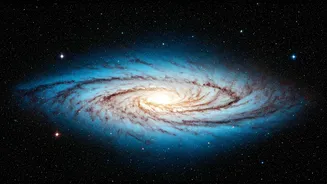
The anomalies brought to light by the AI are as diverse as they are fascinating. Among the discoveries are interacting galaxies, some caught in the dramatic act of merging, resulting in strikingly distorted forms and elongated trails of gas and dust. The analysis also identified instances of gravitational lensing, a phenomenon where a massive foreground galaxy's gravity warps the light from more distant objects, bending it into ethereal arcs and rings. Furthermore, the AI has highlighted galaxies exhibiting robust star formation, alongside 'jellyfish' galaxies, so named for their trailing tendrils of gas and stars being siphoned off by their environment. Even edge-on protoplanetary disks within our own Milky Way, where planets are in the process of formation around nascent stars, were identified. Significantly, several dozen of these newfound objects defied classification within existing astronomical frameworks, underscoring the novelty of these findings.
AnomalyMatch: The AI Star
The groundbreaking work was facilitated by AnomalyMatch, a sophisticated neural network developed by the European Space Agency. This AI was meticulously trained to recognize unusual patterns in visual data, mirroring human observational capabilities but with vastly superior speed and scale. The deployment of AnomalyMatch signifies a paradigm shift in how astronomical archives are explored. It enables the rapid and comprehensive examination of immense datasets that would be practically impossible for human researchers to manually inspect. While citizen science initiatives have previously aided in cosmic discoveries, the sheer volume of data from Hubble, coupled with upcoming surveys from observatories like Euclid and the Vera C. Rubin Observatory, necessitates more powerful tools. AnomalyMatch's application represents the first systematic and complete search of the Hubble Legacy Archive, with human scientists playing a crucial role in confirming the AI's findings, thereby validating this AI-driven approach as a potent method to enhance the scientific yield from existing observational data.