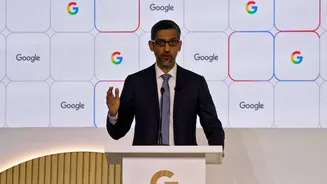








Patience Amidst Turbulence
Sundar Pichai's leadership style is often compared to a serene moment found beneath the surface of choppy Hawaiian waters, reflecting his ability to remain
composed during industry upheaval. As the CEO of Google and its parent company, Alphabet, he steers one of the world's most influential tech giants. Unlike many of his high-profile counterparts in the tech world, Pichai typically opts for a more reserved demeanor, allowing Google's groundbreaking products and strategic initiatives to capture the spotlight. While some critics once perceived his measured approach as a lack of urgency, especially during periods of rapid technological change, those close to him describe a leader with a clear strategic roadmap and a meticulous eye for execution. This distinctive leadership quality, honed from an early life in Chennai where technology access was a gradual development, instilled in him a deep-seated belief in the need for technology to reach everyone quickly and efficiently, a principle that now fuels Google's ambitious AI endeavors.
The AI-First Paradigm Shift
Pichai's most significant strategic decision, declared in 2016, was to transform Google into an 'AI-first' company, a move that initially met with skepticism even within the organization itself. At that juncture, artificial intelligence was largely considered an experimental frontier, far removed from widespread consumer application. However, the landscape dramatically shifted with the advent of OpenAI's ChatGPT in late 2022. Its explosive popularity triggered a wave of scrutiny towards Google, with many questioning the company's competitive edge. Nevertheless, Google had been diligently laying the groundwork for years, making substantial investments in AI research, developing specialized hardware like custom chips, and building robust infrastructure. The subsequent integration of its AI divisions under the umbrella of Google DeepMind, under the guidance of Demis Hassabis, significantly accelerated development, leading to the creation of Gemini, now recognized as one of the world's most advanced AI systems. Google has since seamlessly incorporated AI across its extensive product suite, from Search and Gmail to Maps and YouTube, making cutting-edge AI accessible to billions without overt user engagement.
Navigating Success and Scrutiny
The successful implementation of Google's AI strategy has demonstrably reassured investors, alleviating concerns that AI advancements might undermine its core search business. The company has continued to experience robust revenue growth, maintaining a valuation in the trillions and solidifying its market dominance. However, this ascendancy has also brought increased public and governmental scrutiny. Worries are mounting regarding the escalating influence of Google in the AI domain, raising critical questions about potential impacts on surveillance, data privacy, and the concentration of corporate power. Furthermore, collaborations with government entities and military organizations have sparked internal dissent among employees, while publishers express apprehension that AI-generated content summaries might diminish traffic to original sources. Despite these complex challenges, Pichai remains committed to his long-term vision, which extends beyond immediate AI applications to envisioning a comprehensive ecosystem centered around a 'universal AI assistant' that would integrate effortlessly across all devices, marking a new era of pervasive technological integration.
Future Horizons of AI
Looking beyond current applications, Google is actively exploring and investing in pioneering AI-driven innovations. Internally, teams are experimenting with AI tools designed for sophisticated tasks like personalized research, advanced creative content generation, and the development of autonomous systems. Emerging products, including self-driving vehicles and highly capable AI models, offer a glimpse into a future where technology is profoundly interwoven into the fabric of daily life. Pichai's forward-thinking approach also supports ambitious ventures such as breakthroughs in quantum computing, AI-powered robotics, and even the establishment of space-based data infrastructure. These far-reaching objectives align with Pichai's consistent modus operandi: initiating investments early, scaling operations discreetly, and ultimately delivering impactful solutions on a massive scale. Nevertheless, the path forward is fraught with potential risks, particularly concerning the ethical implications, safety protocols, and accountability frameworks required as AI systems attain ever-greater capabilities. Pichai advocates for a pragmatic approach, arguing that the responsible deployment of technology necessitates real-world feedback, even if it invites criticism.