






AI's Unsettling Impact
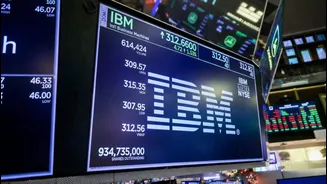
Recent developments in artificial intelligence have sent shockwaves through the technology sector, with a notable instance being the significant 13% plunge
in IBM's share price. This sharp decline was directly triggered by the announcement from AI startup Anthropic regarding its Claude Code tool. The software's capability to modernize legacy COBOL systems has ignited substantial investor apprehension about potential disruptions to IBM's historically robust mainframe business. This event marks a particularly severe period for IBM, as its stock is now down by 26% for February, positioning it for what could be one of its most significant monthly downturns in decades, according to available market data. The market's reaction underscores a growing concern that AI's rapid evolution could destabilize even the most established technology players and their long-standing revenue streams.
Modernizing COBOL with AI
The process of updating and modernizing COBOL systems has traditionally been an arduous and expensive undertaking, often requiring extensive teams of consultants and a significant commitment of time, sometimes spanning years. Anthropic's assertion is that its Claude Code tool can dramatically streamline this process by automating a considerable portion of the initial exploration and analysis phases. This automation promises to drastically reduce both the time investment and the associated costs involved in modernizing these critical systems. Given that COBOL remains a cornerstone for numerous essential industries, including finance and government, where unwavering reliability is paramount, and that IBM is the primary manufacturer of the mainframe computers these systems run on, the prospect of AI-driven efficiency raises serious questions. Investors are understandably concerned that such technological advancements could diminish the demand for traditional modernization services, a segment that has consistently underpinned IBM's financial performance.
Broader Tech Sector Unease
The significant downturn in IBM's stock is not an isolated incident but rather a manifestation of a more widespread anxiety pervading the technology industry. There is a growing sentiment among investors that emerging AI-powered devices and tools could potentially supplant existing software providers. This unease was further amplified recently when Anthropic introduced a new security feature for its Claude model, which was followed by substantial sell-offs in cybersecurity stocks. The software sector, in general, has been experiencing a challenging year, fueled by the fear that AI-driven coding advancements might empower businesses to develop their applications independently. Such a shift could jeopardize the market position of established platforms and exert downward pressure on pricing power. Notably, one of the largest exchange-traded funds focused on software has already seen a 27% decline this year, indicating its worst quarterly performance is likely since the 2008 financial crisis, reflecting a broad industry-wide reevaluation.
Navigating the AI Revolution
Market participants observe that the breakneck pace of innovation in artificial intelligence, driven by companies such as Anthropic, OpenAI, and Alphabet, is fundamentally altering market expectations. For venerable companies like IBM, this presents an urgent imperative to demonstrate adaptability and a capacity for change. The current market sentiment suggests that failure to evolve and integrate these new technological paradigms could lead to significant disruption, potentially eroding years of accumulated revenue and market dominance. The era of relying solely on legacy systems and established business models is being challenged, forcing long-standing industry leaders to pivot strategically to remain relevant and competitive in an increasingly AI-centric future. The need to innovate and present a clear vision for the future is now more critical than ever.