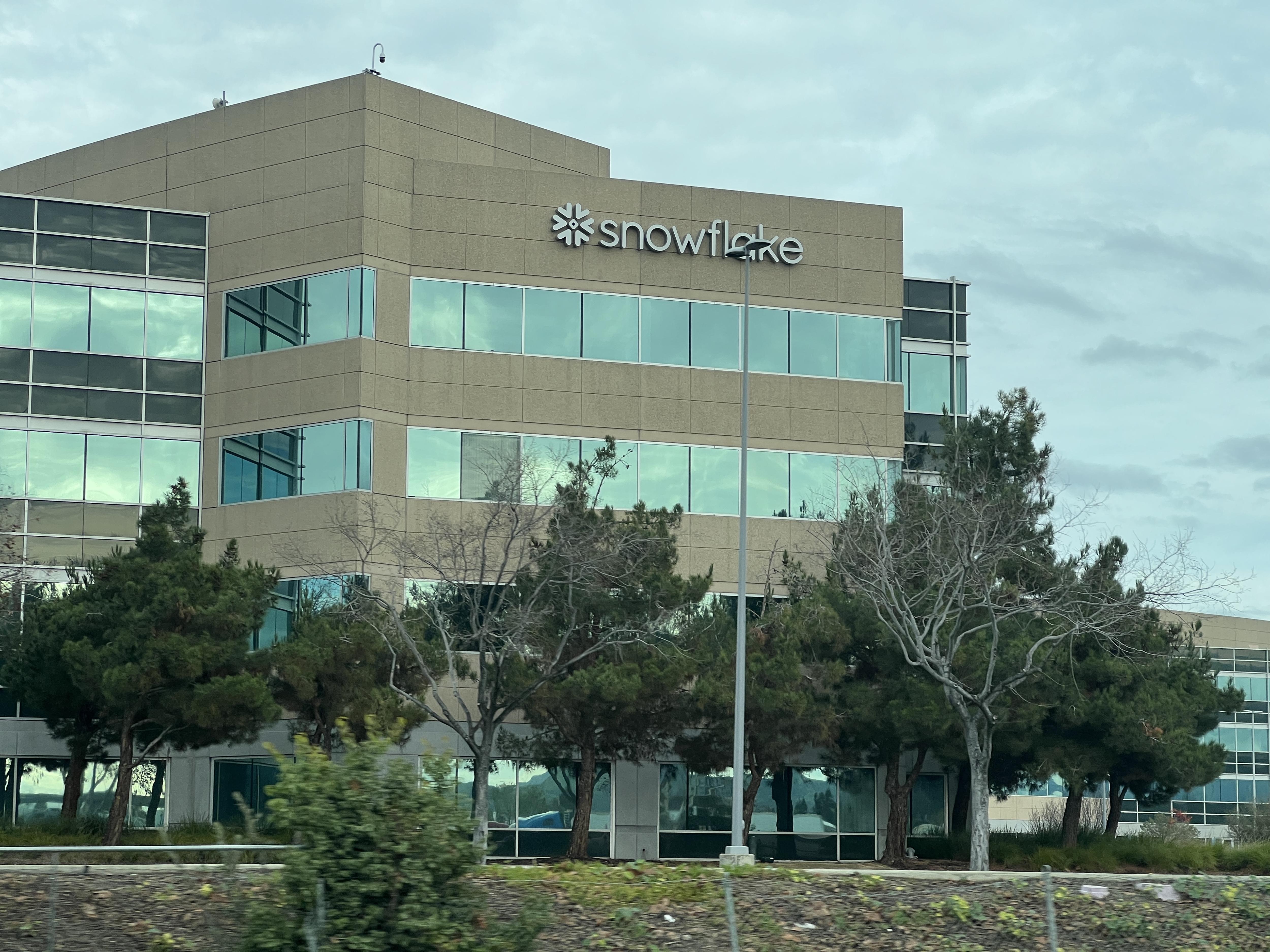




What's Happening?
Snowflake's AI products are significantly contributing to the company's accelerated growth, with CEO Sridhar Ramaswamy attributing approximately half of the fiscal second quarter's acceleration to these
offerings. The company reported a 37% increase in product revenue, reaching $1.49 billion, marking its third consecutive quarter of accelerated growth. Net revenue retention hit 126%, and remaining performance obligations grew by 30% to $9.0 billion. The number of customers spending over $1 million annually increased by 27% to 828. Management has also raised its full-year product revenue target to $6.07 billion from $5.84 billion, projecting a 36% growth rate, up from 31%. Despite this strong performance, Snowflake's stock has fallen over 20% from its September high, reflecting investor concerns about the sustainability of AI-driven usage and its impact on gross margins, especially following a similar consumption-based billing company, Datadog, reporting flat sequential revenue guidance.
Why It's Important?
The performance of Snowflake's AI products is crucial for its market valuation and future growth trajectory. The company's ability to translate AI innovation into sustained revenue acceleration demonstrates the increasing demand for advanced data analytics and AI capabilities across industries. The rise in product revenue and customer spending indicates that businesses are actively adopting Snowflake's platform for their data needs, including AI-powered solutions. However, the stock's decline despite positive financial results highlights investor skepticism regarding the long-term profitability of AI-driven consumption models. Concerns about potential erosion of gross margins due to the higher cost of serving AI workloads, coupled with substantial stock-based compensation, put pressure on Snowflake to prove that its AI growth is both robust and financially sound. The comparison with Datadog underscores the volatility and risk associated with usage-based billing models, making Snowflake's upcoming financial report a critical indicator for the broader AI software market.
What's Next?
Snowflake is scheduled to release its next financial report on December 2, which will be a critical checkpoint for investors. The company needs to demonstrate product revenue at the high end of its guidance and an operating margin close to its 15.5% target to reassure the market that its AI-driven acceleration is sustainable. Investors will be closely watching for proof that the new AI agents, such as CoCo and CoWork bots, are driving increased usage without negatively impacting gross margins. The report will also provide insights into how Snowflake is managing its stock-based compensation, which currently accounts for 29.5% of revenue and contributes to a GAAP operating loss. The company's ability to maintain its growth momentum and improve profitability metrics will likely influence its stock performance and investor confidence in its AI strategy moving forward.
Beyond the Headlines
The current situation with Snowflake reflects a broader trend in the technology sector where AI innovation is driving significant growth, but also introducing new complexities and investor scrutiny. The challenge for companies like Snowflake is to not only develop cutting-edge AI products but also to demonstrate a clear path to sustainable profitability. The slight dip in gross margin, from 67.5% to 67.0%, while manageable, signals the potential cost implications of scaling AI services. This highlights the ongoing tension between rapid technological advancement and financial prudence. Furthermore, the comparison with Datadog underscores the inherent risks in consumption-based billing models, where customer usage can fluctuate, impacting revenue predictability. This scenario prompts a deeper look into how AI companies will balance aggressive growth strategies with the need for stable financial performance and investor returns, potentially leading to new industry standards for reporting and evaluating AI-driven business models.