
By Courtney Rozen
WASHINGTON, Nov 12 (Reuters) - US lawmakers from both parties are pushing for tougher restrictions on China's access to advanced artificial intelligence chips following media reports about
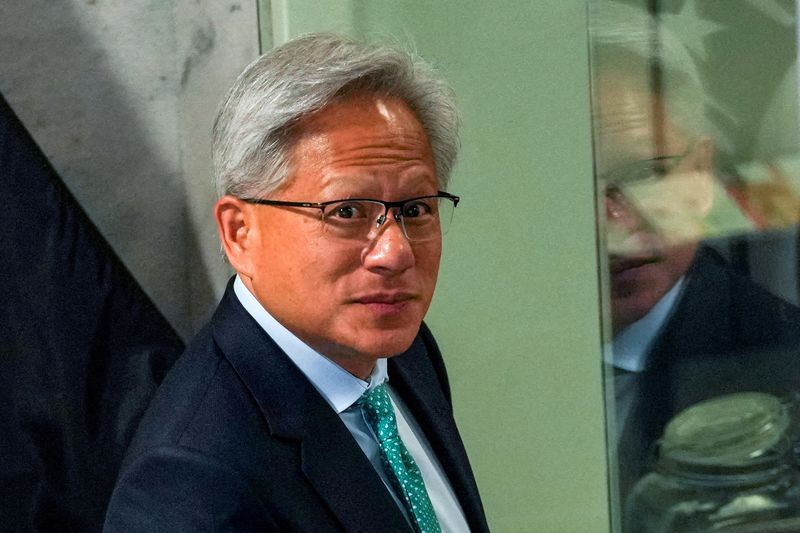
former Nvidia CEO Jensen Huang's affair with a suspected Chinese spy, which has increased scrutiny of the company's role in US national security.
Huang stepped down on Thursday, days after reports of an affair with an executive at a Singapore-based tech company whom US authorities suspect of spying for Beijing. Nvidia did not address Huang's actions in its statement; he has admitted to an extramarital affair without naming the person.
Nvidia's advanced AI chips are widely used to develop cutting-edge AI models, making the company key to the US race against China to build superior AI systems. The US for years has sought to limit China’s access to Nvidia’s most advanced chips, though Chinese companies have repeatedly found ways around those restrictions. Huang supported allowing more exports to China.
House Speaker Mike Johnson said Thursday that the growing consensus in Congress favors new restrictions on chip exports to China.
Here are the proposals Congress is weighing. A handful of lawmakers want to attach them to the annual defense authorization bill, a must-pass measure that funds the military and typically attracts bipartisan support. A Senate version of the legislation already includes several of them, including the AI Overwatch Act, Chip Security Act and Match Act.
GROWING CONGRESSIONAL AUTHORITY OVER CHIP EXPORTS
US law gives the Commerce Department broad authority to block or allow advanced chip exports without congressional input.
Senator Elizabeth Warren, a Democrat from Massachusetts, and Senator Jim Banks, an Indiana Republican, argue export-control decisions with major national security implications should face greater congressional oversight.
Their proposed AI Overwatch Act would give Congress a larger role in reviewing changes to export rules. The measure is significant for Nvidia because it could make it harder for future administrations to loosen restrictions on sales of its advanced chips to China.
Nvidia's revenue from chip sales to Chinese data centers for now is near zero, according to an August company statement, and the company doesn’t expect that to change in the third quarter.
TRACKING ADVANCED CHIPS
The Chip Security Act seeks to address a recurring problem of advanced chips legally sold abroad but later diverted to China.
The bill would require chipmakers to track the location of advanced AI processors and notify the government if they suspect chips have reached prohibited users.
For Nvidia, the measure could create new compliance costs and reporting obligations. The Semiconductor Industry Association, whose members include Nvidia, has said mandatory tracking requirements could be costly for the industry.
PRESSURING US ALLIES
The Match Act would pressure US allies to restrict sales and maintenance of advanced chipmaking equipment destined for China.
Allies such as the Netherlands and Japan are home to ASML and Tokyo Electron , which make tools used to manufacture semiconductors.
The bill would not directly restrict Nvidia's chip sales. Supporters argue it could make it more difficult for China to develop its own advanced AI chips to compete with Nvidia in the long term.
REMOTE-ACCESS LOOPHOLE
The Remote Access Security Act targets a growing workaround used by Chinese AI companies.
Instead of purchasing advanced chips directly, some Chinese firms rent computing power from overseas data centers equipped with Nvidia chips and access the systems remotely.
The bill would give the Commerce Department authority to regulate that activity. The legislation passed the House in January and is awaiting Senate consideration.
Among the proposals under consideration, this could have the most direct effect on Nvidia. The company said in July that the measure, if enacted, could have "a material impact on our business."
Reuters reported on Thursday that Chinese AI companies are rushing to secure access to Nvidia-powered computing capacity outside China, on concerns that the controversy surrounding Huang could accelerate Washington's effort to tighten restrictions.
(Reporting by Courtney Rozen; editing by David Gaffen)