
What's Happening?
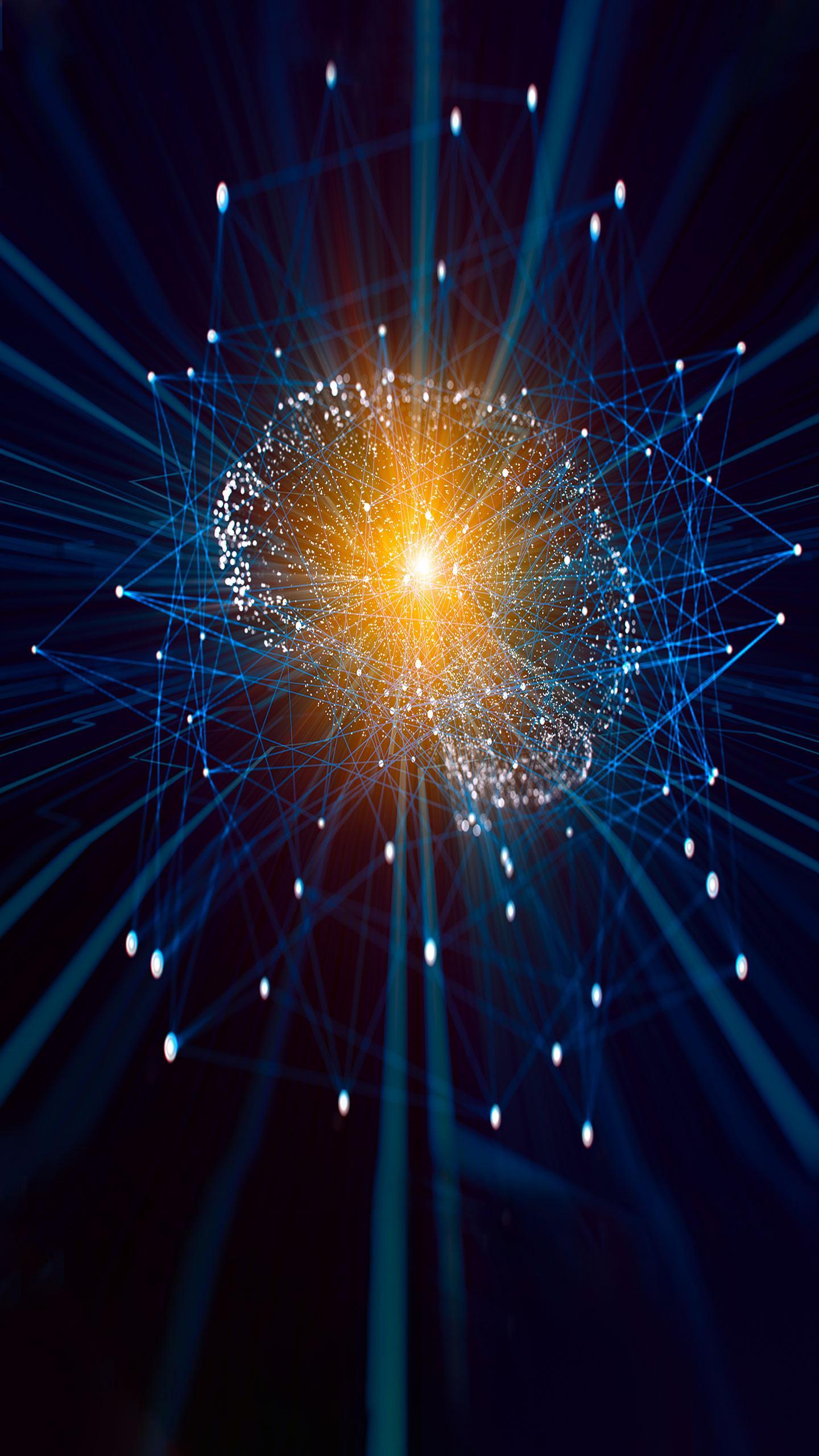
Researchers are utilizing artificial intelligence to transform the entire lexicon of the English language into a 'galaxy of words,' a latent space that maps the relative position of each term based on its
relationship to other elements within the system. This approach, inspired by Ferdinand de Saussure's concept of linguistic value, moves beyond traditional dictionary definitions to create a spatial representation where a word's meaning is determined by its proximity to and distance from other words, as well as their frequency relationships. Data science methods, particularly models like Word2vec, are employed to translate semiology into geometry, encoding natural language into a format understandable by machines. This method focuses on the signifier, mapping relative distances between concepts to facilitate translation between dissimilar languages, even those the AI does not 'understand' in a human sense. The initial hypothesis suggested that these 'vector galaxies' of different human languages would be nearly identical, requiring only rotation to align.
Why It's Important?
This innovative approach to language mapping holds significant implications for artificial intelligence, linguistics, and interspecies communication research. By creating a spatial representation of language, AI systems can potentially achieve a deeper, more contextual understanding of words beyond simple definitions. This could lead to more nuanced and accurate machine translation, improved natural language processing, and advanced AI communication capabilities. The initial belief that these 'vector galaxies' would be isomorphic across languages suggested a universal underlying structure to human communication, which, if true, could revolutionize our understanding of language acquisition and cognitive processes. However, subsequent research has challenged this, indicating that cultural, historical, and syntactic differences significantly deform these linguistic maps. This highlights the complexity of language and the limitations of purely algorithmic approaches, emphasizing the need for multimodal grounding in AI development, especially for ambitious goals like interspecies communication.
What's Next?
The future of this research involves refining AI models to account for the cultural, historical, and syntactic nuances that deform linguistic maps across different human languages. The initial ambition of finding identical 'vector galaxies' has been tempered by findings that show significant differences, particularly between languages with distinct grammatical structures like English, Finnish, and Turkish. This suggests that purely algorithmic, vacuum-based processing of language is insufficient. Researchers, particularly those at projects like the Earth Species Project, are now incorporating multimodal grounding, feeding algorithms with videos, motion sensors, and ecological data alongside audio spectrograms. This shift acknowledges the importance of physical variables and the embodied nature of communication, especially in the context of animal language. The goal remains to build bridges of communication, but with a more comprehensive and context-aware approach that integrates insights from zoosemiotics.
Beyond the Headlines
The development of 'galaxy of words' models raises profound questions about the nature of meaning, consciousness, and the potential for interspecies communication. The debate between purely statistical, algorithmic understanding and a more human-like 'understanding' (as highlighted by the 'stochastic parrots' criticism) continues to evolve. While AI can identify patterns and relationships in language, the question of whether it truly 'understands' meaning in a human or animal sense remains. The challenges in aligning linguistic maps across human languages underscore the deep-seated influence of culture and history on communication, suggesting that a universal 'Rosetta Stone' for all languages, human or animal, may be an oversimplification. This research also pushes the boundaries of zoosemiotics, forcing a re-evaluation of how we define and study animal communication, moving beyond mere vocalizations to consider the full spectrum of embodied and environmental cues.