

The following excerpt from New Kings: Africa's Hoop Dreams and the Future of the NBA by Alex Squadron is reprinted with the permission of Triumph Books. For more information and to order a copy, please visit www.triumphbooks.com/NewKings.

From the time he was 15 years old, Khaman Maluach had been embedded with the South Sudanese national team. Scrawny and largely clueless, Maluach would stand on the baseline, bombarding coaches and veterans with questions: Why did he do that? What should I do if he does that? What’s “drop” coverage? How do you defend that?
“I just love that about him,” says Joe Mantegna, an assistant coach for South Sudan. “I think when I was 30, I was afraid to show people what I didn’t know. As I’ve gotten a little older, I finally
have a little more humility, a little more vulnerability. But he had it at 15.”
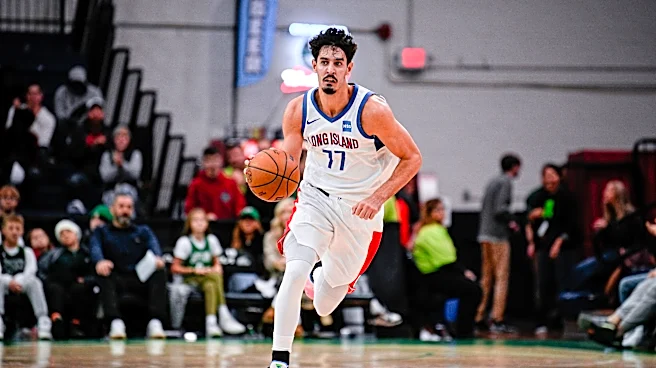
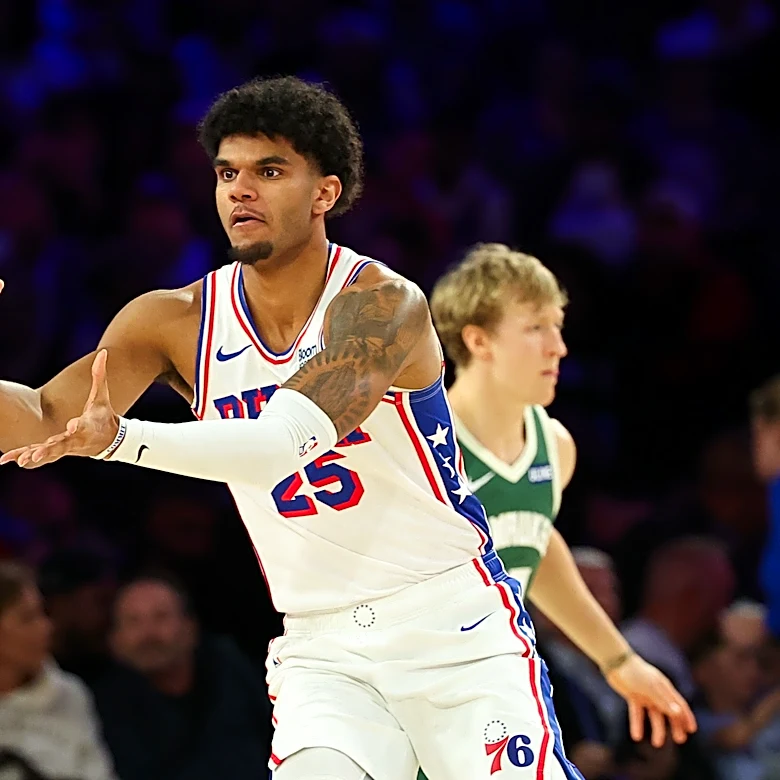
When Maluach first met Marial Shayok, one of South Sudan’s star wings, he rattled off Shayok’s accomplishments as if reading directly from Wikipedia. Yeah, I know you. You went to Blair Academy, then Virginia, then Iowa State, then got drafted 54th overall by the Philadelphia 76ers, then... and so on. “He’s a true student and sponge of the game,” Shayok says.

Nicknamed the Bright Stars, the team was established in 2011 shortly after South Sudan, the world’s youngest country, gained its independence. But it wasn’t until 2019, when former NBA star Luol Deng took over as president of the South Sudan Basketball Federation, that the program took off. Deng was instrumental in bringing structure to the initiative and recruiting the best players from the South Sudanese diaspora, using his own money to fund the operation.
Even with Deng’s support, the odds were stacked against them. The newly founded country didn’t have a single indoor basketball court and had never appeared in a tournament outside Africa. It had been devastated by a civil war after independence and continued to be plagued by violence, conflict, and division.
Basketball, Deng believed, could be a unifying force for a long-suffering land.
“The same irrational confidence that gets Luol Deng to be the seventh pick for the Chicago Bulls and an NBA All-Star is what you need to say, You know what, I’m just going to start a national team,” says Mantegna, who coached Deng at Blair Academy in the early 2000s. “I don’t have any funding, I don’t really have a plan. None of us in this circle has any experience of doing this whatsoever. I’m just going to do this.”
Royal Ivey, a former player turned NBA assistant coach, was chosen as the program’s head coach. Admittedly, the staff had limited knowledge of international basketball competition. They would be en route to tournaments, frantically researching how to qualify for the next FIBA World Cup.
The talented roster was made up of refugees and their descendants, who had fled war-torn South Sudan and settled in places across the globe. All of them had overcome incredible adversity to find success in basketball. Guard Peter Jok, for example, lost both his father and grandfather in the Second Sudanese Civil War before his family escaped to Uganda. They eventually relocated to Des Moines, Iowa, and Jok went on to become a star player at the University of Iowa from 2013–17.
Miraculously, South Sudan managed to earn a spot in the 2023 FIBA World Cup, going 11–1 in qualifiers. Maluach was selected for the team’s final roster, a remarkable accomplishment for a 16-year-old. He had recently been named MVP of the 2023 Basketball Without Borders Africa camp in Johannesburg. Since first becoming involved with the Bright Stars, he had transformed into a completely different player. “It wasn’t incremental,” Mantegna says of Maluach’s growth. “It was overwhelming.”
Maluach would not only be the youngest player in the 2023 World Cup; he would be the third-youngest in the history of the event. Prior to the tournament, South Sudan traveled to Melbourne, Australia, to play a series of exhibition games. When the team landed at the airport around midnight, there were a few familiar faces waiting to greet Maluach: his two older sisters, Nyitur and Agum.
Since they had left Uganda, Nyitur and Agum had barely seen their little brother. The idea that he was coming to Australia, where they had lived for more than 15 years to provide for the family back home, was hard to fathom. The idea that he was coming to Australia as a member of the South Sudan men’s national basketball team was...impossible. “Australia is a place where we were desperately trying to move them to,” says Agum. “As a refugee, it’s not as easy as it may seem. But just to see him there, we were like, ‘Oh my god.’”
Nyitur and Agum had supported Khaman’s hoop dreams from afar, never knowing where the game might take him. They certainly hadn’t expected it to deliver him to their doorstep in Australia. At one point, before Khaman left for NBA Academy Africa in Senegal, Agum sent money for him to buy a pair of basketball shoes. She was also the one who signed Khaman’s Academy paperwork.
To see Khaman under the bright lights at the 15,400-seat Rod Laver Arena was mind-blowing. Only five years earlier, Nyitur and Agum had been concerned with how to make enough money to keep Khaman in school in Uganda. He now held scholarship offers from Duke, UCLA, and Georgetown, and was being heralded as an elite NBA prospect. He was sharing the court with pros, on the precipice of making history at the World Cup. “We were so proud of him,” Agum says. “So proud and so excited.”

The Bright Stars journeyed from Australia to China to participate in two more friendlies. Facing an Iran squad led by legendary center Hamed Haddadi, who played 151 games in the NBA between 2008–13, Maluach made his biggest statement yet as part of the national program.
Haddadi, a savvy veteran who stands seven-foot-two and weighs more than 250 pounds, employed every trick in the book to intimidate Maluach: bumping him, grabbing him, elbowing him, knocking him to the ground. None of it worked. Maluach more than held his own, scoring in double figures to help South Sudan grab a 77–71 win.
Afterward, the team gathered for dinner at the hotel. Everyone was buzzing about Maluach’s performance, his coming-out party to the FIBA world. Maluach mostly deflected or ignored the praise. As he was being ambushed with compliments, he turned to Jacob Ross, the program’s strength coach, and said, “When are we lifting?”
“Sixteen years old, just killed this EuroLeague legend, we won the game, everyone’s celebrating him, and all he was worried about was getting to the weight room to get an extra lift in,” remembers Mantegna. “That’s what Luol Deng was like when I had him at 16. That’s what the special guys are like. Most of us aren’t wired that way.”
That Maluach was special was now apparent to the entire basketball universe. A month before his 17th birthday, he made an impact on the World Cup stage. In an 89–69 triumph over China, South Sudan’s first World Cup victory, Maluach scored a point and pulled down six rebounds in 16 minutes.
“For people who don’t know, Khaman Maluach is a name you should remember,” color commentator Will Voigt said when Maluach first checked into the game. “This is a very, very talented 16-year-old kid, seven-foot-one, can go on the perimeter and shoot it. He’s coming out of NBA Academy Africa and could be one of the best players to come off the continent.”
Maluach would go on to contribute five points and four rebounds in a crucial win over Angola, which helped South Sudan clinch a spot in the 2024 Olympics by finishing as the highest-ranked African team. For a nation younger than Instagram, Uber, and the iPad—and a player not yet old enough to vote—it was an extraordinary achievement.
For more information and to order a copy of New Kings: Africa's Hoop Dreams and the Future of the NBA by Alex Squadron, please visit www.triumphbooks.com/NewKings.
This content may be blocked in parts of Europe due to GDPR. To use it, connect your VPN to a non-EU country and try again.
We highly recommend you add HoopsHype as a preferred source on Google. You just have to click here.
This article originally appeared on Hoops Hype: Excerpt: New Kings, Africa's Hoop Dreams and the Future of the NBA