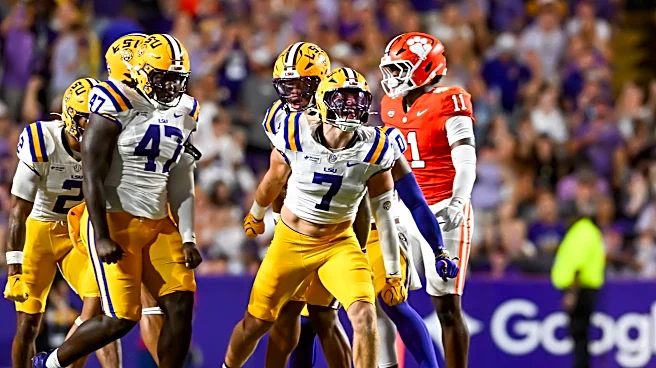


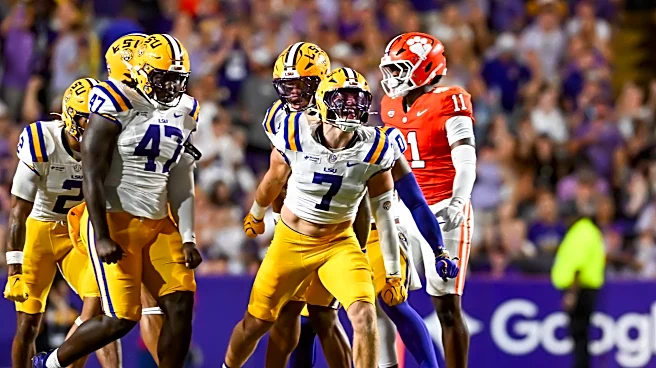
LSU's defense played lights out vs. Clemson. Clemson took a 3-0 lead thanks to LSU throwing a pick on its own side of the field, but after that, Blake Baker's defense didn't let Clemson cross the 50 until garbage time. It was the best we've seen the LSU defense under Baker.
A collection of returning players and transfer additions makes this LSU's most talented defense in several years. The talent was on display in Week 1 with playmakers flashing at all three levels of the defense.
Before we move on to Week 2, let's take a look at what made LSU's defense so special vs. Clemson with our post-Week 1 defensive notebook. I'll try to do these every week, breaking down LSU's defense from a schematic and statistical standpoint.
LSU football defensive notebook
- LSU safety Ty Benefield was a difference-maker. Benefield, a Boise State transfer, drew rave reviews throughout the offseason after arriving in Baton Rouge. His debut lived up to the hype. On Clemson's first series of the game, Benefield broke up a third-down pass to force a three-and-out. Benefield played LSU's high-safety role for most of the game. That put Benefield in position to make plays all over the field, which included crashing down into the box to stop the run.
Ty Benefield is an athlete.
He takes a second to diagnose this and still has the burst and speed to close the space and make tackle. pic.twitter.com/5bFzNgVbfC
— Will Rosenblatt (@rozenwill) September 7, 2026
- LSU's trio of heralded true freshman defensive linemen all saw significant playing time -- Deuce Geralds, Richard Anderson, and Lamar Brown. Geralds played the most of the group, totaling 21 snaps. Anderson played 17 and Brown played 16. All three have room to grow, but the physical talent was evident. Anderson is massive and did a good job taking on double teams. Most of Brown's snaps came at defensive end. He was physically on par with the Clemson offensive line and generated knockback. All three look ready to contribute vs SEC offensive lines.
- I was impressed with TJ Dottery in his LSU debut. I thought Dottery was up and down at Ole Miss last year, but Baker did a good job putting Dottery in a position to succeed. Dottery totaled five pressures and made three stops. LSU let Dottery use his speed to get after the passer and play sideline to sideline.
- On the note of speed, LSU's defense is faster than it was in 2025. Weeks and Dottery form an athletic duo at inside linebacker. LSU is also faster at defensive end. I was a fan of Jack Pyburn and Patrick Payton at DE last year, but Jordan Ross and Princewill Umanmielen are different players. Both are elite athletes and get off the ball fast. The duo combined for eight pressures in Week 1.
- With Harold Perkins off to the NFL, DaShawn Spears stepped in at the star position. I think he's a much more natural fit for the role. Perkins was a linebacker, but Spears is a true nickel. He's a safety by trade and can handle receivers in man coverage, but he's big enough and physical enough to play in the box, too.
- Saturday was what Blake Baker wants his defense to look like. At Missouri, the fire zone was a staple. When Baker has the personnel he wants, he can mix it up, send blitzes from different directions, and keep the scheme relatively simple. For those unfamiliar, he's Brent Pry talking about fire zones. Baker made life hard for Clemson quarterbacks with fire zones in Week 1. Having a guy like Benefield man the middle of the field lets LSU feel comfortable sending five.
Virginia Tech HC Brent Pry's Plug 3 Fire Zone. Inexpensive way to get into a Bear Front scheme post snap. https://t.co/rvFCOrOcUC pic.twitter.com/coJmuuVx0T
— James Light (@JamesALight) March 10, 2022
- I liked what I saw from LSU defensive end Dylan Carpenter. He didn't put up the same pressure totals as his defensive end counterparts, but he was physical when fitting the run.
- LSU cornerback Ja'Keem Jackson was a real part of the LSU secondary rotation. When LSU put extra DBs on the field, Jackson would enter as a cornerback, and PJ Woodland would shift into a nickel role. Jackson, with a 74.3 PFF defensive grade, was LSU's fifth-best-graded defender of the night.
- LSU's defensive tackle rotation was deep. Five interior defensive linemen played at least 10 snaps.
- LSU held Clemson to a -0.47 EPA/play. According to GameOnPaper.com, that was a 0th-percentile performance for the Clemson offense. Clemson's success rate of 29% was in the 2nd percentile. It was statistical dominance across the board for LSU.
This article originally appeared on LSU Wire: LSU football defensive notebook: How Blake Baker dominated Clemson