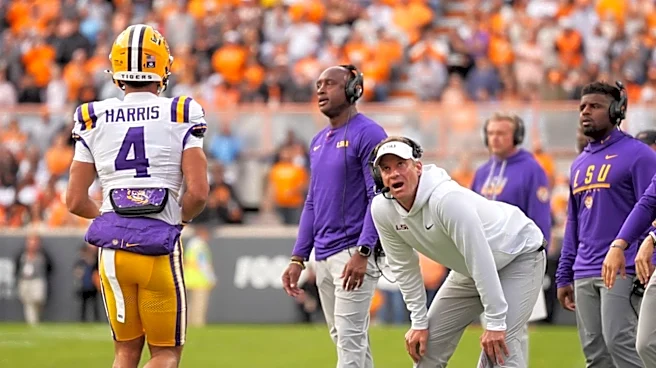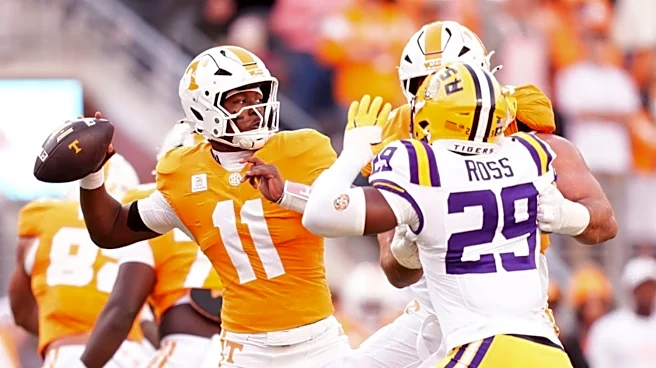


LSU football fell to Tennessee on Saturday, losing 27-13 in Knoxville. With the loss, LSU is now 6-5 this year, with all five losses coming to teams ranked in the latest CFP rankings. LSU has not beaten a ranked team, and won't get the chance to with Arkansas, the lone game left on the regular season schedule.
LSU's last win came on Oct. 24. The Tigers are 0-3 in the month of November. When the month began, LSU's CFP hopes were alive but the Tigers knew the schedule ahead was daunting.
LSU didn't pass any of the tests, losing to Alabama, Texas, and Tennessee.
LSU's offense grew inconsistent, the Tigers committed way too many penalties, and the special teams weren't good either.
Here are five takeaways from LSU's loss to Tennessee.
Penalties doom LSU
LSU committed 16
penalties for 98 yards in Saturday's loss. That's the most penalties LSU has committed since 1995, and only the fourth time since 1970 that LSU has recorded 15 or more penalties.
A handful of the penalties were pre-snap operational errors. Tennessee's crowd was loud and it impacted the LSU offensive line. Several false starts set LSU back throughout the game.
In the fourth quarter, after a tackle for loss, LSU LB Tylen Singleton was charged with a personal foul that gave Tennessee first down on the LSU 22. Without that penalty, Tennessee would have faced third and eight in a tie game. That go-ahead touchdown is where this one swung.
LSU QB Sam Leavitt played his worst game of the year
This was LSU QB Sam Leavitt's worst game of the year. Leavitt only averaged 5.7 yards per attempt, his lest effecient mark of 2026. Leavitt threw a touchdown and didn't throw a pick, but LSU's passing game couldn't push the ball down the field. PFF didn't chart Leavitt with a big-time throw for a third straight game.
Leavitt took seven sacks, and LSU's offense was moving backward far too often. Yes, the offensive line played a role in that, but Leavitt's pressure-to-sack rate of 50% was poor. When the pressure got there, Leavitt didn't manage it well. Leavitt held the ball too long, and his average time to throw was over three seconds for the first time since LSU's Week 3 loss to Ole Miss.
LSU didn't sustain a single touchdown drive. LSU's only endzone trip came after the Tigers recovered a muffed punt inside Tennessee's 10-yard line.
LSU's run game was ineffective
LSU's run game also had its worst game of the year. Per GameOnPaper, LSU's EPA/rush was -0.57. That's a first-percentile performance. LSU tallied just one explosive run and posted a rushing success rate of 24%. Adjusting for sack yards, LSU averaged 3.76 yards per carry.
LSU needed way more from the run game to win this one. Tennessee's pass rush was teeing off on LSU and the Tigers' passing game wasn't good enough to operate from passing downs. Without the run game to keep LSU on schedule, Tennessee's defense had a decisive matchup advantage.
LSU RB Dilin Jones finished the game with 17 carries for 50 yards and didn't find the end zone. Jones also fumbled for the first time in 2026.
LSU could not beat good teams in 2026
LSU has played five good teams in 2026: Ole Miss, Kentucky, Alabama, Texas, and Tennessee. The Tigers have lost to all five. LSU had five chances to prove it can play with the best teams in the SEC, and couldn't close out a single game vs. that group.
Now, a handful of those games were close and came down to the final play. LSU looked like it belonged on the field, but crucial second-half mistakes prevented LSU from making the plays needed to win the games. There was some bad luck, too, but its hard to blame luck when LSU lost every single one of those contests.
LSU's six wins all came against teams the Tigers were supposed to beat. You could argue that Louisiana Tech or Auburn is LSU's best win. That's not how LSU envisioned this season playing out.
Tennessee's QB run game was the difference
Tennessee's leading rusher was QB Faizon Brandon. The freshman QB carried the ball 12 times for 112 yards and two scores. Brandon offered pretty much nothing throwing the ball, completing one of six passes for six yards and turning it over twice. That didn't matter. Brandon broke free for two explosive runs in the fourth quarter that put the game on ice.
LSU limited the Tennessee running backs to 3.8 yards per carry. DeSean Bishop, the SEC's leading rusher, only averaged 2.9 yards per carry.
But the QB run game made the difference for Tennessee. Credit to Brandon for hanging in there and delivering on the ground, despite the struggles through the air. Tennessee head coach Josh Heupel managed an effective two-QB rotation on Saturday evening, which isn't an easy task.
This article originally appeared on LSU Wire: Five takeaways from LSU football's loss to Tennessee