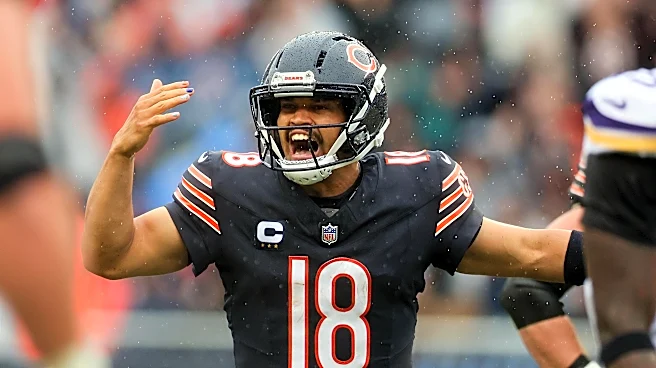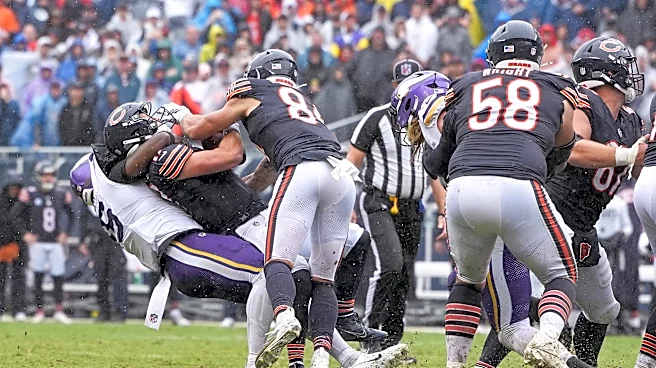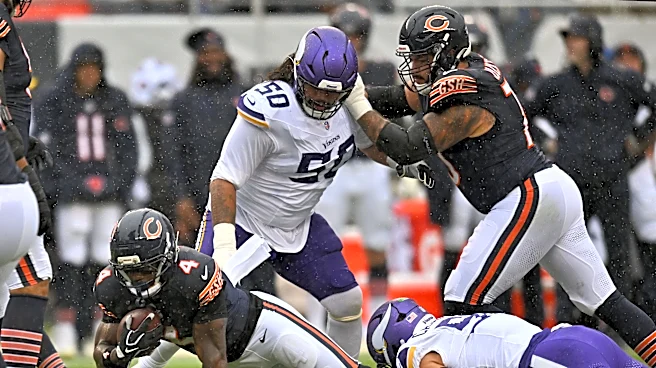

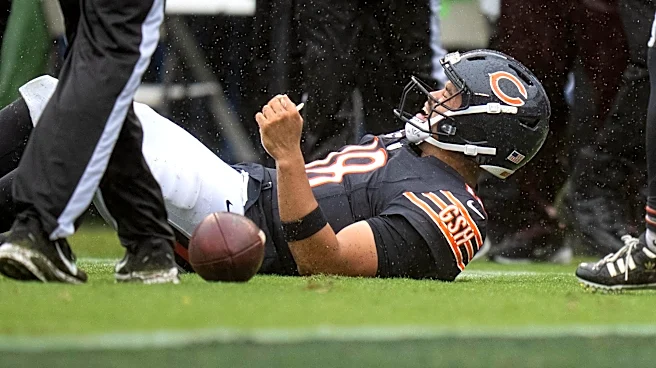
From their Week 2 game against the Minnesota Vikings on Sunday into the latter part of their preparation for the Philadelphia Eagles this Monday, the Chicago Bears have found out that not a whole lot is salvageable when you drop a game 9-3.
Between their lackluster offensive production, inability to avoid costly penalties, and injury to Caleb Williams, the general narrative and any level of clarity around what this team can be in 2026 was lost beyond Sunday's box score. Occasionally, though, one can find a silver lining deeper in said box score if one only knows where to look. No sport is immune to some nuance that can cause a game to be won or lost in a way that defies statistical reason.
The rise of analytics across various sports has allowed
one to check under the hood and see more than what the final line has to offer. Unfortunately for the Bears, the advanced stats aren't working in their favor this week either. Considering the '3' on the Bears' end of the scoreboard, the offense is central to what worked against them on the analytics side of things.
The Bears turned in an overall EPA of -0.13 against the Vikings. That comes almost well on the other side of where the Bears landed on the 'average' threshold (represented by a zero) against Carolina the week before (0.41). Things were slightly worse on early downs (-0.19), and, perhaps most concerning, particularly bad in the run game. Their rush EPA per attempt checked in at -0.16 after coming in at 0.38 against the Panthers.
These may seem like minuscule numbers on a stat sheet, but EPA works in very small increments. The expected points added aren't going to shift drastically on most individual plays, after all. So while the numbers themselves don't differ too much in a literal sense, they're vastly different outcomes in matters of EPA.
Interestingly, their pass EPA per dropback was only slightly below the threshold, at -0.03. Their completion percentage over expected was also -2.4 percent, also better than expected. That the Vikings pressured Williams (and Tyson Bagent) at a 24.4 percent rate against the mere 7.9 percent rate they faced against Carolina speaks to the root of struggles more than the actual production on the field (in addition to the weather, of course). Aside from a couple of specific plays, the pass game wasn't too bad in the eyes of analytics, all things considered.
In addition to the pressure rate, though, the penalties were an issue that EPA can also illustrate. Braxton Jones' holding penalty in the first quarter featured the second-highest EPA swing of any penalty in the game, sapping the Bears at -1.39 (Dallas Turner's roughing the passer in the second actually handed the Bears a +1.79 swing). We probably shouldn't overlook win probability added (WPA) in this context, either. While Garrett Bradbury's three penalties were only at -0.78 in EPA, they were at -0.046 in WPA. Jones' holding call was the second-worst WPA performance (-0.032) while Sam Roush's -0.016 checked in at third. Any penalty is going to factor against you in each, but those three stand out for the wrong reasons.
Overall, the Bears' drive success rate was just 10 percent. That number stood all the way up at 64.3 percent in Week 1, illustrating just how far the offense fell between the two weeks.
The good news is that the defense played their way into some respectable metrics. The Vikings had an EPA per play of just -0.08, a success rate of only 33.3 percent, and an explosive play rate of 7.8 percent that was actually lower than the Bears' rate. Up against it after getting run up and down the field in Carolina, the Bears' defense held their own in a way that wasn't deceptive. They were quality.
Ultimately, the advanced metrics don't tell us anything we don't already know. The Bears were not particularly good in any phase. The conditions didn't help. Brian Flores' aggression didn't either. While that doesn't lend itself to much optimism considering the injuries at quarterback and quality of their impending opponent, it's also impossible to imagine that Sunday's outcomes, standard or of the more analytical variety, were indicative of any number of different factors within this team. Improvement should be on the way in short order.
Follow Bears Wire on Twitter, Facebook and Instagram
This article originally appeared on Bears Wire: Advanced stats provide insight to extent of Bears' Week 2 struggles