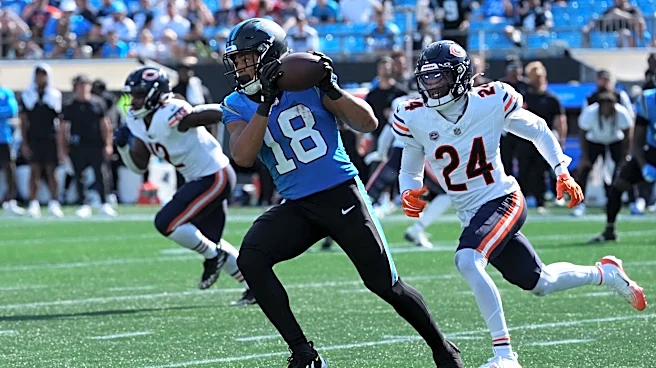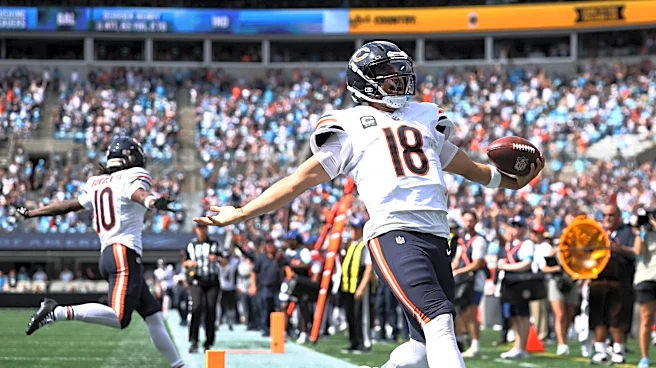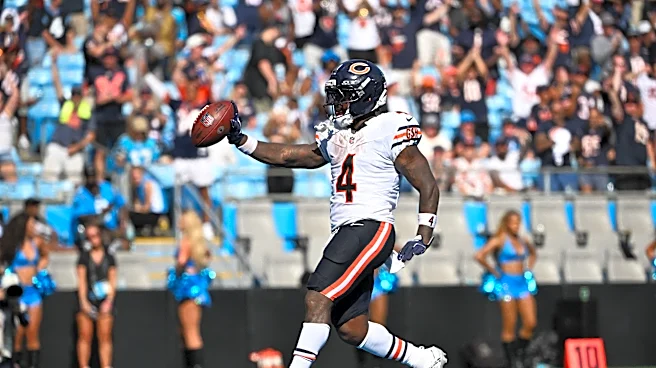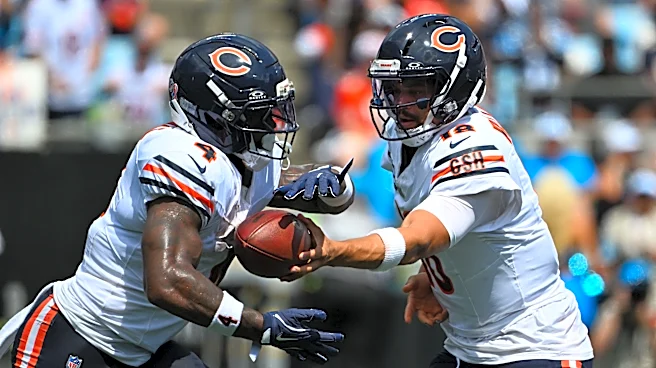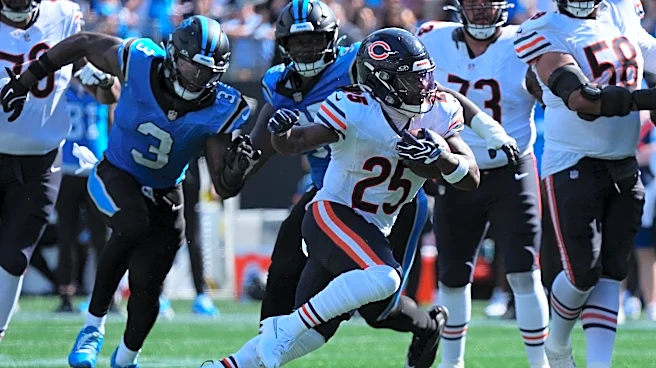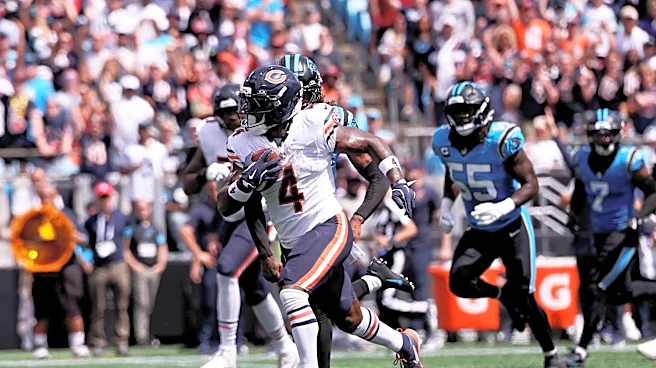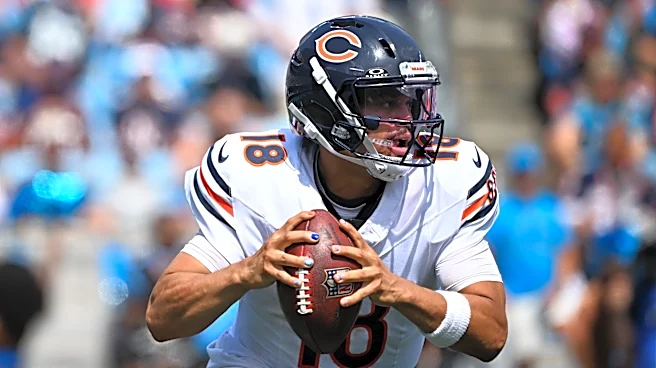

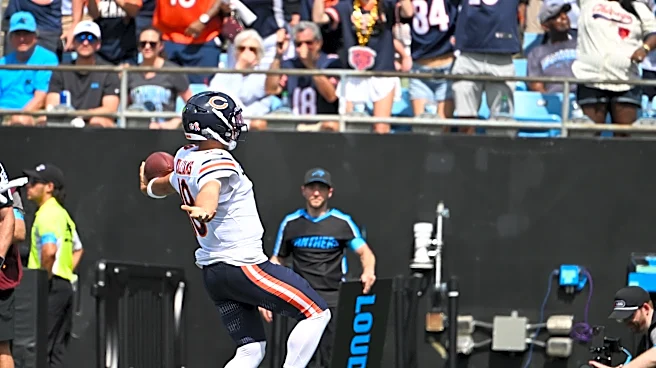
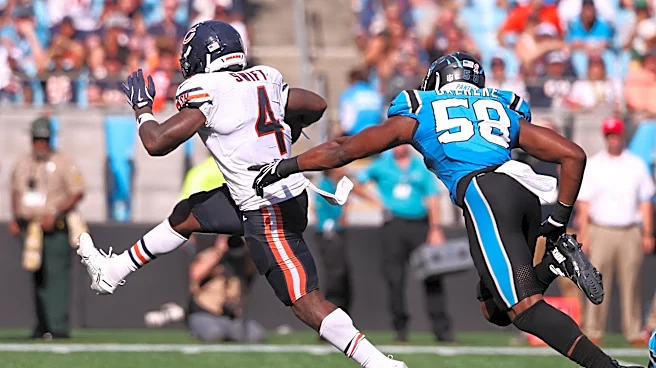
There are few things that one could say about Caleb Williams' performance in the Chicago Bears' 59-37 Week 1 victory that would land as hyperbole. One of the better performances of any quarterback from across the league in Week 1? Yep. One of the best opening week showings for any quarterback, ever? Sure. As good as he's looked in any individual game in his career? Probably.
In general, it's easiest to just settle on the objective idea that Caleb Williams was very good against the Carolina Panthers. He finished 21-of-29 (72.4 percent completion rate) for 269 yards, and a pair of touchdowns to go along with another 65 yards and two more scores on the ground. He finished with a passer rating of 124.1 and a QBR of 94.9. Whether it was his early
throw to Rome Odunze, his touchdown pass to Cole Kmet, or any other of the highlight-reel plays he put to film on Sunday, Williams was electric inside and out of the box score.
The thing about analytics, though, is they don't always love to support what the eye test has to offer. And even if they do, there's something paradoxical about the way advanced stats can influence the perception of a player.
Such is certainly the case with Pro Football Focus, which we already know caught some heat for their low grade of Williams following Sunday's performance. Their 64.6 grade of Williams wasn't just unflattering, but ranked him 18th of the 32 quarterbacks that qualified after Week 1. Williams was graded at exactly average on their model on 23 of his 40 dropbacks, garnering positive grades on just 27.5 percent of said dropbacks, which ranked 12th.
That PFF felt compelled not only to handle the disdain for their grade via social media but write an entire breakdown as part of the justification for Williams' grade speaks to the increasing questions around the reliability of its model. Using advanced stats to chart a quarterback's true accuracy in the event of throw-aways, tipped passes, drops, etc. unquestioningly has merit. However, that the grade took into account throws classified as 'catchable but inaccurate' or 'perfectly placed throw' rate as part of what worked against Williams indicates that perhaps the model is asking too much of its quarterbacks. At least given how reality looked up against the model.
The concept of 'accurate throw rate' is great. Many of the additional PFF passer intricacies are, too. In some cases, though, it almost feels like the grade itself can become weaponized against a player when every other measure indicates we should be examining said player on the other end of the performance spectrum. PFF wants to measure what the player can control, but there's a whole lot in there that even the quarterback does not (defensive backs falling down, miscommunication on routes or timing, etc.), making it almost impossible in this instance to reconcile a poor grade against what we actually saw transpire versus Carolina. It's not even so much about the individual nuance in the stats but the nature of how those stats blend together as part of their model that represents a central issue.
In any case, Pro Football Focus and their analytic measures were not fans of Caleb Williams in really any respect.
The good news there is that we're able to apply more objective means in evaluating Williams' performance beyond the standard box score. Expected points added per dropback (EPA/play) had Williams at +0.45. That ranked fourth among signal-callers in Week 1. His success rate, characterized as plays with a positive EPA, checked in at 61.3 percent (third). At 11.4 percent, his completion percentage over expected (CPOE) was the third-best figure to emerge from the first week's set of games.
A fun note within that is that Williams' rate of aggressive throws was purely in the middle of the pack; his 13.8 Aggr% ranked only 16th. That he was able to put up the type of production he did and feature the number of explosive plays he did without feeling compelled to get too aggressive speaks to the confidence with which the Bears' offensive operation is currently working. Williams' 61.0 percent expected completion percentage also landed well below where he actually did in the box score, which can be perceived as Williams working in a more effective way than the average quarterback against which such a metric is measured (or lends at least a little validity back to PFF's model for risk factors around Williams' accuracy).
Nevertheless, PFF's unfavorable model notwithstanding, the advanced numbers further support just how well Caleb Williams performed on Sunday. He didn't just accrue yardage in the pass but added legitimate value to the operation. Up next, though, is a much sterner test in the former of the Minnesota Vikings' defense.
Follow Bears Wire on Twitter, Facebook and Instagram
This article originally appeared on Bears Wire: Caleb Williams was an analytics anomaly in Bears' Week 1 win