
Florida’s defense needed more than a schematic adjustment to recover from one of its roughest halves of the season. It also needed a change in focus.
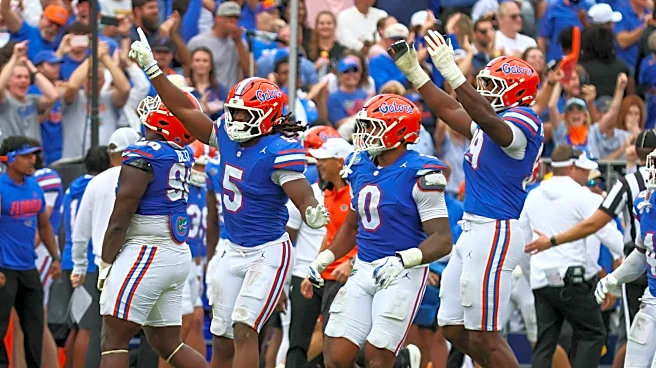
After allowing Vanderbilt to score on five of its first six possessions, the Gators limited the Commodores to three second-half points and closed the 34-27 victory with consecutive sacks. Defensive coordinator Brad White attributed the turnaround to improved communication, leverage, pad level and composure.
White also discussed the development of Ty Jackson and Jayden Woods, the importance of eliminating explosive runs and his personal history playing and coaching at Florida State.
Here’s everything White had to say ahead of Week 13's rivalry game in Tallahassee.
What stood out about Florida’s second-half improvement against Vanderbilt?
It was nothing sort of mind-blowing
from an adjustment standpoint.
It was as much about controlling the unbalanced formations, the shifting in and out and making sure the communication was clean. Then it was going back to the fundamentals.
I didn’t think we played with great pad level. I didn’t think we played with a great understanding of where our leverage was. I don’t think we played with a great understanding of, “What is the formation? Who’s in the game?”
We talked all week about some formation and personnel tells. Those things held up. We knew some of the shifting and motion were coming, but some of it got the guys a little out of whack and uncomfortable from a communication standpoint.
When you feel uncomfortable and then they start moving the ball a little bit, it really puts you on edge. You’re kind of on tilt. It was just about getting settled down.``
They did a nice job of being calm in the locker room and understanding where we were in the game.
Obviously, the big play right before halftime — you never want to give one of those up. We would’ve loved to go get that ball and give it back to the offense on a 50-50 ball. But that’s football. Those plays happen. You’ve got to regroup.
I was proud of their effort in the second half, but we need to start faster.
It has been a tale of two seasons. During the first half of the season, we would start the first quarter really fast, and then we’d fizzle. During the back half of the season, we’ve come out a little bit slowly and then picked it up.
Here we are in Game 12. Hopefully, we can put one together from start to finish. We need to come out of the gate, and then we need to sustain it.
Is Florida’s improved halftime demeanor a sign of growth?
It is. That makes complete sense.
I think it’s a sign of growth for the players, and I think it’s a sign of growth for the coaching staff.
For me, it’s how I handle those guys at halftime. After that South Carolina game, we’ve talked about it, I changed how I addressed them at halftime. I think the response has been better.
That’s a learned thing for me as well. It’s not just them and how they handle the coaching. It’s about how I present the coaching, how we get those things taught and, as a coaching staff, how we handle them at halftime.
That has been positive for all sides involved. It has led to solid results for the most part in the second half.
We need that again this week.
Did anyone notice Jared Curtis’ helmet coming off on the failed fourth-down sneak?
Obviously, it’s a huge play. Sometimes, you need a little bit of luck to go your way.
You’re not teaching your players, “Hey, I want you to rip the quarterback’s helmet off on a sneak.” Now, that may be the new way to stop the tush push. You can’t grab him by the facemask, so just grab the quarterback by the back of the helmet or something.
It was a freaky, fluke play, and it went our way. I’m glad it happened.
Obviously, it created huge momentum to give the ball to the offense on a short field. But there’s nothing you can teach from that as a teaching moment.
How important is emphasizing tackling and pad level this late in the season?
Even this late in the season, you can’t lose sight of it.
You’ve been banging all season through a nine-game SEC schedule. You’ve got a huge rivalry game. Our guys understand that, even on a short week, we’ve got to put the work in.
If you think, “I’ve banged enough. I’ll just show up and play with good pad level and a good strike,” you’re wrong. You have to do it every day.
We did it today. We banged a significant amount, emphasizing footwork, hand placement and pad level because those are things that show up on Saturday.
They also show up when you don’t do them right. That’s what showed against Vanderbilt in the first half.
What gives Ty Jackson his playmaking ability?
Some players just have a knack for making plays, and he does.
Ever since high school, he has been an unbelievable football player. I still think the way he has progressed this year is the way he needed to.
He has grown into his role, and it has allowed him to play fast and free and not feel constrained because he has to do too much thinking one way or another.
He’s in a position where he understands what he has to do and can play fast.
Even in a situation like that, the play in general for the whole defense wasn’t the cleanest. There was some communication we were trying to get through after an unbalanced shift.
But he did a great job pushing through violent hooks and getting the ball out.
Great job by Myles (Graham) on the scoop-and-score. Great job staying down the sideline and not cutting back this time. He found his way into the end zone.
Is communication the next step in Jackson’s development?
I’ve been around a lot of young linebackers who were quiet while they grew into their roles.
That will be a big push for him this offseason. Now that you’re comfortable and feel good about what you have to do, let’s be vocal. Let’s step out because people need to hear you.
You can command the front. You can get things set.
That’s the next step in his development, starting to find his voice.
Right now, he has some veteran players around him who can let him worry about himself. Eventually, he’s going to need to grow into that role where he’s the guy and he’s helping other players.
What does Jayden Woods’ late-season production mean for his confidence?
We’ve seen it since spring, just how talented a young man he is. He has that game-changing ability.
We said we were going to need him to play at that level for us to win games.
You look at the last two weeks. He closed out the game this past week, and against Kentucky, he made that vital strip-sack. Then, on third down during the two-minute situation, he’s really growing into that role of being the closer.
It’s a testament to him. He puts the work in. It’s also a great example for the rest of our team.
You look at a guy who tries to check all the boxes and do everything like a professional. It shows on Saturdays.
He stayed the course. He didn’t get frustrated. He realized, “All right, there are still some things I need to tighten up,” whether it’s footwork, rush line or whatever the case is.
“I’ll keep working on those, but I’m going to stay the course. I’m not going to get frustrated. I’m not going to try to do something that just gets me a sack. I’m going to run around the ball all the time until I find one and run my lanes right.”
You look at him against the run, he’s as stout a run defender as we have. He has made a lot of plays in the run game that get us into those advantageous passing scenarios.
He’s an all-around football player who has elevated this defense.
What was your own development as a communicator at Wake Forest?
I couldn’t run very fast. I couldn’t jump very high. I couldn’t move a weight very fast. That was the one thing I had.
If I wasn’t vocal and didn’t get guys lined up, I wouldn’t have been on the field.
My job was, “If you’re going to be the least athletic guy on the field, align the 10 athletes correctly, make sure they know where to go and then keep yourself out of the way.”
I think I can help guys in that regard because I’ve been in those shoes. I understand how vital and important it is to be a communicator, especially in the middle of the defense.
I can demonstrate it for them. I can walk out and say, “Guys, this is how loud you need to be. This is how demonstrative you need to be.”
If you need to walk up and tap somebody, go walk up and tap No. 3 or No. 5. If they don’t hear you, those defensive linemen have an offensive lineman six inches away trying to rip their faces off. They’re not listening to you. They’re worried about that guy.
Sometimes, you’ve got to go down there and tell them. Sometimes, you’ve got to go down there and move them.
“Well, Coach, I did tell him.”
No. Did you yell it?
It starts in practice. I stand behind the offense. If I can’t hear you while standing behind the offense, you didn’t say it loudly enough. I want to hear that communication.
The older guys, the A.C.s and the Jaden Robinsons and Myles Grahams, you can hear them. You can hear the vocal communication.
It’s the same thing with our safeties. You’ve got to be vocal.
“I think I’m being loud.”
If you’re talking to somebody who’s turned around, they can’t see your face. You have to talk loudly enough to get through to them.
It’s no different when a safety is talking to linebackers.
“I did tell him the check.”
You have to be really loud. You have to be louder than you think you need to be out there.
Then you put that in The Swamp. I’m yelling from the sideline to a corner, and he can barely hear me. Out on the field, they have to be really loud and demonstrative and use hand signals and all that.
Have you faced Florida State since your playing career ended?
I did twice as a graduate assistant at Wake Forest. I haven’t faced them since.
What do you remember about playing at Florida State?
I was a player when Bobby Bowden broke the win record. They beat us for him to break the all-time win record.
They had Darnell Dockett and all those guys on that team. I was there for that game.
I remember it being fourth-and-1. They handed it to Greg Jones, and I met him in the hole. He went down, got the first down and fell over me.
I went to the sideline and said, “Hey, guys, how bad did that look? Did I get trucked?”
They were like, “No, no. Look, it was a good collision.”
I was like, “OK, good.” He’s a big dude.
You never forget him and Greg Reid on the sideline against UNC and the collision they had.
I went back as a graduate assistant and won a game. It was like 10-9 or 10-6. We forced six turnovers, including one during the two-minute situation. I think it was five interceptions and a fumble.
The defense was playing really well. They got the ball in the two-minute drill, and if they went down and scored a touchdown, they were going to win.
You’re sitting there, it’s 10-6, and you’ve played great all day. I remember our defensive coordinator, Brad Lambert, looked at me. I was on the sideline as a graduate assistant.
He said, “Man, it’s one of those games where you can play great all day. If they go down and score a touchdown right now, everybody is going to tell you how bad you were.”
That resonated with me as a coach. You’re like, “Yep, that’s true.” How you finish is how they remember you.
That’s one of those memories I’ll never forget.
Are Brendan Bett, Joseph Mbatchou and Jeremiah McCloud growing at defensive tackle?
Very much so. It has really started to trend in the right direction. It has been good to see.
Mbatchou is starting to become more than just a run-stuffer in the A-gap. You’ve seen some movement, pressure on the quarterback and a little more pass rush from that position.
Having him slide out to the boundary tackle, you’ve seen his pass rush increase.
One of the big plays nobody will talk about was the empty quarterback draw on first-and-10 during the two-minute drill. That was a huge play because then they false-started.
He gets a negative play on first down. Now it’s second-and-11. Boom, they false-start. It’s second-and-16, and now you get a pass rush. Everything starts working in your favor.
That was a huge play. I’m really proud of those guys.
They’re starting to embrace what we need to get done in there. They’re not eaters of blocks. They need to be playmakers.
We’re asking them to make plays. They’ve taken on that responsibility and shown up.
What must Florida do to prevent explosive runs?
The biggest one was the 51-yarder in the second half.
You’ve got an unblocked guy in the hole. It’s a big B-gap. Those are tackles we have to make.
But even with the missed tackle, if we leverage No. 2 and then leverage with the corner, it should be an 8-yard gain.
Those are the frustrating pieces. Fundamental football is leveraging the football and understanding, “If I have to set the edge, it may not be in the box. It can be outside our slot receiver or outside the No. 1 receiver.”
I’ve got to understand where I have to funnel the ball.
Usually, big runs happen as a result of missed tackles or misfits. When you have a missed tackle and a misfit from a leverage standpoint on the same play, it usually results in a big run.
All it takes is one. That’s the frustrating piece.
Take out the sacks. They had 43 carries for 178 yards. Take out the negatives for sacks, and all of a sudden, it’s 40 for 197.
Five of those runs went for 128 yards, which means 35 runs went for 69 yards. That ended up being about 1.97 yards per rush.
I told the defense, “You can play 35 really good plays. Thirty-five really good plays. But if you give up five explosives, it doesn’t matter how good those 35 were.”
If you get 35 out of 40 on an English test, you might be really happy with that grade. You can’t do that on defense.
You get one mistake. We don’t want to give up any explosives, but you can give up one.
You can’t give up five runs of 13 or more yards. It can’t happen.
Follow us @GatorsWire on X, formerly known as Twitter, as well as Bluesky, and like our page on Facebook to follow ongoing coverage of Florida Gators news, notes and opinions.
This article originally appeared on Gators Wire: Brad White challenges Florida defense to eliminate explosive runs