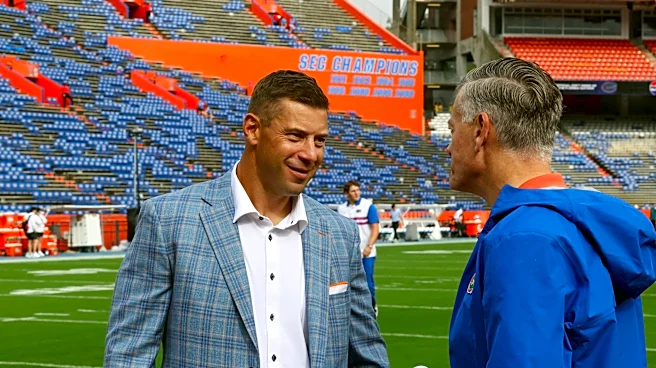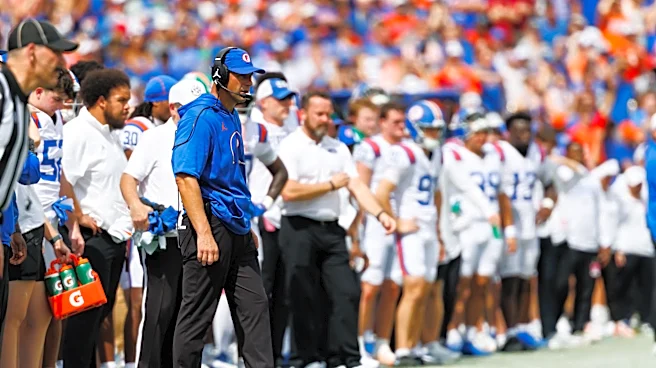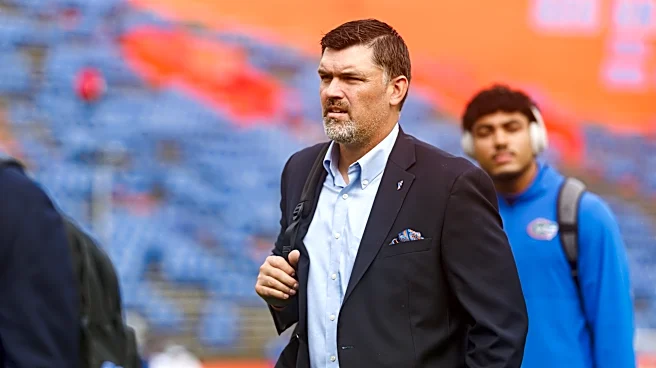

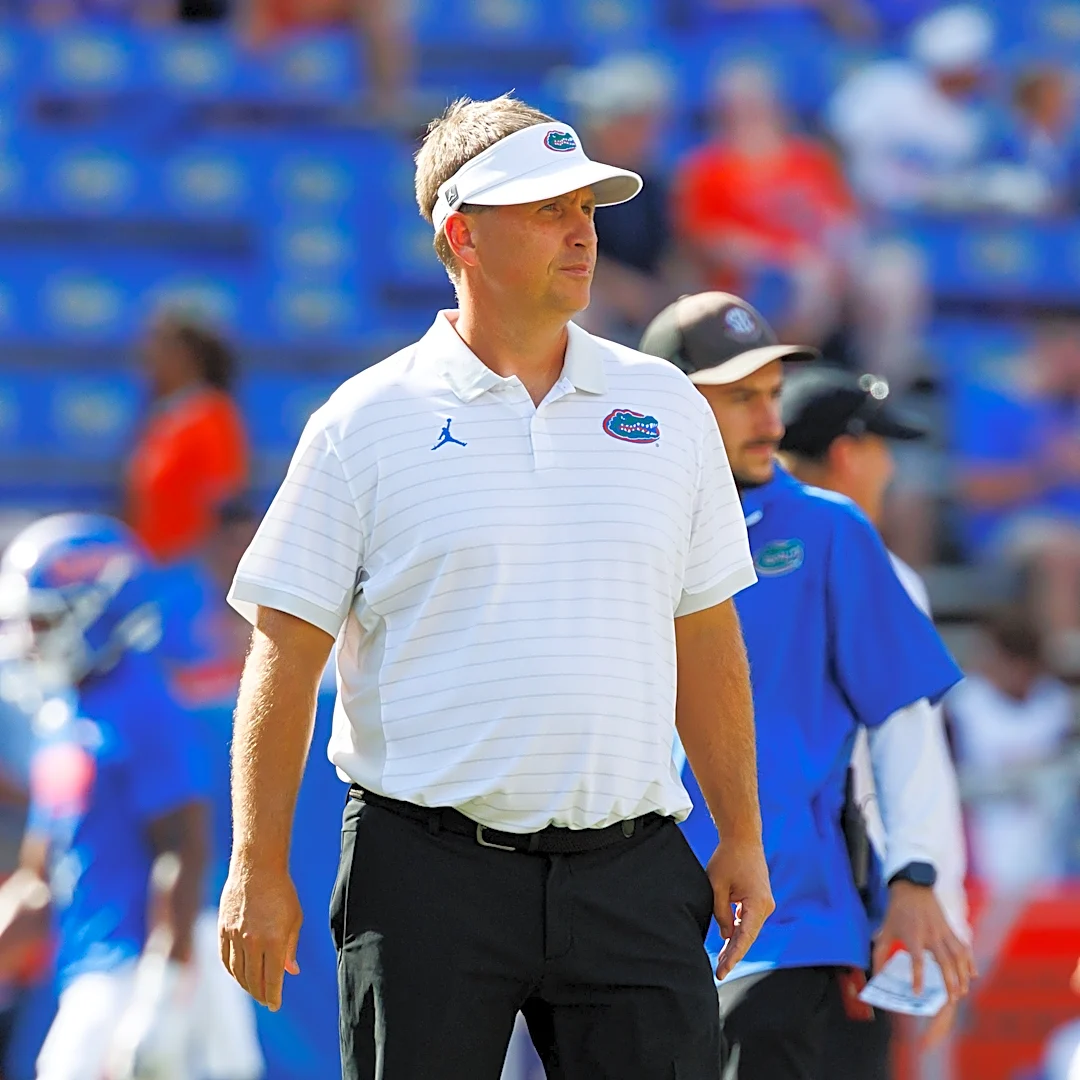
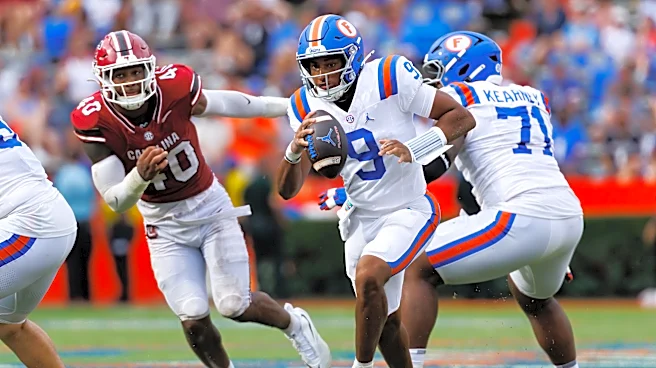

Brad White knows there is no magic button Florida can press to instantly repair a defense that has repeatedly sprung leaks in coverage.
The Gators’ defensive coordinator said the solution cannot be “a microwave thing.” Florida must gradually eliminate individual, technical and communication errors without abandoning a system White believes can eventually produce a dominant defense.
White also discussed Cormani McClain’s development, the possibility of moving Kanye Clark to cornerback and the considerable challenge Arch Manning and Texas’ offensive playmakers present.
Here’s everything White had to say.
How does Florida fix the continuing breakdowns in pass defense?
To (Coach Sumrall's) point, this isn’t going to be a microwave thing. Everybody has a slightly different piece. There might be a play where it’s
an individual in a one-on-one scenario, whether that means coming out of a break or not hitting a landmark on a drop.
Another one might be a communication issue. There are too many instances of somebody raising his hand and saying, “Yep, that one was my fault. Oh, that was my fault.”
You can’t do that. If you add those up over the course of the game, it’s going to cost you. I wish I had a great answer and could say, “This is going to be the fix, and it’s going to be beautiful.” It’s not.
We’ve got to play cleaner, communicate cleaner and play technically cleaner. We’ve got to pass rush with our lanes and hands. Everything has to be cleaner and more dialed in. We’re just a little off, and being off in this league gets you beat.
Are those mistakes happening during practice or only in games?
It has been a little bit of both. Last week, I thought we had one of our better weeks of practice all year, especially Tuesday. You felt like it would translate, but it didn’t.
At the end of the day, it’s about results. We’ve got to find a way to do it Saturday.
Why has tackling remained a problem?
We do tackling circuits every day that we’re in pads. Again, it goes back to the first question. Every missed tackle is slightly different.
On the third-down play when we had a vice tackle, we’ve got to bring our near leg and be powerful. We didn’t. We sat in a chair and leaned back. When you sit back, you have no power. Then you get run over or run through.
We had an opportunity right before halftime. It was third-and-11, and they threw the dart route at 8 yards. We had a corner and safety there to vice it. If we make the tackle, they have a decision on fourth-and-3. They’re probably taking the field goal, which saves four points. You go into halftime down 13-10, and that feels completely different.
Not to mention, our offense drove all the way down and had an opportunity at the end of the half. You could be going in up 17-13 or 13-10. Instead, you give up a touchdown two plays later. It changes the entire momentum.
We’ve discussed that we can’t be followers of momentum on defense. We have to drive the momentum. That comes from third-down stops and turnovers. We haven’t forced a turnover during the past two weeks.
Those are two crucial areas. Even if you’re making mistakes while going through the process of learning every detail of our defense, forcing turnovers and playing well on third down give you a chance to be a good defense.
Those are two areas where we haven’t played well, especially during the past two games.
How motivated is the secondary to correct its mistakes?
They care. That’s the part where, as a coach, you hurt for the entire team, but you also hurt for an individual who plays a bad game when you know he’s putting in the time.
You hurt for a position group when you know they’re trying to improve. That’s on us as coaches. We have to get them to a point where we eliminate some of those mistakes, whether they’re technical or communication errors.
It’s on us as coaches to get that done. Then, it’s on them individually to put in the time, like you said. A large majority of them are doing that. You want to see the results for them.
You have to keep encouraging them: “Even if you didn’t see the results this week, or even if you don’t see them next week or two weeks from now, you can’t quit and say they’re never coming.”
You’ve got to keep putting in the time. That’s what we’re going to do. We’re going to keep working.
Did the new situational signals for the cornerbacks help?
I think they helped. Even within that, there are things that need to be cleaned up. You have it on tape and can say, “If we’re asking you to do this, this is exactly how we want it.”
Maybe we talked about it and did it once, but now we have it on film. We talked as a defensive staff about how we have to rep it over and over so that it becomes second nature.
Those are things where you hope to see continued advancement throughout the season. Then, you get to a point where they understand the situation, when to do it and why to do it on their own.
Right now, it’s our job to help them through that process.
Do you consider simplifying the defense when players are struggling with the scheme?
Someone sent me a response from Coach (Mo) Saleh to a similar question within the past week. I received it Saturday, and it was probably the best six-and-a-half minutes I’ve listened to.
That’s the dilemma. You have to alter things, but there’s another side to it.
To summarize what he said, they were going through growing pains. He said the reason they were staying the course and going through those growing pains was because, on the other side of them, they could become a dominant defense.
Or you can quit, take the easy way and never reach dominant. You can be OK. Do you say, “We’re going to stay the course, do the hard things and get the results at the end?”
So many people bail because it’s easy or because they feel pressure. We’re going to stay the course.
Obviously, you’ve got to adapt and do things that your players can execute and function within. I think you’ve already seen that stylistically in some of the things we’re doing. But we aren’t going to completely overhaul what we believe in.
Has Florida considered moving Kanye Clark to cornerback?
There are two pieces to it. You can’t just throw a guy out there. There’s a building process: What is the vision line? What is the communication? What do you have to do?
Just because you’ve played there in the past doesn’t mean it’s the same. I know he did a little bit of both at UCLA, but this is different.
You’re trying to build him at a position where he feels comfortable. Then, you’re going to put him at a completely different position and make him uncomfortable there, so he becomes less of a player.
Are you really a better team at that point? All of us — coaches and players — need to improve at the positions we’re in.
We’ve talked before about situations where a guy can easily flex. Yeah, we’ve done that. We’ve had those opportunities this year and flexed guys.
But we need to continue to grow, build and gain confidence. The more you know at your position, the more confidently you’re going to play.
How would you evaluate McClain’s performance against South Carolina?
It’s probably reminiscent of just about every player we have on defense right now. It comes down to consistency. There are some really good reps on tape. Then, there are some reps where, obviously, we need more.
I’ve seen growth in Cormani since I’ve been here. Growth in Cormani or any of our players may not always be tangible to people outside the building. That’s fine, and I understand it because this is a results-based business.
But he’s trying to improve. Historically, he hasn’t loved bringing his arms when he tackles. Watch the out route on our sideline. He went to shoulder the receiver, and then you saw him fight himself.
It was like he heard Coach Harris, Coach Sumrall and me in his head saying, “Bring your arms.”
You saw him bring his arms out late on the sideline. Again, that’s something small that nobody outside the building thinks about. But it means something to me. It means that he’s a guy trying to fight bad habits and grow.
There are habits we’re having to break with the guys on our team. Ocala is known for horses. If you’re trying to break a stallion, it takes time. You don’t just walk in, and it starts walking and trotting beside you.
You’ve got to work and put in the time. You’ve got to catch a freaking hoof to the face. That’s what we’re getting right now, but we will not break. We’re going to lock arms and continue to improve.
What does Cam Dooley need to do to earn more playing time?
Just like anybody who wants significant snaps Saturday, he has to practice better. Everything starts with habits and how we do everything. It’s all the little things.
How do we show up in the building? How do we maintain our lockers? How do we act in the meeting room? What kind of effort do we give on the practice field? What kind of effort do we give on special teams? Everything matters in this building.
Are there corners you could cut? Yeah, but those cracks will show up later. If you have to take a lump now for the betterment of the program, then we’re going to take a lump.
We’re trying to build this thing for sustained success. I understand it’s a results-oriented business. Nobody knows that better than me. I’ve been in this league a long time. But I’ve also been in this league long enough to know that when people try to cut corners and make a fast fix, it catches up to them. We aren’t going to do that.
What will it be like seeing Mark Stoops at Texas?
I haven’t talked to him to know exactly where he is with that role. Obviously, I have unbelievable thankfulness for everything he has done in my life. It will be great to see him.
Out of respect, I think both of us will do that after the game. There are no words I can say to thank him enough for what he did for me, my family and me as a football coach.
I’m excited to see him and watch him continue in this profession and be a dominant football coach.
What stands out about Texas’ offensive skill players?
They have a lot of them. They’re big, fast and physical, and they’re hands-catchers. They can catch the ball with their hands. It’s about as skilled a group of wide receivers as you’ll find in the country, and they go deep.
You think about how dominant Coleman and Wingo are. I don’t think Emmett Mosley gets talked about enough for how talented he is and how he helps make that entire thing go from the slot.
Then, they bring in the freshman, No. 4. They can roll the running backs. Their backs are about as shifty in the hole as anybody we’ve played all year.
We know the talent Arch brings to the game. They have a solid offensive line that has been rebuilt and is much improved from last year.
It’s a huge, huge challenge for our guys and one where we’ll have to play our best football to give ourselves a chance.
How did Florida defend LaNorris Sellers when plays broke down?
Not well enough. We knew what he brought to the game in that regard. On the first third down of the second half, if we just keep him in the pocket, we’re going to be in good shape.
I thought the play of the game was the third-and-10 when we brought pressure and collapsed the pocket. But we blitzed and didn’t use our hands. He slid through the extra gap.
Those are little things that we’ve discussed. When you’re playing quarterbacks like that, you can’t use your shoulder because you’re creating an extra gap.
We can’t just talk about those things or do them in practice. We’ve got to carry those little things into the game because they matter.
You hope that, as they watch it, they say, “Oh, man, they do matter. That’s why they were harping on it so much. That’s why we stopped practice, and Coach almost lost his voice talking about that specific instance.”
Those things show up. That’s what veteran players bring to the field and what coaches with scars bring to the practice field. You’ve been scarred in those scenarios so many times that you’re trying to give them a heads-up.
We need to be better this week because Arch does a great job of extending plays. I don’t think people give him credit for how fast he is. Once he breaks, it isn’t just a 5-yard gain and a slide. He’s getting 15, 20 or 25 yards. We can’t give up explosive plays that way, either.
What is the common denominator behind Florida’s third-down struggles?
Those are things we continue to discuss and explore. Ultimately, what is going to be our identity? We’re going to have to say, “OK, we’re going to anchor into these things.”
Maybe to our detriment, I’ve tried to do too much to determine what they feel comfortable with, what they want to be and what they can execute at a high level. It might be that we need to determine what is us and go from there.
Why has Florida struggled during the middle eight?
So much of that relates to what we talked about with being momentum-changers. We haven’t done well there defensively. I don’t know what it is from a team standpoint, but I know it hasn’t been good defensively.
We talked about it specifically during the Missouri game, and that one hurt. We essentially gave up 10 points before halftime. Then, coming out of halftime, we gave up the third down when we didn’t execute the stunt exactly right, which bought the quarterback time. They converted and scored a touchdown.
The game went from 10-10 with about two minutes left before halftime to 27-10. Whether the statistics show it or not, that’s momentum going into halftime and carrying into the second half. We’ve got to do better.
The offense did a great job in this game. They came out, drove down and got a field goal. Boom, we’ve got a chance. We got through first down and second down. On third down, we had a chance to get off the field.
That’s where we let Sellers out of the pocket. Then, we fell down on the curl route. That just can’t happen. We’ve got to stay body-on-body. They drove down and scored a touchdown. That’s a huge swing. That’s four points coming out of halftime.
We’ve got to be better.
Have you considered calling the defense from the booth?
I’ve struggled with that at times. In your head, you think, “Could I call a cleaner game up there?” Maybe. If I’m being 100% honest, you probably could because you can see everything. It’s like watching the All-22.
But, to me, so much of play-calling is being on the sideline and looking into their eyes. When you make corrections, are they understanding them?
When you say, “We’re going with this play on the next third down,” do they look amped, or do they look uncertain? Then you might think, “All right, what do we want?”
You’re down in the huddle before they go out, saying, “We’re going to do this, and this is what I want you to look at.”
You lose all communication with the players when you’re upstairs. I trust everybody on the defensive staff, and they could relay it. It’s just different to me.
That’s as important as any feedback I could receive. What the offense is doing matters, but so does the players’ emotional state in that moment. You can only feel that if you’re down there.
What is the message after consecutive losses with Texas and Georgia ahead?
This is what you signed up for. When you sign up to play in the SEC, if you lose a game, you can’t just say, “Great, we’ll get the next one.”
You had better stand up because another really good team is coming the next week. We didn’t respond. At some point, you’ve got to respond, and you can’t just say you’re going to do it. You have to physically do it.
We’ve talked about three levels of strain. Everybody thinks about physical strain, which we need. We need to learn how to physically strain through hard things. But we’ve also got to strain mentally. Every detail matters.
What is the offensive line trying to do? What formation is it? They motioned into a double-condensed formation that we said all week would produce middle flood. You can’t forget that in the moment.
Then, I think this is where we’re really struggling: You have to strain emotionally. You have to fight your internal feelings. Maybe you’re a guy who gets down. Maybe you’re a guy who goes to 8,000 RPMs as soon as something happens, wants to start a fight and loses complete control.
That doesn’t get you anything, either. Now, you’re missing the play call or jumping offside. You have to strain and sacrifice your personal emotions in those moments for the betterment of the team.
We’ve got to strain on all three levels. That’s the only way we’re going to dig out of this thing.
Follow us @GatorsWire on X, formerly known as Twitter, as well as Bluesky, and like our page on Facebook to follow ongoing coverage of Florida Gators news, notes and opinions.
This article originally appeared on Gators Wire: Brad White says Florida's defensive fix cannot be a ‘microwave thing’