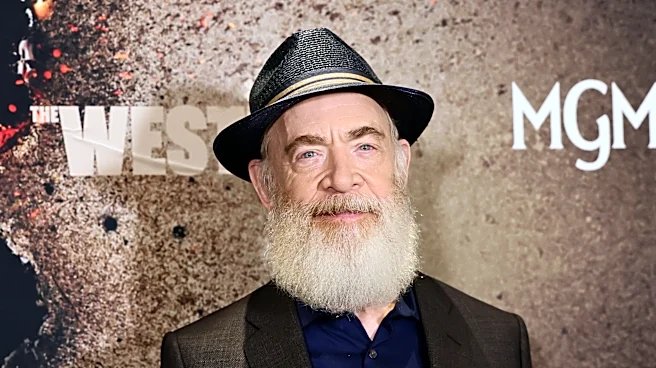








J.K. Simmons is one of the most ubiquitous actors of his generation, popping up everywhere from Spider-Man to Oz.
He's also a die-hard Detroit Tigers and Ohio State Buckeyes fan. When we talked to Simmons for his role on the new MGM+ crime series The Westies, the Tigers had yet to trade superstar pitcher Tarik Skubal to the Los Angeles Dodgers. However, that trade has now passed ahead of The Westies' first season finale on Sunday.
"I can't even; don't even. I can't; I can't!" Simmons exclaimed about the possibility of Skubal getting moved when we talked in July. "Please, Tarik, you'll have enough money either way."
Unfortunately for Simmons and Tigers fans across the globe, Skubal is now an L.A. Dodger. However, Simmons is still an Oscar winner
who has a top-ranked Buckeyes team to look forward to this fall. Maybe another Ohio State national title will ease the pain of losing Skubal to the powerhouse Dodgers?
We chatted with Simmons about his role as Eamon Sweeney on the new MGM+ series, his thoughts on the upcoming MLB CBA negotiations, his sports fandom, that big speech in National Champions and where he keeps his Best Supporting Actor Oscar.
This interview has been condensed and edited for clarity.
You're a baseball guy. Everything might change in December once they get the collective bargaining process going. Do you think it's time for a salary cap in the MLB, or do you still feel like that the system they've got going is working?
The system isn't working well enough for everybody. I do think, I mean, I tend to take the side of the players, of labor, in these things in general. I mean, everybody else has a salary cap. I think, at this point, you're really only serving the multi, multi, multi-millionaires. You're not really serving the rank-and-file... [It's the] same thing with a SAG negotiation or anything else. Some of us, like, we're fine. I'm rich. Justin Verlander is rich. I mean, the high-end players are going to do well, no matter what. I think it's more about the rank-and file-and the same in every sport.
How do you look back on your experience with National Champions, your character and the big speech you give and the way that film handled such complicated subject matter as paying college athletes?
Well, I wish it had come out a year sooner, and it would've been more cutting-edge because, by the time audiences finally saw it, a lot of that was already happening. That speech in particular, that was so fantastic because it was very good on the page. I was given the leeway to play with it as well. We had an 80-man roster sitting in their chairs, looking at this, several of whom were principal actors in the movie, several of whom were just background guys. Anybody that looks like they could have been a college football player, come line up here, and we'll bring you into this room.
There was such an attention to the words. I mean, I was impacting different individuals in their every take of that, whether we were on them, on me, on all of it or whatever. Even though I was the only one flapping my gums, it felt like a very give-and-take environment on that day. Thank you, Ric Roman Waugh, a fantastic director. That movie was a really, really good experience. It only could have been better if I'd have been playing the head coach with the Ohio State Buckeyes.
How do you balance being a Michigan sports fan, like you are for the Detroit Tigers, and also a Buckeyes fan? That's got to be difficult, especially around November.
I mean, it does cause some conflict, but I mean, it's just organic. I was 10 years in Detroit, and then I'm 11, we moved to Ohio, and my dad's teaching at the Ohio State. So, all my new pals in Worthington, Ohio, were Cleveland fans or Cincinnati fans. I was like, "No, I'm not doing that. I'm a Tigers fan for life." [I] had to adopt the Buckeyes, of course, because my dad was there. I was playing football in middle school and high school and got to go watch the Buckeyes win the 1968 championship the same year the Detroit Tigers won the 1968 championship.
Obviously, people have been doing Irish and Boston accents since when movies first got sound. It's such a difficult thing that's just done so often, but I really appreciate, with this, you found such a natural cadence with it that I feel like a lot of people struggle with. What was the secret cracking that with this role?
That was very important to me that, not only for me, for Eamon Sweeney, to be very specifically from this place at this time. Because, if you do the math, Eamon Sweeney's born in 1910, and he's not off the boat in 1910. His father and his mother are off the boat, and he's born and raised in Hell's Kitchen, lived there his whole life. So, it was important for me to really work and nail that dialect. I had experience with it because I lived in the neighborhood at the time.
I worked hard with our dialect coach, Adam Bergquist, and really sort of advocated for all of us to have the same accent or the same access to the accent, to the coach, the dialect, because we all grew up in this same little insular community. So, for us to have 19 different versions of the dialect is going to be sort of ungrounding for us as actors and for the audience as well. There's always going to be a little generational difference between a guy who's 70 years old and a guy who's 25 or 30 years old, but still, same place, same time. That's always a very important thing for me as an actor and as an audience to make me buy in.
Was there a mafia or mobster performance you looked to for Eamon on The Westies as a guiding star when you were developing the role, or are there a couple you had in mind?
I'm trying to think if there are exceptions to this. I never look at any other fictional portrayal or fictional character. To me, it's like this character is on the page. He either kind of jumps off the page toward me, or I find enough of a connection that I feel like I can be the right guy to inhabit that character. If I am, then, great. I hope I get the part. When I do, yeah, I'm pretty sure I can say that I've never tried to base any of my characters off of other [performances], not that there aren't tons of great actors who have played great mobster characters that I've really enjoyed watching, but certainly never consciously tried to borrow anything.
Where do you keep the Oscar that you won for Whiplash?
Apparently, this was a problem with the batch [of Oscars] that year. The base of it is cracked. So, we have to take it in; it's like a recall from Honda. We have to take it in and get it repaired. It's currently sitting in a closet in an in-laws house because we were doing some renovations.
This article originally appeared on For The Win: Q&A: J.K. Simmons talks 'The Westies,' sports fandom, his Oscar location