

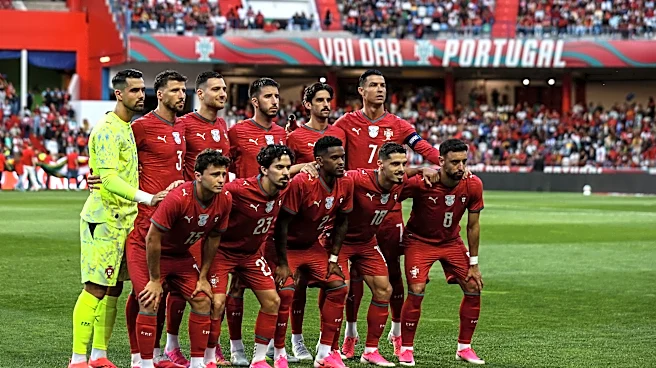
Portugal completed the September-October international window with a perfect 4-0-0 record in its UEFA Nations League matches. But newly hired coach Jorge Jesus is already dealing with the struggle of having Cristiano Ronaldo on his roster.
And now, Ronaldo is going public with his feud.
The drama within Portugal camp started when the 41-year-old Ronaldo was an unused substitute in Portugal's 2-1 win over Norway. Ronaldo had reportedly been told that Jesus would play him in the second half, but the coach changed his mind mid-match. A furious Ronaldo abruptly left the national team with two matches remaining in the window. And ESPN reported that Ronaldo told the federation that Jesus would need to be fired in order for him to play for the national team again.
Come Tuesday, Ronaldo publicly said he would gladly return to the national team. But he offered his side to the story and claimed that the Portugal coach violated his trust. He wrote in a lengthy statement:
“As promised, I have decided to give a direct, first-person account of the circumstances surrounding the final stage of my time with the national team.
After the 2026 World Cup, I prepared a letter to the Portuguese people, which I still have, containing the words I want to share with them when I leave our team for good.
After the tournament, on the flight home from the United States, the federation president asked me, and insisted, that I reconsider my decision to leave because the Portuguese Football Federation wanted me to stay.
Immediately afterward, he asked for my opinion on the current national team coach, whom he was considering alongside other candidates whose names he did not disclose.
I told the federation president that, in my opinion, it would be the right decision.
So, on the day the current coach was unveiled, I was truly pleased with the choice. It was the right decision, as the results have shown.
A few days later, I received my first call from the new national team coach, who told me he wanted to meet me in person. I agreed, and we arranged to meet at the end of my vacation.
We met at the Cidade do Futebol, where my club was holding its preseason training.
That day, the coach told me he was counting on me and that my presence was essential to his project. He outlined a plan for my involvement there and then. He told me I would play the first and last games and that, for fitness reasons, he would always make three or four substitutions per game.
At that point, he suggested that I not travel with the national team to Norway and Denmark. He proposed that I play the first game and stay in Portugal, then rejoin the team before the game at the Estádio do Dragão.
I rejected the offer immediately. It seemed obvious to me that I could not accept it. Not playing the games abroad did not mean I would stop being our team’s captain. Having the privilege of staying in Portugal would not set a good example.
In the end, the coach agreed with my assessment.
Simão Coutinho, Al Nassr’s sporting director, took part in this conversation. He was the person the current national team coach reported to throughout last season and one of those responsible for bringing him to the club in 2025.
On the eve of the training camp, the coach came to my home in Lisbon to speak with me, at his request. The conversation was calm, and all the principles agreed upon in August remained in place.
I played in the game at Alvalade and, despite being a substitute, caused no problems. I personally put the captain’s armband on Bruno Fernandes, without imagining that I might be taking my final steps as a player and captain of the national team. What mattered to me that day was our victory. Winning is always good, but winning in Portugal and for my country is even better.
On the day of the game in Norway, at lunchtime, one of the national team coach’s assistants approached the table where the group was eating and told me the coach wanted to speak with me. To my complete surprise, he asked whether I was fit enough to play 30 minutes. I was fully focused on my physical recovery, involved with my teammates as always, and thought I would not be playing that day. There was no problem.
This request fell outside my recovery and training plan, since I was only due to play on the fourth at the Dragão, but of course I said yes. He replied that I should be ready because I would play 30 minutes.
The rest is history. I warmed up from halftime, watched the minutes tick by and was never called on.
The coach had not given me his word.
At the end of the game, all I wanted was for it to end in a victory and to be alone. I did not go over to acknowledge the fans. That was a mistake for which I take full responsibility, and it should not have happened. I apologize to the Portuguese people who supported us so passionately, to the fans, and to those who, despite not being Portuguese, traveled there to see me and whom I may have disappointed.
Forty-eight hours later, the coach, Coutinho and I had a conversation, since Coutinho had been involved in our discussions in August.
It was an intense, very direct conversation, with nothing held back.
We agreed there was only one way to bring this ‘case’ to a close: for the coach to repeat in the press room what he had just told me privately, in Coutinho’s presence.
The agreement was simple: the coach would begin the press conference by addressing the issue, seeking to close the matter by telling the truth. He would say that I had never asked for playing time.
Not a single minute. It was the coach, and nobody else, who had proposed my plan for this training camp. It had been a mistake to have me warm up only to leave me out, and if the same situation arose again, he would not do it.
We ended the meeting with the coach asking me for a hug, promising that he would say at the press conference what he had just told me and that the matter was settled. I would not play in Denmark, but I would play in the game in Porto. All of this, as always, took place in Coutinho’s presence.
At the coach’s request, a video call was held between him, Coutinho and Tiago Craveiro, summarizing what we had discussed.
A short document was drawn up, which I personally approved and which, with my knowledge, was given to the coach, as he had requested.
The press conference went exactly as expected: his attitude bore no resemblance to our meeting. I heard remarks and aggression that I do not believe were justified, an attitude of ‘I want to, I can and I’m in charge’ that I had never heard in private the previous day.
The notes I approved were as follows:
‘I think it is important, particularly because it is the truth, to clear up a few things before discussing Denmark.’
None of those notes, therefore, said that the coach had apologized to me.
It was the second time my word had been broken.
I decided to leave the training camp rather than wait for more broken promises. For me, truth remains the most important thing in relationships between people. However much it hurts, I need to be told the truth.
Furthermore, in a conversation I had with the federation president and the national team coach on the morning of that press conference, something they can surely confirm, I reiterated that if they did not want me there, they simply had to tell me. They only needed to be honest with me. I would accept it, and I promised we would prepare something beautiful, as I dream will happen, and nobody would be upset.
I remember it as if it were yesterday. They answered in unison: ‘No.’ They said my place was with the national team.
Never, in my almost 25-year career, have I interfered in any technical or tactical decision made by any club or national team coach. For better or worse, I accept what they propose. I respect the decision, and when they do not keep their word, I feel I have no place there.
I also owe my teammates an apology for leaving the training camp. Despite the complete loss of trust in the coach that I expressed, as anyone who witnessed those conversations can attest, I should not have done it. The responsibility is mine alone.
I apologize once again to the Portuguese people, but the breaking of my word affected me deeply. I felt that, from that moment on, my presence would only harm the group, so I did what I had always said I would do if I no longer felt useful: I packed my things and left.
The Portuguese Football Federation must assess my actions and impose the appropriate punishment. I believe that punishment should not be reduced. I am not just any player; I am the team’s captain, and that is an aggravating factor. I have already apologized, but I know actions must have consequences. Anyone involved in soccer, as I am, knows that, regardless of an individual’s position, the rules are the same for everyone.
In that regard, I have heard a great deal about farewell games, about needing a fitting farewell and about the federation wanting to give me that opportunity.
I learned in life, often when I was hungry and had nothing to eat, that nobody gives anyone anything.
I can promise all my supporters, particularly the Portuguese people, that we will play one or more farewell games. There will be time for that.
But when I think about the national team, what really comes to mind is competition. That was what I thought on the day I learned of my father’s death. I was away with the national team and decided to stay until the following day’s game was over. I did something for my country that I would never do for any club.
So, if I am physically fit, playing for my club and, hopefully, scoring goals, after serving the suspension that will be imposed on me, I will be available, as I always have been, to compete and win with our national team.
This, believe me, is the absolute truth.
Ronaldo
October 6, 2026”
We'll have to see if Jorge Jesus welcomes Ronaldo back to a future camp. But as the team showed in its past three matches, Portugal may be better off without the aging superstar.
This article originally appeared on For The Win: Cristiano Ronaldo claimed Portugal coach betrayed him in lengthy statement on playing future