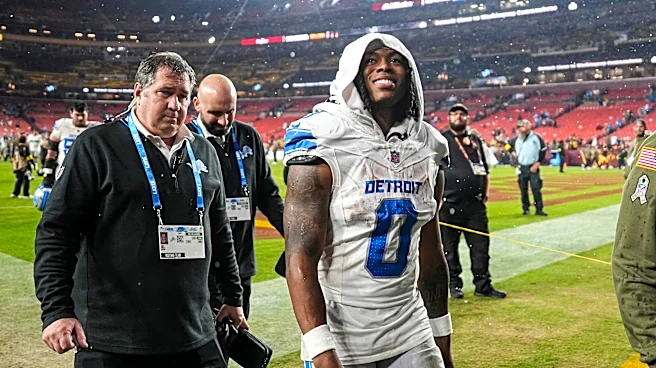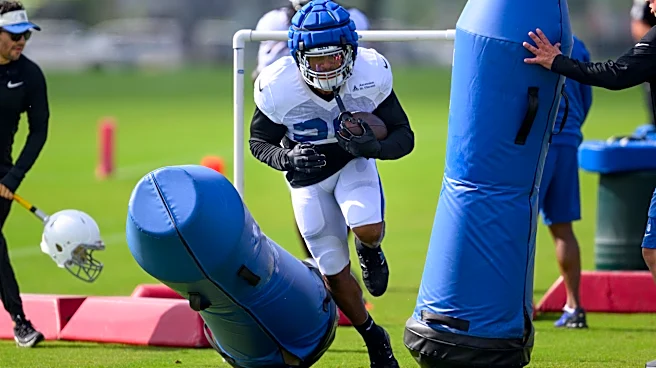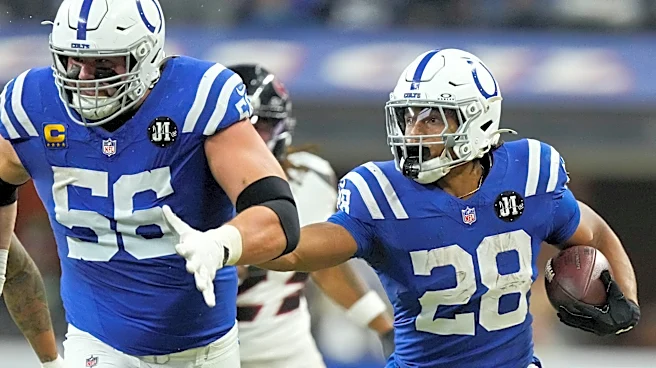


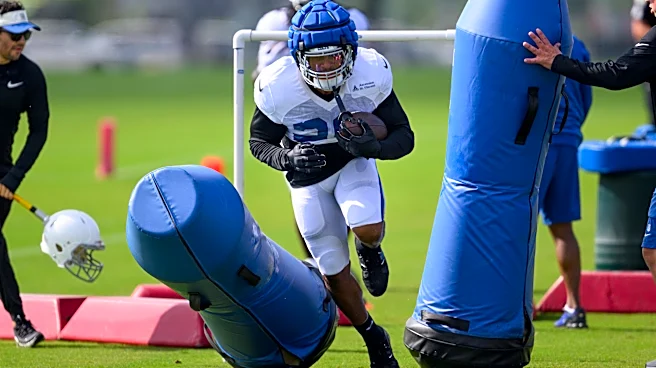
Jonathan Taylor has always been a good NFL running back. On occasion, he's emerged as the best back in the league.
2025 was one such season, even if his argument ran out of steam as the wheels fell off for a team that quickly rose to the top of the AFC, then plummeted back down the ranks. Taylor was on pace for 1,936 rushing yards and 25 touchdowns at 6.0 yards per attempt in the Indianapolis Colts' 8-2 start. That dropped to 1,083, seven and 3.3 yards per handoff over the final seven games of the year as his quarterback flipped from an injured Daniel Jones to Riley Leonard and a 44-year-old Philip Rivers. The Colts lost all those games, but general manager Chris Ballard is undeterred.
He's spent the 2026 offseason effectively running it back
-- retaining key players like Jones and wide receiver Alec Pierce while making modest additions elsewhere. Now, that includes Taylor. On Thursday, he signed a two-deal contract extension with a base value of $44 million, a maximum value of $47 million and a massive $39 million guarantee.
With Ballard's seat hotter than ever, this could be the last extension he gives out in Indianapolis. Will he regret it? Let's break down why it might, or might not, work.
The deal: Indianapolis Colts sign RB Jonathan Taylor to a two-year, $44 million extension ($39 million guaranteed and incentives that could escalate the total price to $47 million)

Taylor wasn't a hold-in like Bijan Robinson or Jahmyr Gibbs, but he was in the final year of a three-year, $42 million extension with the Colts -- one that had no guaranteed money left for 2026. While the 27-year-old didn't reset the tailback market, he still landed firmly in its upper crust. His $22 million annual average salarytrails only Robinson's $22,250,000(and, in short time, will also trail the $22.3 million or so Gibbs signs for in Detroit).
His $39 million in guarantees is third-most, trailing Robinson and Jeremiyah Love's $53 million rookie contract. 88.6 percent of his contract is guaranteed, highest among any running backs outside their rookie deals and better than Robinson's 76.4 percent guaranteed deal.
That's big money for a player who has vacillated between good and great over his NFL career, occasionally in the same season. His raw stats remain impressive. He rushed for more than 3,000 yards in 31 games the last two seasons. He's taken at least 20 handoffs in 38 of his 85 pro games, which has been vital for a team searching for its quarterback answer since Andrew Luck retired the season before Taylor entered the league. He stepped up his receiving game in 2025 to bolster Daniel Jones, setting career highs in receptions (46), receiving yards (387) and yards after catch over expected (80).
But drilling down suggests there's a limit to all that. Taylor is efficient, but the advanced stats paint him more squarely in that "good" category. He finished third in total rushing yards last season but fifth in total rush yards over expected (RYOE) and 17th in RYOE per attempt. 129 of his 190 RYOE came in a single game -- but what a game it was, an absolute clinic against the Atlanta Falcons in Germany. He recorded a negative RYOE each of his final five games to finish 2025.
Fortunately, much of that can be explained by the swap to Rivers and Leonard at quarterback and opposing defenses with absolutely nothing to worry about in the passing game. Taylor actually got stronger to finish the 2024 season. 184 of his 194 RYOE came in his final four games that winter (his 0.65 RYOE/touch ranked 14th among qualified runners). It didn't make a difference -- Indianapolis remained mired in its "8/9 wins, no playoff" phantom zone -- but it helps reassure the Colts he's not yet wearing down despite his workload.
So does his six runs last fall where he hit at least 20 miles per hour on NFL tracking devices. That matched a career high, set in each of his first two seasons in the league.
Ultimately, this deal will come down to availability. Ballard has indicated he thinks 2025 was a breakthrough season derailed by injury and he's happy to see it through in 2026. That means a steady dose of carries for Taylor and more utility as a receiver. If he averages 25 touches per game and above average numbers doing so, he'll be a good value even if he isn't one of the league's most efficient running backs since so much of the offense flows through him. Since this deal only takes him through his age 29 season, there's a good chance it pays off, even as his odometer nears 1,800 total NFL rushes/receptions.
The trade-off, however, was making that heavily concentrated guarantee in order to extricate the team from Taylor in 2029 should things go sour. What happens if Taylor lives up to his contract, the Colts remain in neutral and now he has to negotiate with a new general manager approaching his 30s? Will he be as patient with a new regime if the one that drafted him is swept away? Could the Colts regret not spacing this deal out more and adding an extra year? Or will this all be a moot point when he quietly ages out of his prime or Indy merely re-ups him for another two years and, oh, let's say $52 million two years from now?
That's a problem for future Chris Ballard, who could also be unemployed Chris Ballard. Right now, the concern is reclaiming 2025's potential. The cost, between Taylor, Pierce and Jones, is about $95 million per year.
Grade: B
This article originally appeared on For The Win: Grading Jonathan Taylor's $44 million commitment to the Colts