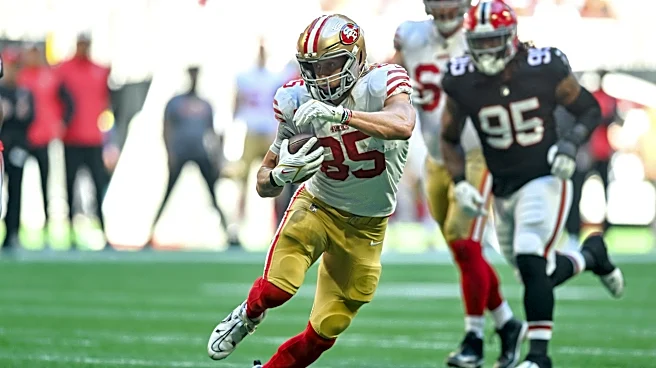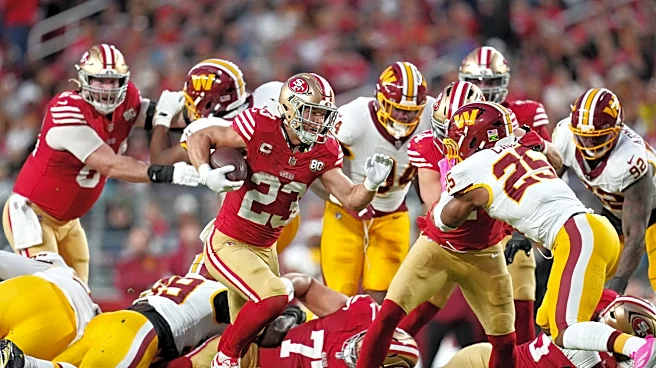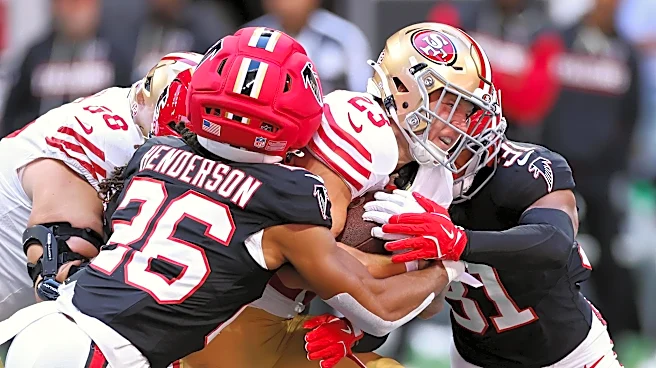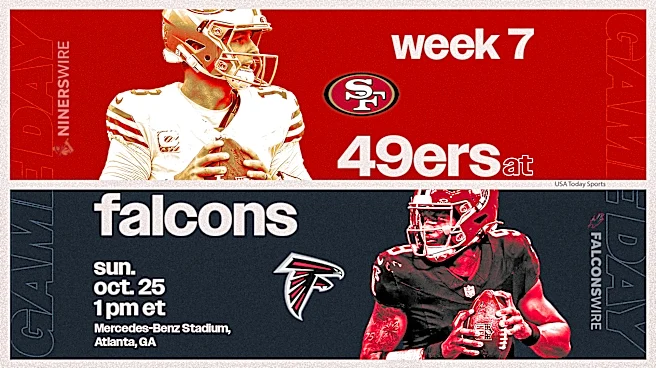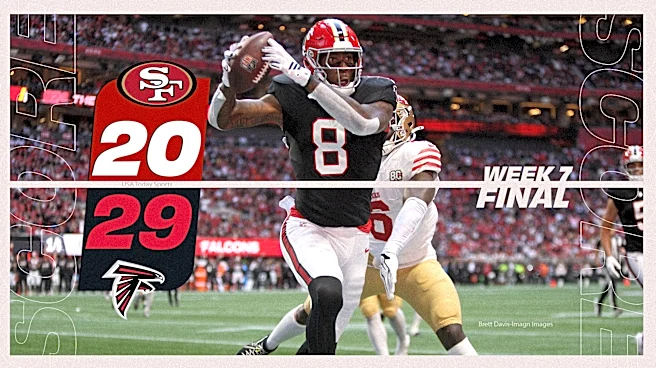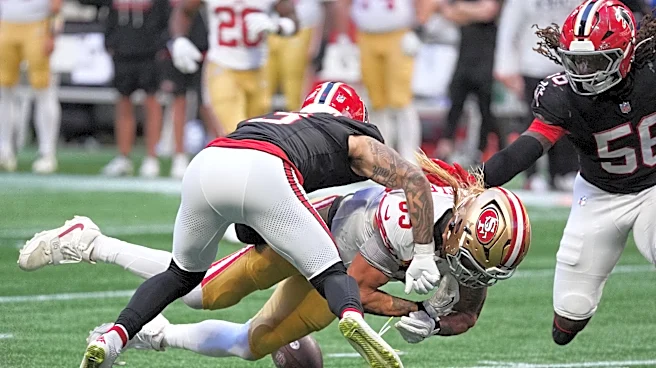


There's a very simple reason for why the San Francisco 49ers lost their first game of the season in Week 7. They had four turnovers. The Atlanta Falcons had none.
But that's too basic a reading of the Falcons' 29-20 win at home. To understand why the 1972 Miami Dolphins took another step toward popping champagne bottles, you have to look elsewhere. Largely, that's to the 49ers injured list.
It's simplistic to blame injuries for Sunday's downturn, but all the signs were there. An early 13-0 lead crumbled into the sea after a Christian McCaffrey-centric offense was devastated by the loss of Christian McCaffrey. The All-Pro back had 69 yards in a 64-yard opening touchdown drive (made possible by a false start by Trent Williams on the first play of the game).
But after an early catch on San Francisco's second possession, he left the game with a thigh injury and was ruled questionable to return.
This left George Kittle as the only proven veteran skill player along the offense.
Injuries had already scratched a cavalcade of stars from Brock Purdy's depth chart. Ricky Pearsall was lost for the season before it even began. Deebo Samuel and Mike Evans both missed Week 7 after hot starts cut short by October maladies. Christian Kirk was activated off IR this week but did not play.
Rookie wideout De'Zhaun Stribling got hurt in his NFL debut. Even key backups who could backfill the vacancies created by injury have missed time; Demarcus Robinson, Jake Tonges and Isaac Guerendo are all on the reserve list.
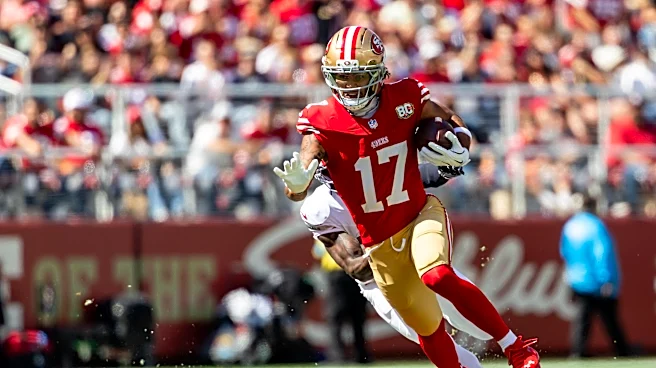
Kittle picked up his end of the bargain. McCaffrey returned and played sparingly in the second half, gaining just 26 yards from scrimmage in the final three quarters. That shifted the focus to a receiving corps led by Jacob Cowing, Jordan Watkins and a 33-year-old Brandin Cooks. Kaelon Black thrived early in relief of McCaffrey, but after running for 52 yards on three carries on the team's third drive of the game he had only four carries for 10 yards the rest of the way. That included a fumble inside the Atlanta 30-yard line that set up a long Falcons field goal drive before halftime.
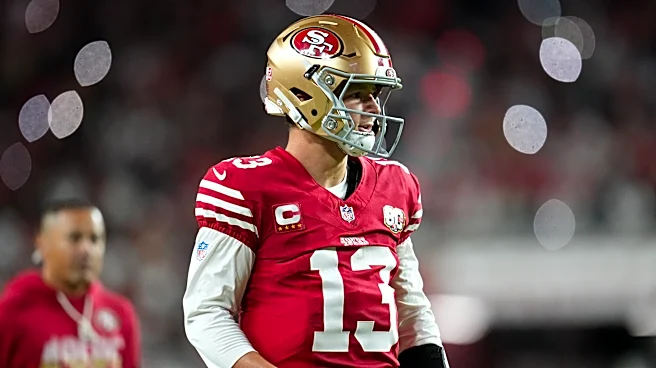
This puts a Kyle Shanahan offense in a tight spot. Shanahan's playbook is predicated on getting balls to high-impact runners in space, leading to league-high run after catch numbers. But in 2026, San Francisco had slipped to sixth in yards after catch per reception coming into Week 7. Further losses of personnel meant Brock Purdy -- a very efficient player made better by the studs around him -- had to lift much more weight than usual. Sometimes it turned out well.
well ok Brock Purdy
— Christian D'Andrea (@trainisland.bsky.social) 2026-10-25T18:02:04.235Z
Sometimes, it did not.
JB3 in his own league 🔥
— Atlanta Falcons (@AtlantaFalcons) October 25, 2026
FOX | NFL+ pic.twitter.com/1mdXYHdXKY
To be fair, that was one hell of a play from Jessie Bates III, who performed an act of borderline wizardry to corral that ball in bounds. But you can see his intended target give up on the play as he approaches the sideline instead of running it out. Purdy and third-year wideout Jacob Cowing aren't on the same page. Where Mike Evans or Deebo Samuel could have at least kept running and been the roadblock that at least allows the 49ers to fight again on third-and-long and turn a solid drive -- one that featured an impressive Purdy bootleg to get into field goal range:
Brock Purdy with one of the slowest jukes of all time and he makes it work for a first down
— Christian D'Andrea (@trainisland.bsky.social) 2026-10-25T18:49:13.569Z
into much-needed points.
The lack of secondary playmakers cropped up as the Falcons rallied back from a 13-0 deficit and into the lead. Cooks turned his three targets into only one catch and 13 yards. Watkins made the most of his opportunity, but the biggest takeaway from his 56-yard performance may be a catch he didn't make.
overturned because he didn't survive the ground but rule of cool dictates this is a touchdown
— Christian D'Andrea (@trainisland.bsky.social) 2026-10-25T19:26:43.358Z
Atlanta took the lead, then left room for a comeback. But a limited McCaffrey and receiving corps that invited single coverage left room to bracket Kittle and send blitzers to overwhelm Purdy and limit his downfield effectiveness. Once that got into his head, the Falcons could flash like they were sending extra attackers into the pocket, then drop back into coverage where the in-breaking routes San Francisco runs so well would be.
BOOM!@KendalDaniels__ picks it off!
— Atlanta Falcons (@AtlantaFalcons) October 25, 2026
FOX | NFL+ pic.twitter.com/7VBExpgNMh
With Cowing, Cooks and Watkins failing to draw focus, the Falcons could swarm to a suddenly predictable offense in the clutch. After a 90-yard scoring drive made the score 26-14, the San Francisco defense held Atlanta to only nine yards on its final three drives before a string of game-ending kneeldowns. But the Niners couldn't take advantage of those. They fell behind and, when each side needed a big play, the Falcons were the ones who got it.
Jessie Bates III had a crazy interception to keep the 49ers off the board deep in ATL territory, then he hits a perfect punch to eliminate any chance of a 49ers comeback and give San Francisco its first loss of the year
— Christian D'Andrea (@trainisland.bsky.social) 2026-10-25T20:10:04.893Z
That won't happen every week, but it showcases the knife's edge the injury-riddled 49ers have walked. What looked like a comfortable win stalled out. After averaging 6.7 yards per play with McCaffrey in the lineup, San Francisco's output dropped to 5.9. That's the difference between the NFL's most efficient offense this season and a top 10 one.
It's evidence a healthy 49ers team will be the football equivalent of a mythical beast. And like a mythical beast, it may only exist in theory, passed down from person to person in hushed tones while reasonable people doubt whether it ever could have been possible to begin with.
This article originally appeared on For The Win: The 49ers finally cracked under the weight of their injuries