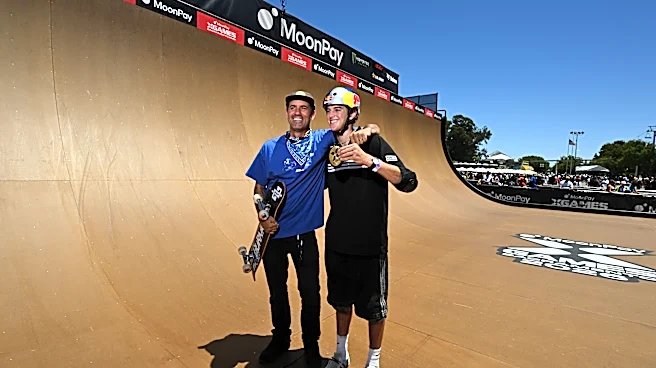


Bob Burnquist forged his legend on a skateboard, and he's now helping young action sports stars craft their game by encouraging them as an MoonPay X Games League general manager.
The skateboarding great leads X Games Club São Paulo, a competitive action sports team within X Games League that features exciting young talents like skater Gui Khury, skater Sky Brown, BMX rider Ryan Williams and skater Ibuki Matsumoto. Burnquist guides them along the way as they compete in the X Games League's first season.
"It's kind of like more of a friend, a buddy," Burnquist described of his X Games League role. "I know I inspire them, and they inspire me. At a respect level, it's been pretty amazing."
From 2025: X Games CEO Jeremy Bloom on its 30th anniversary
and the future
While São Paulo sits fourth in the X Games League standings behind New York, Tokyo and Los Angeles, Burnquist still describes the experience as overwhelmingly positive, one where individual achievements forge together to build up a team in the first year of X Games League's operations. Recent events have taken the league to Sacramento, Chiba, Japan, and New Orleans.
We spoke with Burnquist in July about his experience as an X Games League general manager, how he sees his new generation embracing action sports, past pop culture tie-ins and scuttlebutt over a possible Grind sequel.
This interview has been condensed and edited for clarity.
How has it been being on the other side of the aisle with X Games and seeing the league from a new perspective?
It's been pretty fun. I mean, and it doesn't really feel like the other side because I mean.... I'm constantly skating, filming with the guys. Obviously, a lot of the guys that are in at the league, like Tom Schaar and stuff, we tend to skate a lot together. Then, we go to the league, it's just kind of like, all right, here's swapping hats, and, then, this is my role here and kind of corralling everyone and putting everyone, kind of, trying to bring in the team spirit, let's say. It's kind of similar to our skate teams in the sense when we're traveling together and all pushing each other. It doesn't change much from that other than, now, you're at X Games. It's a gamified version of X Games, which I didn't know what to expect, but after the first two [events], it just felt like now you're following all these different.
I'm going over to BMX, and then, going over to all the different disciplines. You have this overall interest and perspective and points because, now, we're doing this together even though we're all individually out there, and we're supporting them individually, whatever results they get is going to support the team. That was an interesting aspect that we didn't really know how it was going to be, but it was really exciting. It's cool to just go and have conversations with them, see what their head's at because they're all amazing riders, skateboarders and BMX riders. What I can add to it is just like understand where their head's at, whether if they bailed their first run, and they're not used to it or their mental games; they're a little nervous. I just have conversations with them. Sometimes not even about the run, just kind of like, "Hey, it's all good." Just bring their frequency back down into a good place so that they can go out there and maybe get that last run in and make it happen.
Tell me a little about your team. Who are some of the folks on there you're really excited about getting to coach and getting to work with?
I think most of the guys and girls that I picked I can relate to, and I made it a strategy to go after the people I wouldn't have to micromanage. Last thing I want is to try and butt heads with ego and try to direct them in a place. It's just kind of like, well, everyone that I kind of was able to draft are in a space that I can relate to. What I say is that you got Sky Brown, amazing skateboarders, one of the best styles out there. Could really put it together. Her post interviews, amazing skateboarder, and she did win, but the interviews after show me why. She's very gracious. [Skater Arisa Trew] was out on one... she got hurt in one of the events, and Sky went out of the way to make sure that she knew that she was missed and things like that.
Ryan Williams, R Willie, just an incredible BMX rider, just always coming up with new things, just super excited about putting in new tricks and then doing it for the collective. He'd come out and talk to me and show me what he was working on. He was like, "I'll think about doing this." Then, we would talk about where he would do that and just really excited, pumped every time we would connect, and he would see the team. He's just like, "Let's go." He's got that vibe of like, [excitement]. Those type of personalities are just amazing. Ibuki [Matsumoto], who I really just am so impressed by. She's super young. She's a street skater from Japan, just won her first major world skate event in Sao Paulo recently. Then, she's a part of the team. Just what I also liked about her is that after winning that incredible event and after she does runs, she's very respectful.
She's got that Japan culture and [is very] humble and the way she interacts. It's just like, wow, okay. They're all so inspiring. I can go on and on by each of them, but we got Luigi Cini. Obviously, we got Gui Khury, who's an incredible, cold competitor. He knows what he wants to do, and he's out there, and he doesn't get really phased by what's going on around him. He goes out there and puts it together. So, real young, too, just 17. That's what I'm impressed by everyone there and not having to micromanage them really. All I do is just have conversations so they're in the right place. There's no coaching outside of that. Sometimes, coaching is as simple as that with a friend. It's really making sure they're in the right head space to go out there and compete.
Is there anything about this generation of skaters and competitors that really stands out to you as kind of being special or different from kind of what you've encountered in the past?
Well, naturally at every generation turn, what's normal and what's possible on a skateboard is imprinted on them as they start. So, when Gui Khury started skateboarding, he's watching the videos, obviously, and everything that was possible for him is normal. If you've seen things, like you've seen 900s and you start seeing kickflip 540s, everything's normal. You start with that base. It's natural that what is, to us, took generations to achieve because it's about progression. It's possible when they start. So, they bring those in, and then, that is what's the normal in a sense. When they go out and skate, they base their tricks, and they're just like at this level that is above when our generation turned, which is a natural [progression]. What is confidence for them is what they're building out super young is incredible combinations that for us, each individual trick sometimes took a while to get to.
What impresses me is obviously the level of technical ability so young. Speaking of [skater Ema Kawakami], who's one of the youngest out there and still kind of working in his power and starting to get higher in his tricks showed in Chiba that he has the combinations that are just mind-boggling and has the speed and is starting to kind of grow into his power... and still a kid. We're out there in an athletes lounge, and he's playing video games, and we're just messing around. There's just this little kid, and he's interested in watching skateboarding and watching games. Then, all of a sudden, he goes on the ramp, and he just goes out and goes off. It's just incredible to me. I'm really impressed by the Japanese culture. I've always enjoyed the culture, but I'm impressed by the talent that's coming out of Japan, not only on the vert or park or street, but in Chiba, we got to see some of those mini-ramp, that's like mini-ramp contest and a lot of the really young Japanese kids at a level that are just mind-boggling on the technical abilities on the small ramp.
They're looking at Ema, who's not that older than them, skating the big ramp with the big guys. What's happening there is just like, you got Ema inspiring this whole new young generation and the young generation, just incredible talent. Then, Ibuki and [skater Yuto Horigome] already kind of developed, but at an insane level. There's this generational push of progression in Japan that's just awesome to see. I remember when there weren't that many. I mean, obviously, there's been Japanese skateboarders throughout the ages and decades and different inspirations, but now, they're getting at a top level performance in a sense. Japan is pretty much the growth [point], where right before them, Brazil was bringing a lot of the new talent. Now, you're seeing that in Japan. You're going to see that shift around the world just because skateboarding is so global, but Japan is it right now.
What have you seen, particularly with this generation, that's really made them latch on with action sports like folks did 20, 25 years ago?
Well, I think it's the same appeal as always. When I started skating, the reason I liked it is because everything I did was either my fault or my merit. If I slammed and got hurt, I mean, it was my fault. If I got back up and made the trick happen, I had that merit. Obviously, you have your friends and your support. You don't do anything alone, even in skateboarding. That feeling of creation and independence and expression, really, is what carries through every generation. I mean, the reason you skate, or at least the reason I skate, is that it's kind of more of an art form, a way to express myself and to prove to myself that whatever it is that I put my mind to, I can get into, and I can make happen. I mean, to this day, I know that if I go and start skating, and I want to learn a new trick, I'll get it.
I'll learn it. Well, how do you know? Because I've done it thousands of times before, and I know the process. It's just a matter of patience and consistency and insistence and effort, energy, and it'll happen. Once it happens, that feeling is what makes you start it all over again. It's the reason I still skate. It's just because I'm still learning new tricks, and I'm still progressing. So, it's like that feeling is what you go after. I think that is what, as opposed to a team sport, which also has their own merits, but I think personalities kind of gravitate towards the individual and expression-creation for that simple matter. Then, how you do it and what you do on your board is just a generational thing. Like I mentioned, the level of tricks now as opposed to before are completely different. The reason behind it is absolutely the same.
It's learning something new, progressing, expressing a different way, something you haven't seen that gets really technical. I think that technical progression happens so quick because of social media. We're exposed to it really quick. As opposed to when I started, we would work on a couple years on something and then put out a massive, strong five-to-six minutes part. That still happens now. Tom Schaar had one of the most amazing video parts last year, and it took him a few months to work on this. Every day, he is putting out social media clips. Then, you're seeing the kids in Japan skate mini-ramp at an amazing level, and we get to see that right away. You're seeing that constant, instantaneous, technical progression, inspiration going out. You're just getting this exponential growth and progression out of skateboarders because of it.
Just as someone who's been involved with the X Game for the time that you have and being able to do so many different roles, how cool is it to see it kind of having a resurgent moment and really expanding into some new ways to really kind of reengage in culture?
It's great because it used to be the only big event in town. I mean, for the longest time, X Games is seen as the Olympics of action sports and all that. It was always a thing. It was one of the biggest mainstream media events. Then, it got competition, actual Olympics came in, and then, they're the Olympics of the skateboarders; that's the Olympics. You're going to have these big events, and a lot of the people and skateboarders are focusing and pushing their progression and their efforts towards that. That narrative can be siphoned and vacuum into only that. Now, there's Olympics, so people just tend to talk about the next Olympics, and then, the cycle ends, oh, the next Olympics. It's not really what it's about. It's one aspect of what we do. And then you have the individual skateboarding events that are more looser in different generations like Jackalope.
We go out there, it's like a different type of vibe. Then, X Games finding a narrative aside from the full-on just festival type of skateboarding or the Olympic narrative of skateboarding. There's no road to the Olympics from the X Games, and I don't think there should ever be because it's its own thing... It's great to see that X Games found its own narrative and its own story and its own pro league because it creates now a different place for you to put your efforts in. Also, it gives access to more and more skateboarders to kind of like go, "Okay, I can focus on this. This is kind of fun. This is a different type of game." That's what I say. It's like X Games gamified because, for the longest time, it was an individual [event], you go out there, you win your medals, and that's good. It's a contest, and that's there.
Now, it's that, but now, you're collecting with different team members, and that adds points to your team, and there's a championship, and now it's teams... I don't think people knew much to expect. There's already been two events [as of mid-July]. Now, it's like everyone on the team I can see is excited. I don't have to ask them to see if they like it because I can already tell they're engaged, and so am I. Because I'd be straightforward. If I was like, if I'm not into it, I'd be like, "It's kind of working, not really." I feel like they hit the spot in the sense of bringing in this gamified version of X Games where it's a collective through individual performances. It's a place now. It's definitely its own pillar.
I think we're going to see it for some time now. I think that the first two [competitions] landed good enough and exciting enough to where there's momentum. I think that just the fact that they were able to sell already a few clubs before even the event happened; they're already interested. There's club interest and ownerships moving around. That in itself is kind of proof. Now, that their events already happened, and there's this excitement. I think that we should be seeing this type of narrative for some time from X Games, I believe.
Did you ever have a favorite pop culture tie-in you were involved in that was just so strange to work on? You're like, "I can't believe I'm doing this." Or just as someone who was a professional just being like, "Wow, that's wild that they somehow found a way to tie this into this."
Well, the Disney tie-ins were obvious, obviously, because of ownership, and it made sense as you navigate these different properties. I'm sure if you're up there, you're like, "Oh, it'd be good to grab this and put this together." The Goofy thing [An Extremely Goofy Movie] was obviously setting that and [being] like, "Wow, okay. There's the Disney connection." That kind of starts going into the homes, just like the video game. You're watching a cartoon; you're playing video games. Now, you're in. I remember doing demos at Disney, which was pretty wild. X Games put a ramp together one year to promote. Then, we're out there at California, the Disneyland here. There's a vert ramp set up, and we're skating, and then going to Disneyland. So it was just kind of a wild connection. Then, the other thing, the [MVP 2: Most Vertical Primate]...That was unique and cool. I mean, we actually had them skating here in my backyard. They came out and skated as we're promoting the movie.
A lot of people come up to me because of those tie-ins. The Tony Hawk Pro Skater is an obvious one. People talk about my characters as being the only Brazilian there. They're like, "Wow, I always played with your character there." So, that's almost like the 80% of people approaching like, "I used to play you in Tony Hawk." That's deeper than saying, "I watched your gold medal run," which is amazing, but it's a different type of connection. Then, the chimp movie too, like, "Hey, I remember watching..." Brazil has this on TV; there's a session of movies in the afternoon or whatever. It was every Monday or whatever it was. Then, people were like, "Oh, I remember watching you in the chimp movie every session." So, those are unique tie-ins that I was able to get from that.
I think even flying with the Thunderbirds was a unique experience, too, that I got to tie in from that. My experience at X Games has been great competitively and has connected me to these side pop interactions that were down and got me to experience a lot of things. Now, as a GM, it's just unique to see and get inspired. After every event, I actually get inspired to skate. I'll skate the vert a little bit with them and kind of feel the ramp out and everything, but I'm always inspired after I watch and when the events are done.
Are you involved in the new Grind movie that they're doing? I know you were in the first one, but, apparently, they're trying to bring it back. Have you heard anything about it?
Yeah, I had someone reach out on Instagram, something about, "Oh, we're doing Grind 2." This was a few months back. I never heard anything again. Then, I started hearing through the grapevine that they're pushing and working on that. That was one of those, I was at home, and then, they're like, "Oh, we're filming this thing. You got to come up to Hollywood." It was like 6 a.m. call or something like that. I was just like, "Man, I don't know if I'm going... That's early. I'm want to go skate." Then I was like, "I'll go." Woke up early and went. Then, all of a sudden, it's out there. That's another one people come up, and they mimic what the guy goes in the bar and is like, "Hey, Bob Burnquist, yo." They're like, "You should be in Grind 2." That was [a] great five seconds of my acting, just like, saying what's up back.
This article originally appeared on For The Win: Q&A: Skating legend Bob Burnquist talks GM role with MoonPay X Games League