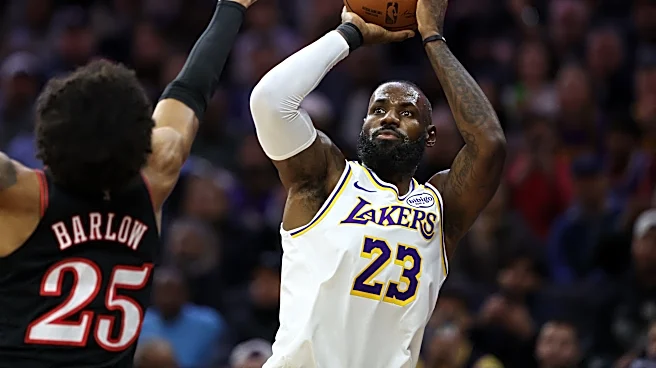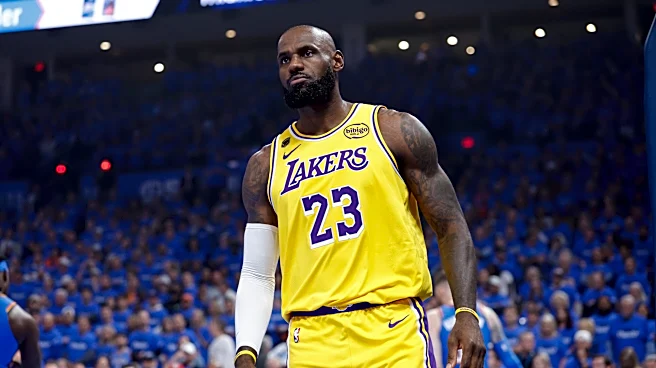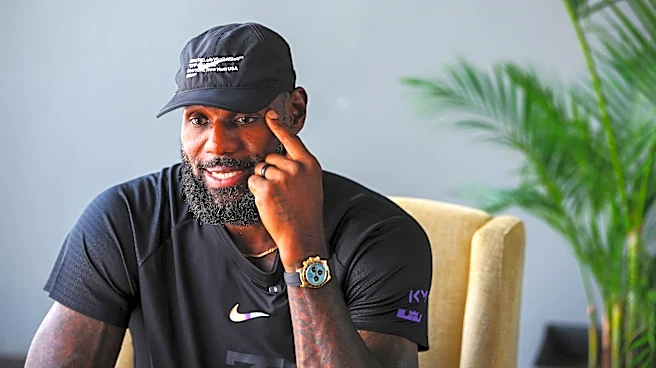




When the Philadelphia 76ers signed LeBron James to a minimum deal this summer, it was arguably the best value contract signed in league history.
LeBron made headlines for spurning more favored suitors like the Cleveland Cavaliers, Miami Heat, and Golden State Warriors. Instead, he unexpectedly inked a relatively cheap (for his standards) two year-minimum deal with the 76ers.
The four-time NBA Finals MVP said he signed with the 76ers because he felt joining forces could make them a serious title contender, helping LeBron win his fifth championship. Additionally, signing a minimum deal would allow his new front office to assemble the best possible team around him.
Of course, it didn't hurt that before leaving the Los Angeles Lakers, his on-court
career earnings exceeded $583 million. Plus, when factoring off-court deals with companies like Nike or Beats by Dre or AT&T, he reportedly has a net worth above $1 billion.
Money isn't exactly a problem for LeBron or his family as he is the first active NBA player with a billion dollar valuation.
But it didn't take a financial genius to understand that this was not LeBron's only source of income heading into the 2026-27 campaign. He had other lucrative marketing deals both under his belt and coming his way, like a recently announced endorsement with the prediction market Polymarket.
He is the first athlete to sign an endorsement deal with Polymarket, per The Athletic. Meanwhile, reporting from Ryan Glasspiegel and Ben Horney indicated that LeBron is set to collect $15 million from Polymarket (via Front Office Sports):
"The prediction-market platform is paying James $15 million a year under the recently-announced partnership, sources tell FOS. James is not an investor in Polymarket, just an endorser, one source says. The length of his agreement with Polymarket was not clear, although one source says it’s an “ongoing engagement” with multiple “deliverables,” such as social media posts and other content."
The implications of LeBron earning nearly four times as much from a gambling deal as he does from his NBA team is, at its most charitable reading, uncomfortable. These waters remain murky for several reasons, though.
Remember: This endorsement deal comes in the wake of arguably the harshest punishment league history, issued to the Clippers, following an investigation into the relationships that Kawhi Leonard had with endorsers. Already simply by appearing in one ad, LeBron has arguably provided more "deliverables" than Leonard did. But there is a careful eye to individual players and endorsement deals around the NBA right now.
He is such a marketable, recognizable star that it is easy to argue in favor of paying him a large sum as a pitchman.
It is also worth noting that LeBron previously signed a deal with a traditional gambling company, DraftKings, in 2024 that expired earlier this summer in 2026. At the time, the company told For The Win he would "focus" on football picks as an endorser. Following league rules, now with Polymarket, he must continue endorse the product for other sports like football and never basketball.
But the league has an undeniably ugly history with gambling like ex-NBA referee Tim Donaghy's match-fixing conspiracies. Even more recently, several recent players (e.g. Jontay Porter, Terry Rozier, and Malik Beasley) as well as former players (e.g. Chauncey Billups, Damon Jones, and Ed Davis) have come under fire for their alleged roles in gambling schemes.
Jones pled guilty in April 2026 to selling non-public information to sports bettors about LeBron's injury status for a game in February 2023. He cited "insider information" he obtained from his relationships as a former player. Jones was a former teammate of LeBron's who worked for the Lakers in an unofficial capacity in 2022-23.
LeBron was not accused of any wrongdoing surrounding this particular scandal. In fact, before LeBron's endorsement deal with DraftKings, LeBron spoke openly about how gambling occasionally took "integrity" out of the game (via Los Angeles Times):
“I mean, it’s weird that some of our regular fans that love the game kind of only care about a parlay now,” he said. “I guess that’s the word everybody is using. It’s kind of taken some of the integrity out of the game because people are kind of really only caring about the betting.
This quote has come under fire from multiple publications as his tune has seemingly changed just a few short years later. Meanwhile, it is increasingly common for superstar athletes to align themselves with prediction markets. Earlier this year, for example, Miami Heat star Giannis Antetokounmpo announced his own partnership with Polymarket competitor Kalshi.
Polymarket allows users to trade on specific events not allowed at a typical sportsbook. In fact, per CryptoBriefing.com, over $43 million was wagered via Polymarket on LeBron's free agency destination this summer.
Sports are the most commonly traded subject on these prediction markets by a significant margin. According to a recent report by the New York Times, the "$2.4 billion traded on Kalshi" during the first Sunday of the NFL season is "more than 11 times the volume" traded on the 2028 Democratic presidential nominee market.
Prediction markets like Polymarket and Kalshi, overseen by the federal agency Commodity Futures Trading Commission, are ripe breeding grounds for insider trading at a large scale. There aren't the same regulations or limits when using a prediction market compared to a traditional sportsbook.
Earlier this year in April 2026, the NBA wrote a letter to the CFTC Secretary Christopher Kirkpatrick urging for "robust and comprehensive" regulations for prediction markets in sports.
"There is no higher priority for the NBA than protecting the integrity of our games and preserving public confidence in our league and in our sport. While this letter takes no position on the legal question of whether sports prediction markets constitute gambling under federal or state law, we believe that such markets raise integrity concerns that are similar to those associated with sports betting. lt is the NBA's view that sports prediction markets should be subject to robust and comprehensive regulations that are specifically designed to protect the integrity of sports leagues and their competitions."
The NBA has already flagged this exact risk. The letter to the CFTC explicitly called for banning contracts tied to "officiating, injuries, league disciplinary actions, player or team transactions" while citing their susceptibility to "manipulation" and "insider information" around the league.
Even with the NBA pushing for it, that regulation isn't in place yet, so what is there to stop others like Jones (who may also have insider information) from doing something similar on something even easier to predict (like a free agency destination) than the results of a game where anything can happen? How would that look if LeBron is simultaneously endorsing that product?
Imagine all of that, when also factoring in that that endorsement deal is for nearly four times as much as his actual NBA contract.
While prediction markets still operate like the Wild West, it probably isn't great that the most well-known basketball player in the world is earning so much more from one of these companies than his actual employer.
This article originally appeared on For The Win: Why it's bad LeBron earns far more from Polymarket than the 76ers