





For only the 11th time in nearly four decades of ocean exploration, scientists from the Monterey Bay Aquarium Research Institute encountered one of deep sea’s most unusual and bizarre creatures.
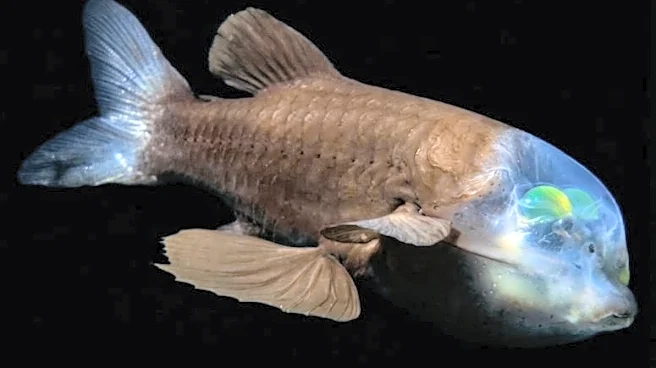
The researchers captured stunning footage of a barreleye fish, a rare sea creature with a transparent head and rotating eyes that track prey.
The expedition aboard the research vessel David Packard was about 55 miles off Central California when the camera on the remotely operated vehicle spotted the rare fish in 1,970 feet of water, as reported by the Monterey Bay Aquarium Research Institute.

Scientists were filming and collecting deep-sea organisms on an eight-day Diving Deep for Delicate Drifters expedition, and on this day, most of the scientists had
already moved to the ship’s wet lab as the ROV was piloted quickly to the surface as the day’s exploration was done.
But as the ROV ascended, Research Specialist Shannon Johnson noticed the unusual fish and asked the operator to stop and focus in on the unique specimen.

“When word spread about the sighting, [the scientists] hurried back to the control room, along with crew members, eager to witness the rare encounter,” MBARI reported.
The sighting turned out to be the highlight of the expedition, which primarily investigated gelatinous marine animals, including jellyfish, siphonophores, and ctenophores, aka comb jellies.

“Seeing a barreleye fish is a rare treat,” Senior Scientist Steven Haddock said. “Crew from across the ship joined the science team in the control room, mesmerized by this remarkable animal.
“Deep-sea animals capture the imagination, creating wonder and awe that we hope will inspire stewardship of the largest living space on Earth.”
Also on FTW Outdoors: Serial poacher to spend 5 years in prison for wildlife crime spree
The barreleye fish’s anatomy helps it to find food in the ocean’s twilight zone, a dimly lit region where sunlight is faint and spotting prey can be difficult.
From the Monterey Bay Aquarium Research Institute:
“Rather than constantly swimming in search of food, Macropinna can remain nearly motionless in the water, supported by its large fins, which provide both stability and precise control over its movements. Its tubular eyes normally point upward, allowing it to watch for the faint silhouettes of animals passing overhead.

“Once the fish detects something worth eating, its eyes can rotate within a transparent dome of tissue covering the top of its head. This unusual ability allows the barreleye to maintain visual contact with prey as it changes position to capture it.”
So, how rare was the encounter? Consider that MBARI has conducted approximately 7,000 remotely operated vehicle dives and accumulated more than 41,000 hours of deep-sea video, and this, as stated before, was only the 11th sighting of a barreleye fish, and first since 2021.
This article originally appeared on For The Win: Rare encounter in ‘twilight zone’ leaves scientists mesmerized (video)