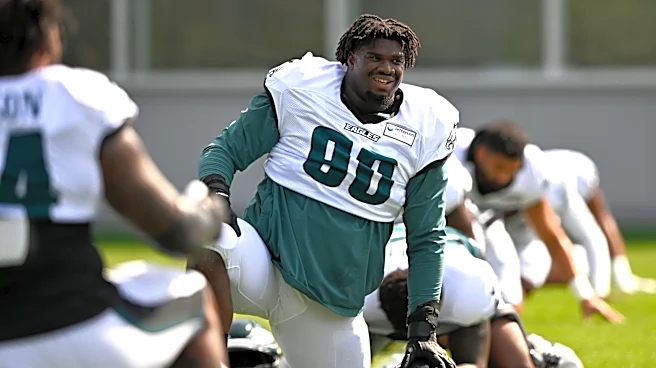




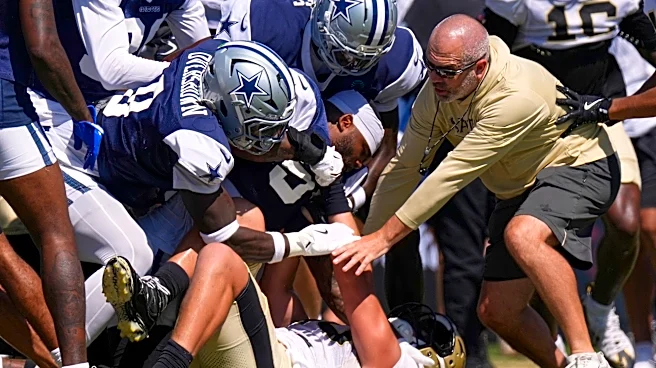
The Philadelphia Eagles have spent the summer doing what they always do: building from the inside out and investing in the defensive front to increase their chances of winning in the trenches. The early returns suggest that confidence may be justified. Even without Jalen Carter participating in Thursday's joint practice with the New England Patriots
, Philadelphia consistently found ways to disrupt thePatriots' running game from the interior.That matters for reasons that extend beyond tackles for loss. Vic Fangio's defensive philosophy is built in part around limiting the number of defenders committed to the box without sacrificing the ability to stop the run. Doing that requires defensive linemen capable of winning their individual matchups,
occupying blockers, and disrupting without constant assistance from the second level.
The Eagles appear to have the personnel to make that approach work. Jordan Davis and Moro Ojomo were particularly disruptive against New England. At the same time, other members of the interior rotation have continued to show signs that Philadelphia can maintain its effectiveness even when Carter isn't on the field.
The Eagles' advantage starts with the big men.
Davis has always possessed the physical profile to be a problem for opposing offenses. Still, the encouraging part of his recent development is how often he is affecting plays without necessarily being the one who finishes them. When an interior defender forces a running back to stop, change direction, or bounce outside, the defense has already won part of the rep.
Ojomo has provided a similar element. His quickness allows him to penetrate gaps rather than absorb blocks, giving Fangio another interior player capable of disrupting the timing of a run before it develops.
That combination is particularly valuable because, according to sources including Jeff McLane, the Eagles don't have to rely on a single player to create disruption. Carter remains the centerpiece of the group, but Davis and Ojomo can keep the interior competitive when he leaves the field.
That creates the kind of depth that allows a defensive coordinator to maintain his preferred structure throughout a game. The schematic benefit becomes clearer when considering what happens behind the defensive line.
Why Vic Fangio's light boxes matter
If Philadelphia can consistently trust its interior defenders to handle the run with fewer bodies in the box, Fangio can keep additional defenders available for coverage or pressure responsibilities. That gives the defense more flexibility without constantly requiring the linebackers and safeties to compensate for problems up front.
It also places greater responsibility on the defensive tackles. They have to win enough individual battles to prevent offenses from creating easy running lanes, particularly when Philadelphia doesn't commit an extra defender to stop them. So far, the Eagles have offered some encouraging evidence that they can do exactly that.
It's still August, and joint practices are not a substitute for regular-season football. Offensive game plans are limited, personnel groupings are different, and neither team is revealing everything it intends to use once the games count. But the early signs are difficult to ignore.
Philadelphia may have more than a talented defensive interior. It may have the depth and versatility that allow Fangio to build an entire defensive structure around it. That could become one of the Eagles' most valuable schematic advantages once the games begin to matter.
This article originally appeared on Eagles Wire: Eagles’ defensive line gives Vic Fangio a schematic edge