


The Philadelphia Eagles have enough offensive depth to create difficult decisions throughout training camp.
Most starting jobs are settled, but the competitions behind them contain draft picks, established veterans and developmental players. Philadelphia also has several position groups where there may be more deserving players than available roster spots. Strong preseason performances will matter. So will positional versatility, special-teams production, and the ability to contribute on game day without receiving significant offensive snaps.
Here is one player at each offensive position facing a difficult path to Philadelphia’s initial 53-man roster.
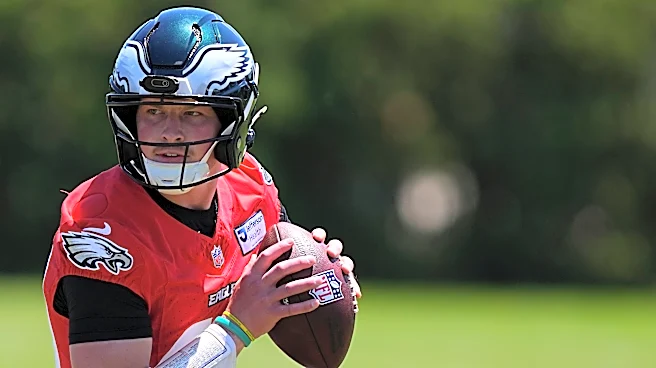
Quarterback: Cole Payton
Payton has more roster security than a typical bubble player because Philadelphia selected him
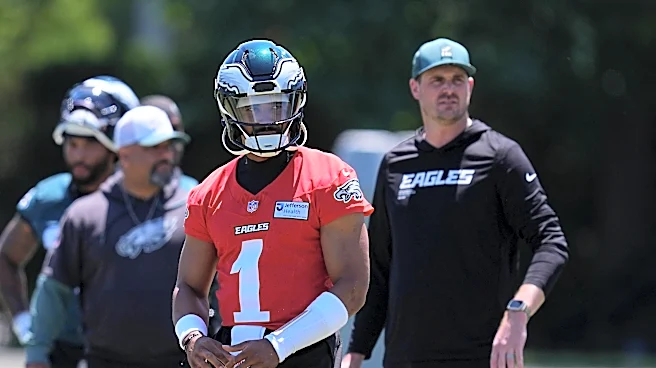
in the fifth round of the 2026 NFL draft. The crowded quarterback room still creates uncertainty. Jalen Hurts is the unquestioned starter. The Eagles acquired Andy Dalton in a trade with Carolina, while Tanner McKee returns after serving as Hurts’ primary backup last season.
Philadelphia kept three quarterbacks on its initial roster in 2025. Carrying four would be unusual, meaning one player could be traded, released or moved to the practice squad.
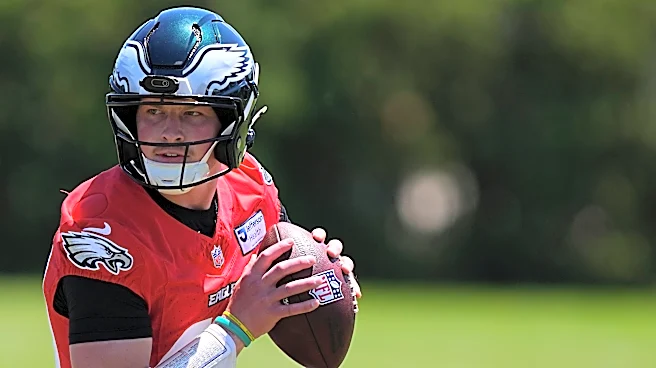
Payton threw for 2,719 yards with 16 touchdowns and four interceptions during his only season as North Dakota State’s starter. He added 777 rushing yards and 13 touchdowns, giving the Eagles a developmental quarterback with dual-threat ability.
The draft investment makes it unlikely Philadelphia will expose Payton to waivers without careful consideration. His presence nevertheless creates a numbers problem that must be resolved before the regular season.
Running back: Elijah Mitchell
Mitchell has produced at the NFL level, but recent injuries and a loaded Eagles backfield have made his path to the roster difficult.
He rushed for 963 yards and five touchdowns as a San Francisco rookie in 2021. Across four seasons with the 49ers, Mitchell accumulated 1,523 yards and nine touchdowns while averaging 4.7 yards per attempt.
He played in only one game for Kansas City last season before finishing the year on New England’s practice squad. Philadelphia signed him in June after he participated in rookie camp on a tryout basis.
Saquon Barkley, Tank Bigsby and Will Shipley enter camp with clear advantages. Mitchell must also compete with Dameon Pierce and Carson Steele. Pierce brings starting experience, while Steele can play fullback and contribute on special teams.
The Eagles kept four running backs on their opening roster last season. Mitchell may need to outperform both Pierce and Steele while proving he can stay healthy.
Wide receiver: Erik Ezukanma
Philadelphia signed Ezukanma after June minicamp following his productive season with the D.C. Defenders of the United Football League. Ezukanma recorded 264 receiving yards and one touchdown in 12 games. He also rushed for 71 yards and produced 621 kickoff-return yards, giving him multiple avenues to contribute.
The problem is Philadelphia’s crowded receiver room. DeVonta Smith, Dontayvion Wicks, Hollywood Brown and first-round pick Makai Lemon are expected to hold prominent offensive roles. Elijah Moore and Darius Cooper also enter camp with advantages.
Ezukanma must compete with Britain Covey, Quez Watkins, Johnny Wilson, Danny Gray and Samori Toure for what may be one remaining position. His return experience could help, but Covey already has a strong NFL record as a punt returner.
The Eagles kept five receivers on their initial roster last season. Ezukanma likely needs to earn a return job or produce consistently on offense to force Philadelphia to keep a sixth.
Tight end: Dae’Quan Wright
Wright enters the NFL with intriguing receiving production after catching 39 passes for 635 yards and five touchdowns at Mississippi last season.
His 10.1 yards after the catch per reception led all Football Bowl Subdivision tight ends. That ability gives him developmental appeal in an offense looking for more production behind Dallas Goedert.
Philadelphia’s investment elsewhere makes Wright’s path difficult. The Eagles selected Eli Stowers in the second round and expect him to compete for an immediate role. Grant Calcaterra is the only reserve tight end returning from last season’s initial roster.
Veterans Johnny Mundt and Stone Smartt provide NFL experience, while E.J. Jenkins and Cameron Latu have already spent time in Philadelphia’s system.
Wright must demonstrate that he can block well enough to complement his receiving skill. The Eagles are unlikely to keep more than four tight ends, and three positions may already have clear favorites.
Center: Jake Majors
Majors spent the entire 2025 season on Philadelphia’s practice squad after signing in September.
Cam Jurgens is the established starter, while Drew Kendall can play center and both guard positions. Kendall’s versatility makes him the likely choice to handle the backup center responsibilities on game day.
Willie Lampkin can also play center and guard, giving Philadelphia another flexible interior option. Veteran Michael Jordan and draft pick Micah Morris add further competition at guard.
Majors has extensive starting experience in Texas, but he must demonstrate sufficient positional flexibility to justify an active roster spot. The Eagles rarely carry a backup who can play only one interior position.
Another season on the practice squad could be the most realistic outcome unless Majors moves ahead of Kendall or proves he can contribute at guard.
Guard: Jaeden Roberts
Roberts joined Philadelphia as an undrafted rookie after making 25 starts at right guard during five seasons at Alabama.
His size should immediately attract attention. Roberts is listed at 6-foot-5 and 333 pounds, giving him the power to compete in Philadelphia’s physical running game.
The depth chart presents a significant obstacle. Landon Dickerson and Tyler Steen are the starters, while Kendall appears secure as a versatile reserve. The Eagles drafted Morris in the sixth round and signed Michael Jordan after minicamp.
Lampkin and Micah Morris also have developmental advantages, while Cameron Williams received guard work during spring practices despite being drafted as a tackle.
Roberts must outperform multiple players who either have NFL experience or draft investment. A strong preseason could earn him a practice-squad position, where the Eagles could continue developing his size and power.
Offensive tackle: John Ojukwu
Ojukwu brings more NFL experience than many players on Philadelphia’s roster bubble. He appeared in 16 games and made nine starts during three seasons with Tennessee.
The Eagles signed him to a reserve/futures contract after the 2025 season. His experience should give him an opportunity, but Philadelphia has numerous candidates for its backup tackle positions.
Fred Johnson returns after making 14 starts over the past two seasons. Third-round pick Markel Bell should be given time to develop behind Jordan Mailata and Lane Johnson. Myles Hinton, Cameron Williams and Hollin Pierce also return as young developmental linemen.
Ojukwu must move ahead of at least two of those players. Bell’s draft status and Fred Johnson’s experience give them strong roster advantages, potentially leaving one position for Hinton, Williams, Pierce or Ojukwu.
The Eagles kept 11 offensive linemen on their initial roster last season, but that number does not guarantee room for every capable tackle. Ojukwu needs to show he can play both sides and contribute as an extra blocker.
This article originally appeared on Eagles Wire: One player on the Eagles' roster bubble at each offensive position