
Three games into the 2026 season, the Philadelphia Eagles have received drastically different results from two defensive backs classified among the NFL’s qualified safeties. A recent Pro Football Focus chart measured safeties in two important coverage categories: how effectively they prevent separation and how well they perform when the football arrives. The separation percentile appears on the horizontal axis, while the on-ball grade percentile appears on the vertical axis. Higher and farther to the right is ideal. League averages are about the 49th percentile in both categories.
How well Safeties have prevented separation & their grade at the catchpoint pic.twitter.com/suMnTByFsk
— Jrfortgang (@throwthedamball) September 30, 2026
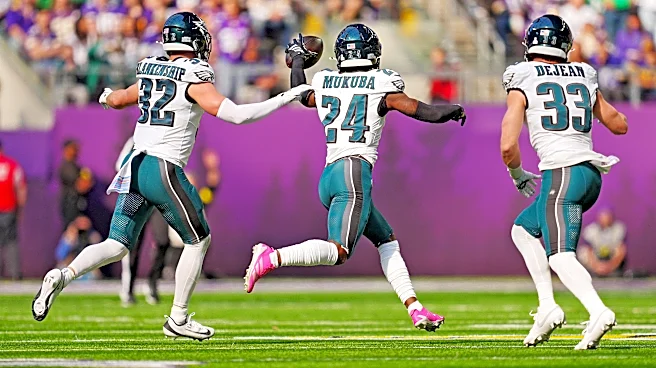
Cooper DeJean sits comfortably above both lines. Andrew Mukuba
is well below them.
Cooper DeJean remains a reliable coverage option
DeJean lands around the 60th percentile in preventing separation and the 75th percentile in on-ball grade.
Those results place him in the chart’s upper-right quadrant, reserved for defenders performing above the NFL average in both categories. DeJean has limited receivers’ ability to create space while also remaining productive when targeted.
His inclusion among the safeties reflects the hybrid nature of his role. DeJean can align in the slot, cover tight ends and receivers, handle zone responsibilities, and play safety depending on the personnel grouping.
The chart reinforces what Philadelphia has already learned about DeJean: His awareness and technique allow him to succeed without being locked into one traditional position. He understands route combinations, remains connected to receivers, and consistently competes through the catch.
That versatility becomes even more valuable when the rest of the secondary is struggling with communication and coverage discipline.
Andrew Mukuba has struggled in both categories
Mukuba sits around the 40th percentile in separation prevention and the 16th percentile in on-ball grade.
The separation number is concerning but not disastrous. Mukuba is still relatively close to the middle of the pack in his ability to stay connected to receivers. His work at the catch point represents the larger issue.
A ranking near the 16th percentile suggests Mukuba has not consistently finished coverage opportunities. Even when he is positioned to challenge a pass, the results have too often favored the receiver.
That matches what Philadelphia has experienced through three games. The Eagles have surrendered explosive plays, missed opportunities to break up passes, and failed to force a turnover. Mukuba is not solely responsible for those problems, but his place in the chart illustrates why the back end has not produced enough impact plays.
Young safeties often need time to improve their angles, route recognition, and timing at the catch point. Mukuba has the athletic ability to recover, but relying on recovery speed is not a sustainable replacement for arriving early and playing through the receiver’s hands.
What the numbers say about Philadelphia’s secondary
The chart clearly separates DeJean and Mukuba.
DeJean has been one of Philadelphia’s most dependable coverage defenders. Mukuba remains a developing safety whose struggles have contributed to the defense’s inability to finish plays.
The Eagles should not abandon Mukuba after three games, but they may need to simplify some of his assignments or give him more help against sophisticated route combinations. Philadelphia could also lean further into DeJean’s versatility when a matchup requires another dependable coverage player in the middle of the field.
The biggest concern isn't simply that Mukuba ranks below average. It is that Philadelphia has received few compensating plays from the rest of the defense. A young safety can survive occasional mistakes when the pass rush creates hurried throws and teammates generate takeaways. The Eagles have not received enough of either.
Final analysis
DeJean’s results provide Philadelphia with something solid to build around. He prevents separation at an above-average rate and performs even better when the football arrives.
Mukuba’s results require patience and adjustment. His separation grade suggests he can get into competitive positions, but the poor catch-point grade shows he is not consistently completing the assignment.
That distinction matters. Mukuba is not hopelessly lost in coverage. He often loses at the most important moment. Improving his timing, ball awareness, and physicality at the catch point would produce a significant change without requiring Philadelphia to redesign his entire role.
This article originally appeared on Eagles Wire: Eagles safeties grade in coverage reveal one strength and major concern