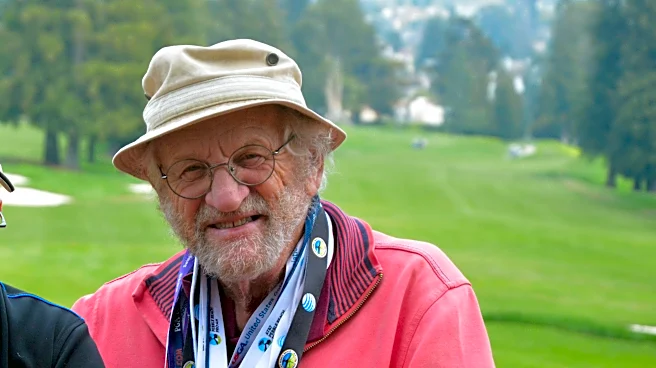







Al Barkow, the acclaimed golf writer, historian and author of Golf's Golden Grind: The History of the PGA Tour and Gettin' to the Dance Floor: An Oral History of American Golf, died Sunday. He was 93.
Barkow began his career in golf journalism in 1963 when he joined the television series Shell's Wonderful World of Golf. His first assignment was the famed "Hogan vs. Snead" match at Houston Country Club. Over the next six years, Barkow served as the show's chief writer and associate producer before eventually becoming a co-producer.
"Al led a tremendously full golf life," said Jaime Diaz, longtime contributor to Golf Digest and Golf Channel. "Al knew the game as well as any golf writer who ever lived and loved its mysteries as deeply as anyone I've
ever known. All of that, along with an invigorating stint at Second City, produced a singularly soulful body of work."

Over a career that spanned seven decades, Barkow authored 12 books and collaborated with some of the game's most respected teachers and players. His later works included Sam: The One and Only Sam Snead and The Upset: Jack Fleck's Incredible Defeat of Ben Hogan for the U.S. Open.
He also co-authored instructional books with professionals Dave Stockton, Phil Rodgers, George Low and Carl Lohren, as well as World Golf Hall of Fame members Billy Casper and Ken Venturi.
Barkow was perhaps best known for his historical works. Golf's Golden Grind became one of the definitive accounts of the PGA Tour's development, while Gettin' to the Dance Floor earned the USGA's inaugural Herbert Warren Wind Golf Book of the Year Award in 1986. "I discovered if you called him Ben instead of Mr. Hogan. he eased up a little," Barkow recalled. "Then he knew you weren't intimidated. He was a great intimidator."
In recognition of his contributions to golf journalism, Barkow received some of the profession's highest honors, including the Memorial Tournament's Journalism Honoree Award in 2003, the PGA Lifetime Achievement Award in Journalism in 2005 and the Metropolitan Golf Writers Association's Linc Werden Journalism Award in 2007.
Born in Chicago, Barkow attended Western Illinois University, where he helped the school win the 1959 NAIA national championship in golf. He later graduated from Roosevelt University. Despite making a living writing instruction articles, Barkow proved to be a skilled player himself, qualifying for the 1971 U.S. Amateur at Merion. "One of my biggest thrills," he told NCGA Golf Magazine.
"From starting out in Chicago caddying at Tam O'Shanter, to being a member of a national championship small-college team, to traveling the globe with Shell's Wonderful World of Golf, to innovative editorships at Golf Magazine and Golf Illustrated, to then writing more than a dozen exceptional books on the game, Al touched nearly every corner of golf," Diaz said.
"His Gettin' to the Dance Floor stands as golf's greatest oral history, and Golf's Golden Grind is an essential chronicle of the PGA Tour's evolution. His intimate portrayals of Hogan, Snead and Nelson were informed by long, relaxed conversations with each man, and before Shell matches, he and Gene Sarazen formed a feisty and fast-moving twosome on some of the world's great courses."
Just like Art Spander strolling into the media center at Pebble or Al Barkow still turning an instruction piece for @ncga1901. If you love what you do, you never work a day in your life.
— Adam Schupak (@AdamSchupak) April 7, 2021
Barkow moved to Oakland, California, in 2002 and spent much of the last decade contributing to NCGA Golf magazine. His stories ranged from profiles of Bay Area courses and professionals to deeply personal essays.
Among his most memorable work were stories onBlack golf pioneer Lucius Bateman, efforts that helped lead to Bateman's posthumous induction into the NCGA Hall of Fame; major champion Olin Dutra; and a moving account of his son Adam's recovery from alcoholism and the role golf played in that journey.
"As a professional journalist, I am always looking for stories to tell of events that reveal something about how the world works, how people deal with the turns life takes, how they made it turn and the outcomes," Barkow wrote.
"But that is not the case here, for the story to be told involves my son, Adam Barkow, and how golf, which has been an integral part of our lives, has played so large a role in his tale of rebirth, recovery and emancipation. It's a good story that is getting better, and I think best told by his dad."
The story ran in July and served as a reminder that even in his 90s, Barkow had lost none of the curiosity, warmth or storytelling touch that made him one of golf's most respected writers.
This article originally appeared on Golfweek: Al Barkow, award-winning golf author and historian, dies at 93