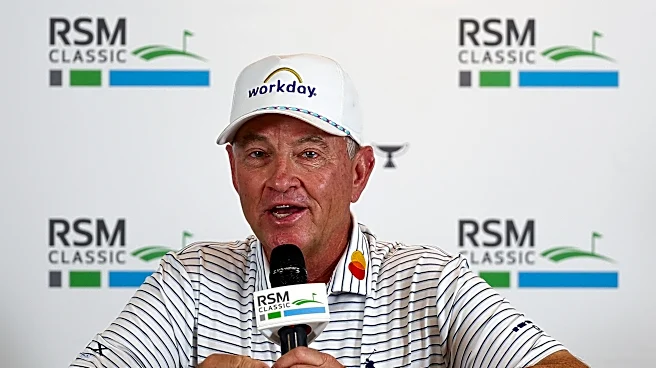



For Henry Diana, the text message arrived on a Sunday afternoon.
It was 3:48 p.m. on Aug. 9, and he stared at his phone in disbelief.
"Hey, HD," the message began. "Hope you're doing well ... I'd like to see if I can help at all with your kidney."
For months, Diana's world had been shrinking. His kidneys were failing. His energy was disappearing. The longtime PGA Tour caddie who had spent decades navigating fairways and reading greens now measured life through doctor visits, prescriptions and dialysis sessions. At 57, he didn't know what the future held.
Then came a text from a woman he barely knew.
At the donor's request, her identity is being withheld. They knew each other through golf circles but weren't close friends. A mutual friend in the small
community of St. Simons Island, Ga., where they both live and everyone seems to know each other's business, had updated her on his condition. Yet she wasn't offering sympathy, advice or financial support. She wanted to donate a kidney. Diana replied with his trademark sense of humor: "I'm hanging like a loose tooth!!"
The woman quickly answered.
"I'm 100,000 percent serious. I've been thinking about this for days. I'm committed to this ... Please let me do this for you!"
Diana sat stunned.
"I didn't know what to say," he recalled. "The selflessness of people and the love and sacrifice people would endure for you. It's just so humbling."
Today, Diana is recovering from a successful kidney transplant in Dallas. The swelling is gone. His energy is returning. The future suddenly looks bright again.
But only a few months ago, that future was anything but certain.
To Diana, the woman who sent that text will always be an angel. And hers is only one piece of a remarkable story.

Diana's long decline
For most of his life, Diana embodied durability.
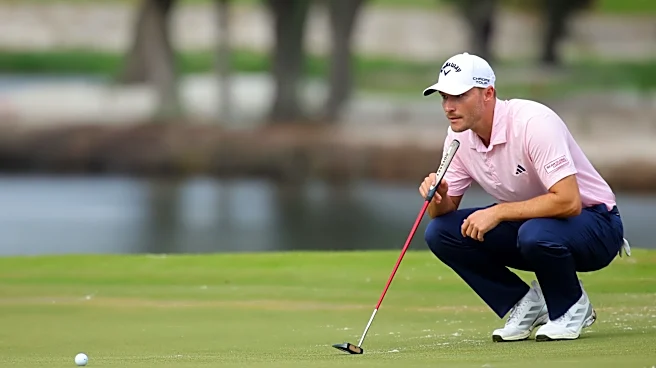
A former University of Alabama golfer and aspiring tour professional, he built a career carrying bags through blistering heat, cross-country travel and some of golf's most pressure-filled moments.
Few realized his body was quietly betraying him. The problems began in 2018. After years of searching for answers, Diana finally learned that an adverse reaction to thyroid medication had likely caused the kidney damage.
For years he managed the disease. Medication helped. Determination helped. Eventually neither was enough. When he arrived in January at the season-opening 2026 Sony Open in Hawaii, his ankles were badly swollen.
"I knew the writing was on the wall," Diana said. "I had hardly any kidney function left."
He postponed dialysis as long as possible. Then he had no choice.
"My numbers were at lethal levels," he said.
Things worsened during the AT&T Pebble Beach Pro-Am in February, when he suffered an allergic reaction to cholesterol medication that further damaged his failing kidneys. He was hospitalized, spent time in intensive care and battled severe fluid retention and exhaustion.
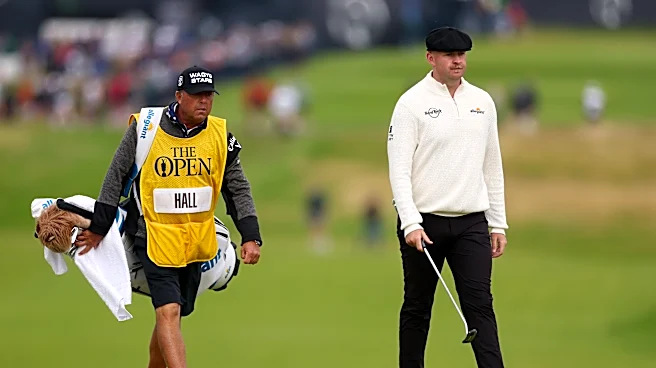
On Friday night at Pebble Beach, he called Harry Hall, the player he was caddying for.
"H, I'm at the hospital," Diana told him. "If I caddie tomorrow, I could die."
Hall was stunned.
Somehow, after undergoing dialysis that weekend and again the following week at the Cleveland Clinic during the Genesis Invitational, Diana returned to work at Hall's next start at the Arnold Palmer Invitational. Looking back, even he isn't sure how he did it.
"I was kicking the can down the road with dialysis and medicine and trying to avoid dialysis at all cost," he said.
By the time he stepped away after the Memorial Tournament in early June, his kidney function had dropped to 4 percent. His life had become a relentless cycle of treatments, fatigue and uncertainty.
Stranger steps forward with kidney donation
As Diana's health deteriorated, so did his outlook.
Then a connection led him to Dallas and Dr. Hassan Ibrahim, a nephrologist at Baylor Scott & White Medical Center in Plano, Texas. Ibrahim introduced Diana to the possibility of living kidney donation.
Normally, patients can wait years for a compatible kidney from a deceased donor. Living donors offers another path, one that often provides better long-term outcomes, but another option proved even more important: A paired kidney exchange.
The concept is simple in theory and astonishing in practice. A willing donor who isn't a compatible match can still help by donating to another recipient. In return, another donor provides a compatible kidney to the original patient. The process creates a chain that allows multiple lives to be saved simultaneously. That is exactly what happened for Diana.
Although the woman who first volunteered was not the same blood type, her willingness to donate – she is scheduled to undergo surgery on Feb. 16 to remove her kidney for another patient in need – set the exchange in motion and opened the door to a life-saving transplant.
Ultimately, another donor, Ashley Maudsley of Salt Lake City emerged as the best match for Diana's O-positive blood type. Her donation became part of a three-way kidney exchange orchestrated by Ibrahim.
Three donors. Three kidneys. Three recipients whose lives changed forever.
For Diana, the logistics almost felt secondary to the extraordinary acts of kindness that made it happen. What mattered most was that an acquaintance and a complete stranger were willing to undergo surgery to help save lives they had never known.
"She's my new hero," Diana said of the woman who first volunteered to donate. "I'm indebted to her for life. She saved my life."
The gift behind the gift
The donor's decision carried personal meaning.
A couple years ago, she lost her mother to ovarian cancer and wished there had been something she could have done to give her more time.
Helping someone else became a way to honor her mother's memory. When she informed her boss about her decision, she began with a simple sentence: "I have something I need to tell you."
Her boss immediately assumed she was resigning. Or perhaps announcing a pregnancy.
Organ donation never crossed his mind.
"I told her, I could've guessed all day, and I never would have come up with organ donation," he said.
For Diana, the gesture remains difficult to comprehend.
"When you're losing hope in life, for her to reach out to me and tell me she really wanted to help, I didn't know what to say," he said. "There was a lot more emotion that went with it than I ever thought."

A lifetime inside golf's traveling family
Long before kidney disease entered his life, Diana earned a reputation as one of golf's most respected caddies, the type capable of squeezing better play out of every player he worked for. After making 11 Korn Ferry Tour starts during his playing career, he arrived on the PGA Tour in 1999 when friend Brent Schwarzrock encouraged him to caddie while continuing his pursuit of professional golf. One year became two. Two became 26.
Along the way, Diana spent nearly nine years with Charles Howell III, celebrated victories with Tom Hoge and Stephan Jaeger, and helped Hall reach the 2025 Tour Championship.
But the accomplishments he values most have nothing to do with trophies.
"I'm most proud of just having the opportunity to work on the PGA Tour for that long," Diana said. "To have the ability to endure and enjoy that many years out there and be around what I truly love."
Veteran caddie Travis McAlister believes Diana's greatest achievement is something else entirely.
"I never once saw him put himself above anyone on or off the course," McAlister said. "He was team before self, always. His greatness was in his ability to be a good human."
Hall echoed that sentiment.
"I love the guy. He's so calm," Hall said. "We'd walk by anybody on the Tour and he'd know their first name. Pretty impressive."
McAlister described Diana as one of the best in the business at solving “the imaginary problems of very successful people who occasionally act like children.” It's a humorous description, but one that speaks to the unique role a caddie plays in professional golf — part strategist, part confidant and part counselor. Over 26 years, Diana built a family within the PGA Tour. And when he needed help, that family showed up in ways big and small. Players, fellow caddies and officials reached out with encouragement and support. Among those who went out of his way to help was Jason Gore, the former Tour pro who now serves as the Tour’s executive vice president and chief player officer, who helped connect Diana with the Cleveland Clinic, earning his praise as "a class act and a tremendous representative of the Tour."
Caddie gets a second chance
The transplant procedure lasted a little more than two hours. The results were almost immediate.
"It's night and day," Diana said.
The swelling disappeared. The bags beneath his eyes faded. His mind became clearer. His strength returned. His creatinine level, which had climbed to approximately 15 when normal levels are generally around one, began moving in the right direction. For now, Diana expects to remain in Dallas for approximately eight to 12 weeks, where his sister, Rita, serving as his caregiver, has rarely left his side, undergoing regular testing as doctors continue monitoring his progress and adjusting medications. There were challenges, too, including a reaction to one anti-rejection medication, but overall the recovery exceeded expectations. He knows the transplant is only the beginning of another long journey. Transplant recipients require lifelong care and monitoring. But after years of uncertainty, Diana finally has his life back and the future looks considerably brighter.
As for a return to professional golf, Diana isn't making any promises. For decades, he helped tour pros find their way around golf courses. When he needed help finding his own way forward, others stepped in and carried him.
An acquaintance volunteered to give away a kidney. A stranger in Utah provided the match that saved his life. And an entire golf community rallied around one of its own.
Then, thinking about the woman whose text message started it all, he returned to the same word he'd used from the beginning.
"She's an angel."
Adam Schupak is a senior writer for Golfweek, covering the PGA Tour.
This article originally appeared on Golfweek: PGA Tour caddie Henry Diana was down to 4% kidney function. Then an ‘angel’ saved his life