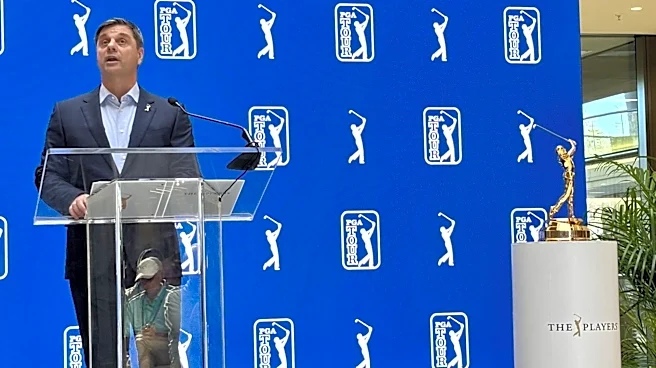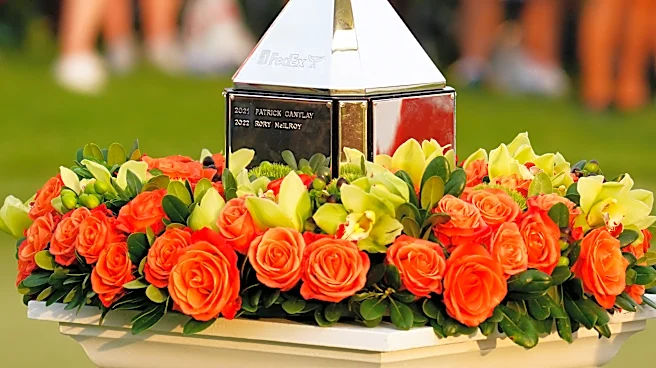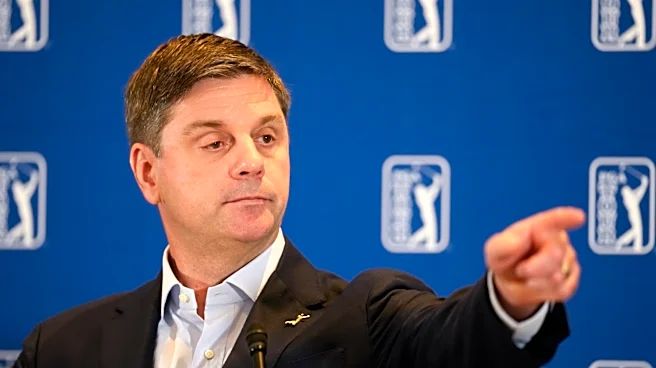

ATLANTA, Ga. — When Brian Rolapp approached the podium at East Lake Golf Club a year ago, he was still too new in his role as the PGA Tour’s CEO to articulate a specific action plan underpinning his broad ambitions. Now he’s more about particulars than philosophy, as evidenced Tuesday when he announced a new Tour Championship to replace a playoff system that, over 20 years, has gained all the traction of a Lake Placid luge, and also a root-and-branch review aimed at reimagining (without retreating on) his organization’s commitment to charity.
His no-frills, fact-focused attitude to press briefings can sometimes disguise the more subtle messaging, and he sent some signals today that were, if not exactly pointed, at least unmistakable in their
intended recipients.

Fans, for starters. The PGA Tour has long been run for its members, the operating principle often seeming to be that no player can be inconvenienced. They compete where and when they wish, and engage outside the ropes as they wish (or not). And fans? Well, they could pound sand. Rolapp’s moves suggest that the all-important end consumer of the Tour product is finally moving up the priorities list.
That’s why the playoff system is being binned after next season. Fans have always recognized what the Tour has always declined to acknowledge: that it hasn’t worked, that there was too little jeopardy, that Ponte Vedra kept a thumb on the scale to ensure preferred participants were there at the end, that events take place on too many ‘So what?’ courses in too many sweltering cities. While some fans ignored, others advocated, and they’re finally being listened to with a match play format at venues of historical stature or architectural interest. Make no mistake, this change isn’t born of player preference. If Tour members were enthusiastic about the format, the schedule would have plenty of match play, but it has none.
Rolapp also used his remarks to acknowledge another obligation the Tour has beyond paying guys lavishly for tournament performances. Charities that rely upon Tour events have lived without clarity for the past year, wondering if the imminent changes to the structure would adversely impact their dollars. They will have to live without specifics for a little longer while a review takes place, but Rolapp gave an assurance that just about amounted to a pledge to backstop outside organizations who depend upon his.
“We are not going backwards on our financial commitment. We’re trying to increase the impact,” he said. Nor was it coincidental that he named Lucas Glover as part of that review. He’s been vocal in insisting that the Tour’s charitable impact can’t be diminished in the for-profit era.
Rolapp also aimed a message at players, and not just those on his own circuit. Asked if he will resurrect the Returning Member Program — the terms by which Brooks Koepka returned to the PGA Tour from LIV Golf earlier this year — he sounded emphatic. Almost.
“No, currently there's no current plans for Returning Member Program like you saw earlier this year,” he said.
Alert listeners will have noted his use of “currently,” “current” and “like you saw earlier this year,” all inherently fungible parameters that don’t exclude a future decision to create an amended version of the program with different penalties for eligible players.
Asked if players who competed on LIV this year could be on the PGA Tour in 2027, without a year in the sin bin, Rolapp was, if not evasive, then decidedly non-committal. “We haven't made any decisions,” he said. “We've been consistent. Anyone who's interested in coming to the PGA Tour needs to demonstrate that they are relieved of their contractual commitments or any tail obligations they might have [with LIV]. Brooks certainly did that, and until then we weren't really able to consider anything seriously. I would say the same thing here.”
What he said later was aimed squarely at his own membership: “The Tour is a membership organization. It has rules … Rules matter. Rules only matter if they're enforced. So accountability and discipline are essential to any organization, and certainly for the integrity of the Tour and for the game… Those are guiding principles for us. Rules matter.”
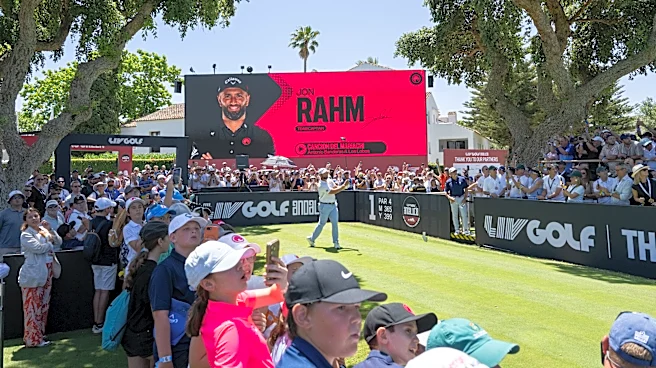
Translation: there’ll be no open borders policy for professional golf’s refugees. In emphasizing the Tour’s meritocracy, how places are earned and not gifted by contracts or YouTube views, he was sending an unambiguous signal to Bryson DeChambeau, Jon Rahm, and anyone else who’s floating on the detritus of LIV and wondering when a Rolapp life raft might appear on the horizon: It ain’t coming. Start swimming.
One last message Rolapp delivered was mostly, but not exclusively, internal. Mostly personal, but perhaps partly political. It was directed to Jay Monahan, who sat directly in front of him, the man he replaces as commissioner in January and who he already supplanted a year ago as the caller of shots.
“This may be one of the last times that I have a chance to comment on his contributions to the PGA Tour in such a public forum,” Rolapp said. “Over the past decade, Jay has guided the organization through extraordinary growth, change and challenges. During some of the most consequential moments in our sport's history, he never lost sight of what mattered most — strengthening the Tour and positioning it for its future. I want to thank Jay for his partnership, his leadership, and his commitment to ensuring a successful transition for me personally.”
“History will acknowledge what everyone in professional golf already knows, that Jay Monahan is a winner.”
It was more than a courteous nod to Monahan’s decade in charge.
It was a reminder to all those who insisted that Greg Norman would outspend him and Yasir Al-Rumayyan would outsmart him and angry players would outflank him, that Monahan is the last combatant standing, listening to his successor boast about how the PGA Tour business is more robust than ever, while the former “existential threat” and the keyboard commandoes who rode alongside are left scurrying around in the rearview.
Eamon Lynch is a columnist for Golfweek and a frequent contributor to Golf Channel.
This article originally appeared on Golfweek: Brian Rolapp sent messages to Jay Monahan and LIV players, and made very clear who won and who lost | Opinion