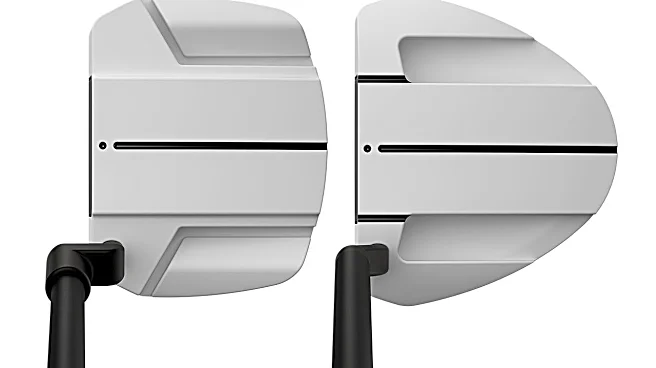







Gear: Ping Scottsdale TEC Ally Blue H, Ketsch 4 putters
Price: $435 each
Specs: Milled 6061 aluminum body, 304 stainless steel sole plate and one-piece PEBAX face insert
Who it’s for: Golfers with a slight-arc and strong-arc putting stroke who prefer high-MOI mallets and want help with alignment.
What you should know: Ping has expanded its Scottsdale TEC putter family with the Ally Blue H and Ketsch 4, giving golfers more stroke-type options within a lineup built around eye-tracking research, distinctive alignment aids and, on select models, an unusual onset shaft configuration.
The Deep Dive: When Ping introduced the Scottsdale TEC putters earlier this year, they represented a striking visual and technical departure from familiar designs such as
the Anser. The all-mallet family uses a white finish and an alignment system called Eye-Q that grew out of research conducted in the Ping Putting Lab.
Eye-Q is based on a visual technique known as Quiet Eye. Ping's researchers found that stabilizing a golfer's gaze before the stroke could improve alignment, so Scottsdale TEC putters feature a small dot on the top rail paired with a long alignment line. The dot gives golfers a specific place to focus their eyes while the line helps orient the putter toward the target.

Perhaps the most intriguing feature in the family is the onset shaft configuration offered in the line-extending Ally Blue Onset and Ketsch Onset. Instead of positioning the shaft ahead of the face, as happens with conventional offset, Ping places it behind the top rail, near the centerline of the head and in front of the center of gravity. That gives golfers an unobstructed view of the face and ball, which can make aiming easier. While the new Scottsdale TEC Ally Blue H and Ketsch 4 feature the Eye-Q alignment, both putters have offset, the tradition configuration, instead of onset.
Importantly, these are not zero-torque putters. Ping positions the center of gravity behind the shaft axis so the CG is effectively pulled through the stroke, maintaining the torque and dynamic feel needed to fit different stroke types.

The Scottsdale TEC heads combine a lightweight aluminum body with a dense stainless steel sole plate. Moving weight low and toward the perimeter raises the moment of inertia, helping the head resist twisting when contact occurs away from the center of the face.
The one-piece face insert is made from PEBAX, an elastomer often used in athletic shoes because it is lightweight, elastic and returns energy efficiently. In Scottsdale TEC, Ping uses it to create a slightly softer impact sensation while maintaining consistent ball speed and distance control.

The newly released Ally Blue H brings a conventional Anser-style hosel and full-shaft offset to the square Ally Blue shape for slight-arc strokes. The Ketsch 4 uses an Anser 4-style hosel that creates more toe hang and is designed for golfers with strong-arc strokes.
That makes Scottsdale TEC more than an experiment in alignment. For Ping fitters, the expanding family provides another set of shapes, visual cues and stroke characteristics to try with golfers who like mallet stability but have struggled to find a putter that naturally looks square to their eyes.
David Dusek is a senior writer at Golfweek covering golf equipment.
This article originally appeared on Golfweek: Ping expands Scottsdale TEC putter family with two new models