


BOCA RATON, Fla. — Ben Hogan. Sam Snead. Jimmy Demaret. Arnold Palmer.
All legends of golf, all long gone.
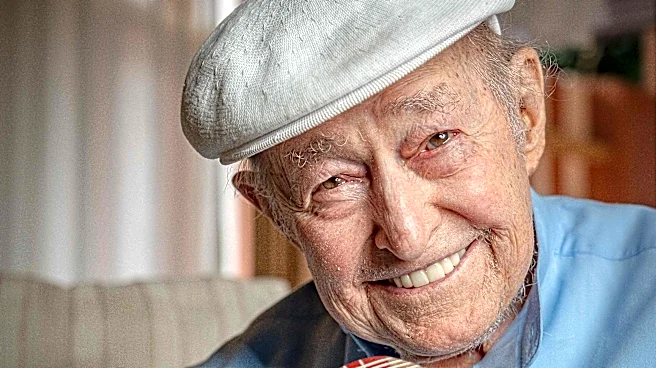
Bob Toski, who beat them all at one time or another and went on to become one of the greatest teachers the game has known, lives on. He turns 100 Sept. 18 at his home in Boca Raton.
What was America like on the day he was born, Sept. 18, 1926? Ten cents got you a cup of coffee or a loaf of bread. A movie ticket cost 50 cents and a gallon of gas 25 cents. Calvin Coolidge was president, the Roaring ’20s were in full swing and the Great Depression was still three years away.
There’s a reason the Toski name isn’t as familiar to golf fans as the legends above. Along with Bobby Jones (28) and Byron Nelson (34), he was one of three elite players to put
away his clubs by his early 30s. After his wife Lynn delivered three boys between September 1954 and April 1958, she pleaded with him to follow the example of his brothers Jack and Ben, who were teachers of the game.
Golf fans in the 1950s knew him. Toski won four times on the PGA Tour in 1954, becoming the leading money-winner with $65,820, breaking the record set by Byron Nelson in 1945 when he won 18 times, including 11 in a row.
“When I came back home to Lynn and my children, that’s what my father would have wanted me to do,” he said in a recent interview. “I was trying to control my three boys, so I came home to be a good father, to be a good husband, and I don’t regret it at all. I was always told if I stayed I would win a major, and I probably would have.”
Jack Nicklaus is among those who consider Toski a golf legend.
"I remember Bob Toski back when he won the prestigious World Championship of Golf at Tam O'Shanter in 1954. I was just a kid, and I remember that," Nicklaus said.
Nicklaus' longtime instructor Jack Grout sent him to Toski for golf lessons.
"Bob played more like I did than anybody else," Nicklaus said. "I got to know Bob even better through the years. I've always had a great relationship with him. He's been a good friend."
Bob Algustoski shortened last name to help first-tee intros
Born Bob Algustoski — he shortened it when told early in his career it made first-tee introductions too difficult — Toski grew up in a house with no indoor plumbing as one of nine children in the central Massachusetts hamlet of Haydenville. His mother died giving birth to a 10th child when he was 6, whereupon he and brother Tommy took up residence in a room above the pro shop of the nearby Northampton Country Club, where his brothers worked as assistant pros.

Jack gave the boys a pair of sawed-off clubs and they started working on chipping and putting. Bob wouldn’t graduate to a full set for nearly 10 years, giving him a short game that would always rank among the best.
Toski’s first notable tournament was the 1944 Massachusetts Schoolboy Championship, which he won. Just after he turned 18, he was drafted into the Army and sent to Burma to prepare for the Allies’ invasion of Japan. Atom bombs dropped on Hiroshima and Nagasaki persuaded the Japanese to surrender, and he made his way back home.
He was beating the local pros routinely by 1948 when Jack invited top pros Doug Ford and Ted Kroll to Northampton for an exhibition. Kroll was so impressed with Bob’s abilities that he said to Jack, “We’re going on the tour and you should let Bobby come with us.”
Kroll, Marion Marusic and Toski traveled from event to event in a Studebaker, with their clubs in the trunk and a pole across the back seat where their golf clothes hung. “You couldn’t even see me in the back seat,” Toski said.
Purses were minuscule compared to today, with first place often worth about $2,000, and Toski won only $519 in nine events on the winter tour that year. Before long, he found himself broke in a hotel in Carmel-by-the-Sea, Calif. He knew if he wrote a check for the room and it bounced he would be banned from the tour, so he called his brother Jack.
His brother suggested he call Joe Stack from Dedham, Mass., who had a business and was well off. He asked for a $1,000 loan that he would pay back. The check was waiting at Western Union an hour later.
"If it hadn’t been for people like that, I never would have made it.”
Bob Toski: 'Pound for pound' best player on PGA Tour

Toski likes to point to obstacles he overcame, such as being the son of a poor Polish immigrant. But his most crucial issue was his size: He stood 5-foot-7 and weighed 120 pounds. Yet he still could drive the ball in excess of 250 yards. Gary Player, who was the same height but 30 pounds heavier during his Hall of Fame career, has never stopped being impressed.
“Like me, Bob was small in stature,” Player said, “but I always enjoyed watching him strike the ball with tremendous power. More importantly, he understood that power alone does not win golf tournaments. The game is played in the mind and ultimately decided by the short game.”
Golf historian Jaime Diaz, a writer at large for Golf Digest who appears frequently on the Golf Channel, said he didn’t meet Toski until the famed instructor was in his 80s, but even then witnessed the joy he got out of hitting a good shot.
“Here was a guy who was so in command of what he was doing technically … the joy he got out of playing that well was just contagious,” Diaz said. “I don’t think I’ve met anyone who loved playing golf as much as Bob.”
His efforts ultimately paid off in 1953 when he won the Hartford Insurance Open on the PGA Tour and the non-sanctioned Havana Open. But it was in 1954 that he reached the pinnacle, coming from behind in suburban Chicago to win the tour’s World Championship of Golf and its unheard of first prize of $50,000.
Toski feels the way he finished - 3-under on the last four holes - that round proved beyond a doubt how well he could play under pressure.
“I was so proud of the way I finished," he said. "What I want to be recognized for is that pound for pound, I was the best player to ever compete on the PGA Tour.”
Toski’s self-confidence and ability to overcome challenges endeared him to top pros such as Hogan, Demaret and Snead, who nicknamed him “Mouse” after the cartoon character Mighty Mouse.
“He’s underrated as a talent, because he weighed 120 pounds and was still one of the longer hitters,” Diaz said. “To do that you have to have almost perfect mechanics.”
Winning the World Championship brought an offer of $50,000 more if he would spend the next year traveling the country to put on 50 clinics. He took it, perhaps unwittingly launching his career as a teacher.
“But I was teaching long before that,” he said. “When I was 10 or 11, Jack would send me out to caddy for the ladies and say, ‘Show them what you know.’ When they’d finish they’d come to him and say, ‘Give Bobby an ice cream sundae.’ ”

After his year spent doing clinics, Toski returned to the PGA Tour, playing in 14 events in 1955, 27 in 1956 and 20 in 1957. He won three lesser events in 1958 - the Massachusetts Open, Jamaica Open and Puerto Rico Open - and the Maine Open in 1959, but wife Lynn kept insisting she needed help at home. That’s when he became a teaching pro at clubs around Miami, where he and Lynn had bought a house following the birth of son Robert.
Ken Duke, Judy Rankin among golfers mentored by Bob Toski

Toski became a mentor to many young golfers over the years. Ken Duke was an assistant pro at a club in Boca Raton before he met Toski in 2004. Duke became a winner on tour, amassing more than $15 million on the PGA and Champions circuits. He said Toski was smart to walk away when he had a young family to support.
“He realized there was no money in what he was doing as a player,” Duke said. “In teaching he saw a future. It takes a really good eye; he could see you swing and analyze what’s going on.”
As his teaching reputation grew, so did his opportunities. In 1960, he was invited to join the Golf Digest staff of teaching professionals, at 33 becoming the youngest member of a group that included Snead, Cary Middlecoff and Nelson. Toski also was pointed to a book by Seymour Dunn entitled "Golf Fundamentals: Orthodoxy of Style," which became his golf bible.
By 1963, Toski was developing a reputation for working with up-and-coming women golfers such as Jane Blalock and Sally Little.
Another such woman was 19-year-old Judy Torluemke, who later became Judy Rankin. A year later, when he moved to Ocean Reef Golf Club in Key Largo, she returned and spent the next four winters with him while launching a career that would one day land her in the World Golf Hall of Fame.
“I was a pretty good player but completely unrefined,” Rankin recalled.
Other male pros would come through regularly and Toski and Rankin would join them for a round. But she said one of the most interesting characters she met was MLB Hall of Famer Ted Williams, who stayed in nearby Marathon and was an avid bonefisherman.
“It was fun to hear him and Bob talk about things like what makes power in a golf swing and what makes power in a bat,” Rankin said.
Toski sometimes played with the 6-foot-3 Williams and would routinely outdrive him, infuriating him to a point that he would smash the tee markers. The club would ban him for two weeks and then he would return.
“Bob was a very good player, and he was long and strong given his size,” Rankin said. “But I really think he would be known mostly for his ability to communicate and teach. Good, bad or indifferent, he turned his teaching method into a little bit of showtime. Some people loved that and some did not. Just his personality. He liked entertaining around golf, he really did. And he still does. Last time I saw him nothing had changed.”
In 1969, executives at Golf Digest had an idea and decided Toski was the man to implement it. John Jacobs was the first to launch golf schools in England, and they felt the time had come to give them a shot in America.
Toski set about hiring a staff that would include legends such as Jim Flick, Davis Love Jr. and Peter Kostis, who, when Toski found him, was working in the pro shop at Doral Country Club.
The schools took off and Toski remained in charge from 1970-90, working with thousands of amateurs. One of those was Takeaki (Tak) Kaneda, who ran a TV network in Japan and attended a Toski session in Hilton Head, S.C. Kaneda was so impressed with Toski's ability to communicate and analyze the swing that he invited Toski to launch a TV show in Japan, and a version of the schools soon followed.
Arnold Palmer? Bob Toski was bigger in Japan
Arnold Palmer, with his unorthodox swing and flamboyant manner, was the most popular golfer in the world at the time, but Toski became bigger in Japan.
“First of all, sensei in Japanese is teacher, and for the Japanese teacher is more important than golfer,” Toski said. “They also liked the fact that I was so small, and how far I drove the ball, that caught their attention.”
His fame grew to a point where one day he visited China to see the Great Wall with wife Lynn and they saw a group of 12 or 15 Japanese tourists coming toward him.
“I’m walking up, they’re walking down, and the leader sees my white cap and says, ‘Toski-san,’ and I said, ‘Toski-san.’ He says, ‘We have to have autographs, pictures.’ So I’m having pictures taken by the Great Wall and signing autographs and Lynn comes over and says, ‘Bob, now I’ve seen it all.’ ”
Toski’s name resonated so much that he cut a deal to launch a brand of golf clubs known as Ryobi, which were manufactured and sold in Japan from 1983-2002.
With all that, it came as no surprise that when Demaret had the idea to start what was to become the Senior (now Champions) Tour in 1980, Toski was among his first calls to help him out. The first event was held at a course Demaret had helped build, Onion Creek Golf Club in Austin, Texas.
“I didn’t qualify for the tour under their rules because I wasn’t playing, but Jimmy says, ‘Anybody who was a leading money-winner and led the year in Ryder Cup points is eligible, so I’m changing the rule.’
“He says, ‘We don’t have money to pay you because I don’t have a sponsor, but if you can put on a clinic, I’m figuring it will draw 1,000 people. So I did, and afterward he gets all the pros together and says, ‘I don’t know if I’m going to raise enough money to pay you, so if you want to go home it’s OK.’ ”
The players agreed they had come to play golf and didn’t care if they got paid or not.
Gene Sarazen had visited Northampton when Toski was 16, so when Demaret asked him who he wanted to be paired with, he picked the man widely known as “The Squire.”
Nervous as he had ever been in front of his hero on the first tee the following day, Toski hit a poor shot and was headed down the fairway when he felt Sarazen’s arm around him.
“He said, 'Bob, what do you see?' And I could see they were lined up tee to green. He says, ‘I think we’re going to get paid.’ ”
Televisions started becoming common in American households in the 1950s - Toski’s World Championship victory in 1954 was the first golf tournament televised nationally - and by 1955 they were in 65 percent of homes.
But it wasn’t until 1970 that the Hughes Television Network, owned by Howard Hughes, started airing tournaments regularly with Toski serving as analyst, working alongside longtime Green Bay Packers play-by-play announcer Ray Scott. The two worked together for nine years before Toski moved to NBC in the early '80s.
“I didn’t like the job,” he said. “You’re sitting up there and you have so much to say and so little time to say it. Ray Scott’s wife called him once and said, ‘Why don’t you use Bob more often?' ”
Bob Toski never stopped teaching
Through it all, he kept teaching. Duke met Toski at a fundraiser in 2004 when he was walking through the dining room at St. Andrew’s Golf Club in Boca Raton. Toski was holding court and Duke sat down to listen.
Duke was born with scoliosis, a curvature of the spine - in his case, to the right - and had a 16-inch metal rod inserted in his back when he was 15. As a result, he would line up left and fade the ball right, sometimes way right. After working with Toski, he became one of the straightest hitters on Tour.
Duke said he and Rankin have talked about how Toski took what they had and made it better.
“That’s what really good teachers do,” he said. “They don’t change everything. That’s the beautiful thing about him: He just wanted me to understand how to swing a club, how to hit the shots, and that’s what he did with me. I don’t think Judy knew what she was getting into and I definitely did not.”
At Toski’s 99th birthday party last year, Duke presented each of the more than 100 attendees a Titleist golf ball inscribed with the number 99. There’s no telling what he might have in store when the celebration for No. 100 comes up at a Deerfield Beach hotel Monday night.
The relationship the two have has become more like father and son than teacher and student.
“We talk on the phone, we have lunch, we have breakfast,” Duke said. “I took him to the range at the NFL Hall of Fame event (in Boca Raton) and the guys enjoyed seeing him.
“What I realized about him is there are a lot of teachers that are not players and never were players. He’s been there and done it; he’s been in the trenches, in pressure situations, and that’s what makes him even more special.”
Brian Biggane is a former Palm Beach Post sports writer who has written a book about Bob Toski.
This article originally appeared on Palm Beach Post: Golf icon Bob Toski to celebrate his 100th birthday