





Even most golf-crazed desert rats would surely agree that a day on the links sounds about as appealing as a root canal when it's 110 degrees outside.
But one blazing August day in La Quinta, California, about 10 people were happily playing on the mountain-ringed fairways that make up some of the Coachella Valley’s most iconic courses.
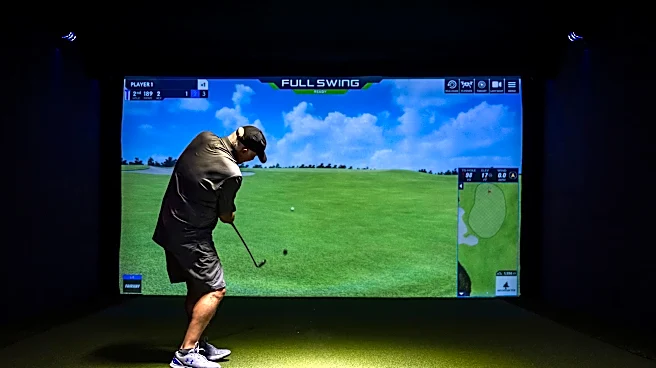
These players weren't in a real golf course, but in the air-conditioned comfort of Golf Social LQ, one of several new facilities in the area offering indoor simulated golf.
At Golf Social LQ and its brethren, groups (and solo players) book time in partially enclosed "bays" where they can choose from dozens or hundreds of computer-generated versions of famous courses to "play." That includes several whose real-world
counterparts are inaccessible to all but the most big pocketed or well-connected golfers. Pebble Beach seems to be the consensus favorite among local simulator players, although it's probably worth noting that August National Golf Club is not among the options.
“Being able to play Pebble Beach for $25 as opposed to spending $2,000 on it definitely makes a big difference,” said Golf Social LQ’s owner, Justin Jarin.
Screen golf, once the province of golf club stores and kids with a Nintendo Wii, is booming nationally, too. According to the National Golf Federation, the number of golf simulator businesses in the U.S. nearly tripled from 2022 to 2025, going from around 570 to 1,500. The federation estimated the number of simulator and screen golf players in America had grown from 3.8 million in 2015 to 8.1 million in 2024.
Given its status as something of a golf capital whose obsession with the game is tempered only by its oppressive summer weather, the Coachella Valley is a natural epicenter for simulated golf. It's gone from zero indoor golf simulator businesses to three in eight months, at a time when growth in the Coachella Valley’s large roster of outdoor golf courses has been notably stagnant.
What it's like to play golf simulators

Once a round is booked and a course is selected, its time for the game to begin. A large screen, the size one might see in a home theater, fills with impressively detailed rendering of the hole's terrain to provide a lay of the land.
You can switch to different angles, something that wouldn't be possible on a real course before ending up on the view from the tee. The first player places a real golf ball on the grass turf in the small bay and then takes their shot as they would on a real course.
And that’s when things get downright sci-fi. As you would expect, the real ball hits the screen with a thud, bounces back and the drops onto the turf. But thanks to ultramodern technowizardry — specifically, sensors that track the club as it swings and then the ball's speed, angle, spin and other factors — a digital version of the ball shown on the screen will soar through the simulated air before hopefully landing in the vicinity of the hole.

Once the ball lands, the player is inundated with a mix of data, graphics and even video footage of their club hitting the ball that are meant to offer insight into why the shot worked, or didn't, and perhaps what to do better next time.
As one local player quipped during a round, all that’s missing is a cheering crowd. But there are other sound effects, such as the splash when an errant shot hits the water.
"The technology is mindblowing," said Chuck Gullo, who opened the Coachella Valley’s first outpost of Back Nine Golf in Rancho Mirage in April.
Pointing to a mural on the wall showing the famous oceanside 7th hole at Pebble Beach and then to the same hole on one of the simulators' screens, he said: "Look at that, I mean the waves, it's so realistic when they are playing in here."

Complement, not competition to real golf
While the business owners and players are understandably proud of their games verisimilitude, the differences from “real golf” might be just as central to the simulators' appeal. Namely, these games don’t require long, sweaty walks or cart rides between holes, and a round won’t ever be cut short by a monsoonal downpour or a pesky gust of desert dust.
“Originally I joined because I didn’t want to play when it was 115 degrees,” said Back Nine Rancho Mirage member Troy Van Sloten. “But it saves a lot of time. … Nobody’s chasing me, I’m not chasing anybody. It’s not a hassle at all.”
On the contrary, it’s all so seamless, comfortable and technologically impressive that one might reasonably wonder if a game of virtual golf might make the real thing feel obsolete.
But Gullo says that’s not the right way to think about simulator golf.
“We want to enhance the game, not eliminate the outdoor golf courses,” Gallo said.
A lot of Back Nine’s appeal, he added, comes from it being a place where players can practice between in-person rounds while taking advantage of what the tech can teach them about their game.
“If you’re on the driving range and you hit a bad shot, you don’t know why,” he said. “You hit it here, you can see the club, the video, you see everything. So you can correct it immediately here and then bring it out onto the golf course.”
The relative speed of a simulated game is also a draw: A player can finish a round on a simulator in around an hour, compared to perhaps three to four hours on a real course. So is the relative affordability: An hour of simulated golf runs about $25 to $65 in the valley, and it can be hard to play a round for less than $100 here during the high season — with some of the most famous courses charging much more than that).

But even as they cater to devoted golfers, the simulator owners say they can also draw new players and provide an appealing way to try out golf for the first time.
Jarin said he designed Golf Social LQ specifically to create a space that would be comfortable for golfers to bring along family and friends to play for the first time.
The atmosphere is akin to a high-end lounge with couches, TVs tuned to sports, speakers playing tunes from the likes of Morgan Wallen, a room with board games and complimentary snacks.
Jarin said he sees a lot of people coming to Golf Social on date nights, which is not something that often happens at a typical course unless both partners are already big into golf.
“You’re not going to pay $150 for your girlfriend to come with you to sit in the cart and typically for her not to be very entertained,” Jarin said. “Here they can sit on the couch, they can scroll, they can watch the TV, they can enjoy and they feel comfortable in the atmosphere.”
Jarin said his business’ name speaks to his view that indoor golf is also more conducive to group socializing than the outdoor game. It's impractical for large groups to play together on a real course, but Golf Social LQ allows up to eight people per bay. Larger groups can reserve two bays next to each other.
Gullo, meanwhile, says his facility has proven particularly popular with physicians from the nearby Eisenhower Medical Center, whose staff members account for about 20% of Back Nine’s current members. He said people who work unusual hours love the fact they can golf at any time.
Bar fare, golf pro among varied amenities facilities offer
While the local simulator centers businesses all have the same core experience, they differ in the type of technology, the amenities and the vibe.
As its name suggests, La Quinta’s Golf Bar offers a bar vibe where customers can sip cocktails and nosh on chicken bacon ranch sliders, a garlic herb quinoa bowl and other elevated bar offerings between swings. If they get tired of golf, they can switch to kicking field goals or throwing dodgeballs at simulated zombies, as the simulators offer around a dozen non-golf virtual games.

But Jarin said Golf Social LQ, which is located just across Highway 111 from The Golf Bar, is all golf all the time. It's meant to appeal to serious golfers, with Trackman simulators that are used on the PGA Tour and which he said provide “one of the more high-end systems you can get.”
Some nine miles west in Rancho Mirage, Gullo says Back Nine is the first facility in the country to have four 18-foot simulator screens. The location also has a PGA Master golf pro on staff, who offers tips to golfers and can be booked for private lessons. There's also a separate area with a private bay and room for 15 to 18 people that's marketed to companies for presentations and team building. After their games, players there can even relax in a high-end massage chair.

All three of the facilities offer memberships as well as walk-in golf, although the costs and benefits vary considerably.
Hotels and golf courses have also been getting into the act. Both Cathedral City’s Doubletree Golf Resort and Indian Wells’ Renaissance Esmerelda Resort & Spa have added Top Golf-branded Swing Suite simulators at their properties. And when the Bunker Bar at PGA West reopened after a renovation in 2023, two Trackman simulators were among the new offerings.Despite the industry’s rapid growth, business owners see demand for even more simulated golf options in the valley. Gullo said he may open more Back Nine locations soon.

Jarin, meanwhile, said real estate developers with buildings in Palm Desert and Indio have already reached out to him about bringing the Golf Social concept there, although he said he's focused on his La Quinta location for now.
“Now it’s become so popular, people can’t get enough of golf, honestly…,” he said. “I get people that work at the golf courses coming in right after they get off work or someone just finished 18 and they want to play some more, but they don't want to pay a premium. They're like, 'Let's go play some more golf indoors.'”
Paul Albani-Burgio covers growth, development and business in the Coachella Valley. Email him at paul.albani-burgio@desertsun.com.
This article originally appeared on Palm Springs Desert Sun: Golf simulators are booming in this California desert locale