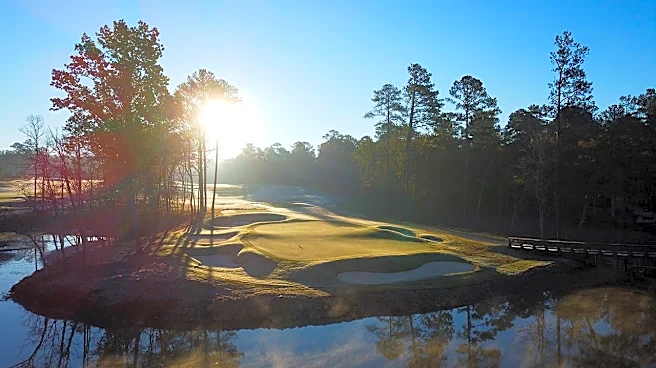








GREENSBORO, Georgia – Reynolds Lake Oconee already was home to several of the best courses in the Peach State. Four of the massive lakefront development’s existing seven layouts ranked among the top 15 public-access courses in Georgia, while two on-property private layouts augmented the member experience for residents.
So how does an architect go about differentiating a new, eighth course at Reynolds? Steve Smyers opted to take what the rolling ground gave him, focusing on the most interesting sections and throwing in a fresh look with the bunkers while ensuring this newest course at Reynolds is no pushover even for gifted players.
Welcome to the private Fenmoor Golf Club, which offers a gracious sampling of what has made golf at Reynolds so inviting,
even if part of this invitation involves sometimes serious demands of a golfer.

That’s fitting, as it’s easy to expect Fenmoor to attract serious golfers, such as the architect himself. Smyers played collegiate golf at the University of Florida in the 1970s and has competed in USGA championships over the span of six decades. Now a veteran architect with more than 60 projects completed around the world, Smyers loves to chat about challenging players, both physically and mentally. After an early preview round of Fenmoor in November 2026, Smyers acknowledged with a grin that he doesn’t mind building a difficult golf course.
“Well, I'm accused of doing that all the time,” the silver-haired Smyers said with a laugh while sitting next to a firepit at Fenmoor’s luxurious practice facility. “And that's mainly because that's what my customers want.”
At Fenmoor, part of the “want” was a course to host championships, be that Georgia State Amateurs or possibly U.S. Golf Association events down the road. To that extent, Smyers – who served on the USGA Executive Committee from 2006 to 2011 and was the ruling body’s executive treasurer in 2011 – utilized plenty of player data in the design of Fenmoor. Fairway bunkers were placed to challenge elite players, curves in fairways were established to encourage shotmaking off the tee, and various sections of most greens were tucked tight to trouble to make elite players think about the risks versus the rewards of attacking tucked flagsticks.
“Why not build a golf course like that?” Smyers asked. “And so, that was the thought process. You know, golf is played by millions of people, and it's enjoyed by millions. Very few of those people really understand the game’s management skills. So while we want to design for the masses, we also want to build a golf course so the people who really understand game-management skills will be stimulated by it. And we want very much to identify one's strengths and expose their weaknesses, both physical and mental. …
“Jack Nicklaus once told me the toughest discipline in golf is to shoot away from your target. But disciplined golf is also the most stimulating, so we’ve provided such situations throughout Fenmoor. I’ve taken to calling it ‘thoughtful golf,’ and I’m proud to say that you will become a better golfer by playing this course. You’ll learn that to play better, you must think better.”

Most of the greens feature open, bouncing-up approach opportunities to parts of the putting surfaces, which allows average players to get around. Other sections of the greens require lofted approaches and plenty of spin control. It’s up to each player to decide how much risk to take on when approaching any given hole location.
The greens feature plenty of interesting run-offs and internal contours, large ridges sometimes separating various sections of the greens. These putting surfaces are never boring without overextending the boundaries of fairness.
Buried within many of Fenmoor’s greens, though, are a superb challenge: sections that fall gently away to the back. Not just roll-offs at the perimeter, but entire swaths of green rolling away, demanding an extra dose of control and spin for a ball to remain on the putting surface. The back fringes and collars at Fenmoor will be popular gathering spots.
Smyers wasn’t afraid to include such riddles to challenge all levels of players to control the weight of an approach shot, especially when that approach happens to be struck from light rough. Even powerful players with plenty of control and height on their shots must carefully consider the bounce and roll of the ball when navigating these rearward tilts.
“You have to be able to control your spin,” Smyers said. “That’s such an important part of the game. That's part of studying the golf course and then understanding the lie that you put yourself in.
“That's all part of the process, understanding the lie that you have, understanding where the hole location is, understanding the green and processing all that. Then you say, ‘OK, where's my target? What type of shot do I want to hit?’ You have to study the course and be able to identify your shot and move from there, then control your spin going into a green like that, that moves away from you.”
With the back tees playing to 7,776 yards long, the data-driven placement of hazards and the possibly nefarious rearward facing slopes on some greens, it might sound like too much. It’s not. This course was envisioned to somewhat protect par in elite competitions, but there’s plenty to recommend it even for casual golfers.

As with all the courses at Reynolds, the terrain would be perfect for a lakeside park. Fenmoor was constructed along Richland Creek, which feeds into the massive and nearby Lake Oconee. Half of Fenmoor’s 18 holes are in contact with the water, playing alongside or over the creek and its tributaries. Smyers uses the term “power point” to describe defining features of a property such as this creek, and he said he was drawn to the water in much the same way a day-hiker would be on a walking tour of the property.
From its lowest elevations along the water, Fenmoor climbs hundreds of feet into forested areas, with the front nine rising to the east of the creek and the back nine climbing mostly to its west. The lifts are not laborious, and they add to the sense of place while offering extra challenge for players. It’s a beautiful property that should become even more so as the course ages, the layers of native grasses and elevated views toward the water offering the impression of a giant, private garden.
The layout itself is core golf. Residences will be constructed adjacent to Fenmoor, but plans do not include lining fairways with homes. Unlike several other layouts at Reynolds, where holes often play through their own corridors, Fenmoor frequently offers views across multiple holes without interruption, especially near the creek.
Another standout feature of Fenmoor is the bunkers, which are very different than the sometimes tall, flashed-face traps of other Reynolds layouts. Smyers instead built flat-bottomed bunkers cut into the hillsides, their sometimes steep, grassed faces rising at the far sides – think of them as Smyers' take on classic designs by Seth Raynor or even the team of William Langford and Theodore Moreau.
“I thought, very much so, that the style bunkers that we have here fit the site better than the flash-top sand,” Smyers said. “Of course, you read the landscape and read the strategy of the hole, and you try to make them fit. I try to give it that seamless transition from golf hole to golf hole, and to the environment.”

The undulating fairways and corridors are generally wide without being excessive, with a mix of hardwoods and pines at their perimeters. It’s not impossible to lose a golf ball with a truly wayward shot, but even for most recreational players there’s ample room all the way up to those challenging putting surfaces, where Smyers’ intent comes much more into focus.
Construction of Fenmoor wrapped up over the summer of 2026, and the course’s grow-in has been superb. The playing surfaces were nearly perfected during early preview play in November. The tees and fairways were covered with Zeon Zoysia, while the roughs are TiffTuf Bermudagrass that will be kept at relatively lower heights – equivalent to half the height of a golf ball – to encourage playability for the masses while challenging spin control for elite players who might encounter flyers. The putting surfaces are TifEagle Bermuda, which can handle Georgia’s heat in the summer. Zoysia also was used around the bunkers. Prime conditions can be expected when the course fully opens to members, along with its dedicated clubhouse, in the spring of 2027.
Fenmoor also includes an elite practice experience. Trackman Range technology was built in, with every shot being measured and that data relayed to screens behind each player. There are hitting bays with artificial turf as well as a large grassed tee, but to make sure practice never becomes too serious, there are comfortable seating areas built behind the covered bays. An extensive short-game practice area is nearby. Range rats should love this facility.
Built as a standalone and elevated private club within the bounds of the 12,000-acre Reynolds Lake Oconee, Fenmoor serves up a familiar taste of the entire upscale development while offering plenty of its own flavor, too, with those greens providing the most spice. In requiring a carefully considered approach to the risks and rewards, Smyers did his part by giving players plenty to chew on.
Jason Lusk is Golfweek's travel and golf course architecture editor, as well as the print magazine's creative director. He has written for and designed Golfweek for more than two decades.
This article originally appeared on Golfweek: New private course adds fresh spice to Georgia destination