
The PGA Tour approved on Monday the final recommendations of its Future Competition Committee, paving the way for a revamped developmental system designed to create a clearer, more competitive pathway for emerging players to reach the sport’s highest level.
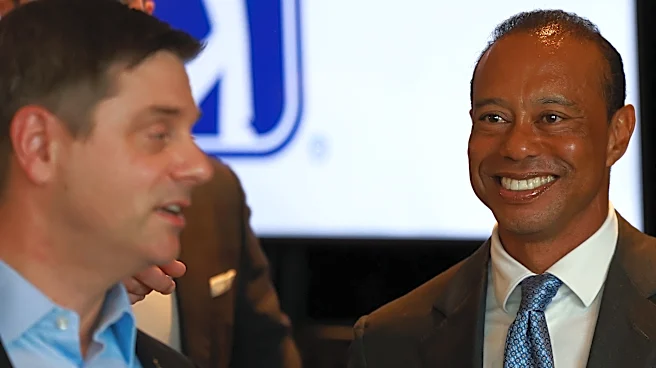
The announcement follows 18 months of work by the committee, chaired by Tiger Woods, to reshape the Tour’s competitive model and strengthen its long-term future.
At the center of the changes is a more connected, merit-based developmental structure that will bring together the Korn Ferry Tour, PGA Tour University, qualifying tournaments and a new network of affiliated events under a unified priority ranking system.
The Korn Ferry Tour will remain the primary pathway to the PGA Tour, annually
promoting its top 20 players to the PGA Tour Challenger Series. Beginning in 2029, a new performance-based ranking will place players throughout the developmental system on a single list, with playing opportunities determined by results in PGA Tour-sanctioned events.
Tour CEO Brian Rolapp said the changes are designed to provide emerging players with a more direct route to professional golf's highest level.
“By creating a more connected, merit-based developmental system, there is a clear and open path for emerging talent to pursue their dreams,” Rolapp said.
The revamped Korn Ferry Tour will feature a minimum of 20 events annually, generally running from March through September. Events will consist of 72 holes of stroke play, a 36-hole cut to the top 65 and ties, fields of 144 players and $1 million purses.
Another significant change involves PGA Tour University. Beginning in 2028, players ranked Nos. 6-25 in the PGA Tour University Ranking will earn Korn Ferry Tour membership for the remainder of the current season following the NCAA Championship and the entirety of the following season.
The Tour will also introduce affiliated events throughout the year, partnering with third-party operators to provide additional playing opportunities for non-member professionals. Strong performances in those events will be recognized through the unified priority ranking, allowing players to advance regardless of when they emerge during the season.
The new structure also includes an elevated season-ending event for the PGA Tour Challenger Series. The top 90 players on its points list will qualify, and the tournament winner will earn promotion to the PGA Tour Championship Series for the following season, regardless of their final position on the points list.
The Boards also approved a consistent points distribution model across the PGA Tour Championship Series, Challenger Series, Korn Ferry Tour and the new last-chance series. The system will place significant value on victories and high finishes, with the winner earning 300 points compared to 200 for second place and 150 for third.
Woods, who chaired the Future Competition Committee, believes the changes position the Tour for long-term success.
“Having been on this Tour for almost 30 years, I can confidently say the PGA Tour is in the best position it has ever been,” Woods said. “We set out last year to build the strongest possible version of the PGA Tour, and by listening to our fans, players and partners, we created a competitive model grounded in meritocracy, built to last and that offers the best opportunity for the next generation of players.”
The committee was established in August 2025 and initially unveiled its recommendations for the Tour's new competitive model in June. Those proposals focused on bringing top players together more consistently, implementing true promotion and relegation, and introducing match play during the postseason.
Membership criteria, eligibility and transition-year performance benefits were subsequently announced in September. Monday's approval also included transition-year eligibility provisions for the 2028 season, outstanding Challenger Series eligibility matters and several membership and governance changes.
The PGA Tour will operate with two primary competitive divisions: the PGA Tour Championship Series and the PGA Tour Challenger Series. Players will earn voting membership by competing in 15 events within their respective series. Members of both divisions will also be eligible for the PGA Tour Cuts Plan, while health subsidies and other benefits will extend to members of the Korn Ferry Tour.
The Player Advisory Council will also expand to include representatives from both divisions. The 16-player council will be made up of members on both the PGA Tour Championship Series and PGA Tour Challenger Series, with a combination of elected and appointed members. More information, including the composition of the PAC, will be announced at a later date.

Leadership changes coming in 2027
Alongside the competitive changes, the Board meeting in Boca Raton, Florida, marked the final meeting for several board members, with leadership transitions scheduled to take effect January 1, 2027.
With Jay Monahan's tenure as commissioner concluding, Rolapp will officially begin his appointment as PGA Tour Commissioner and assume the board seats previously held by Monahan.
PAC Chairman Lucas Glover will also join the board, while Adam Scott will transition into the position previously held by Patrick Cantlay, whose term is concluding.
Rolapp thanked both Monahan and Cantlay for their contributions during a significant period of change for the organization.
He credited Cantlay for representing the membership with care and attention to detail, while recognizing Monahan's leadership during what he described as some of the most consequential moments in the sport's history.
With the Future Competition Committee's work now complete, additional competitive decisions will move through the Tour's traditional governance process and the Player Advisory Council.
The PGA Tour also reiterated that it will reveal the complete schedule of dates and venues for the 2028 PGA Tour Championship Series, including the location of the 2028 Tour Championship, on February 22, 2027. The announcement will be made during a live broadcast from PGA Tour headquarters in Ponte Vedra Beach, Florida, produced by PGA Tour Studios and airing on Golf Channel.
The approved changes represent a significant step toward the Tour's next era, with an emphasis on creating a more connected competitive structure, rewarding performance and establishing a clearer path for the next generation of professional golfers.
Adam Schupak is a senior writer for Golfweek, covering the PGA Tour.
This article originally appeared on Golfweek: Tiger Woods-led PGA Tour path overhaul is official. Here are the biggest changes