



When you consider all the advantages mallet-style putters have over traditional heel-toe weighted blades, it’s easy to understand why so many pros and recreational golfers have put their Ansers, Newports, #1s and BB1s in the closet and bought Spiders, TRTLs, Phantoms, and Ally Blues.
In the hands of a player who practices his putting for several hours a week, a well-fit blade can deliver precision and touch on the greens, but its size and shape have limitations. Mallets, by contrast, offer sensible solutions for elite golfers and recreational players. They’re not better than blades for everyone, but they do offer a variety of solutions to many putting problems that confound blade players, and that makes them a solid choice for most recreational golfers.
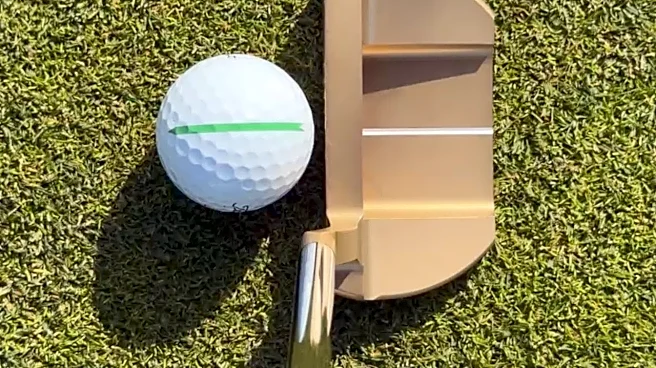
The most obvious edge that mallets have is their size creates space for alignment features that would be impossible to fit on a traditional blade. Designers can use long lines, contrasting rails, dots, wings and shapes that frame the ball. The goal of these features is to make it easier to point the face where you want your putt to start rolling, and to keep your eyes focused on that starting line.
Scottie Scheffler and Rory McIlroy, who both used blade putters for years before switching to TaylorMade Spider putters, both side a big reason for their transition into a mallet was the Spider made it easier for them to aim.
A mallet’s footprint also gives engineers more freedom to shift more mass outside the middle of the head and toward the perimeter. This raises its moment of inertia, or MOI, and makes the putter head resist twisting when impact occurs outside the center.
Pros occasionally mis-hit putters. Recreational golfers do it more frequently. So, when a putter twists less on a heel or toe strike, and can protect more of a putt’s direction and ball speed, that margin for error can make a huge difference to recreational players don’t practice very often. It does not erase a poor stroke or guarantee a better result, and a larger head alone does not make every mallet more stable than every blade, but mallets typically are more stable than blades, and that’s a good thing.
Then there’s feel. The head’s shape does not dictate whether a putter feels soft or firm at impact. Mallets, like blades, can feature a milled steel hitting area, a polymer or urethane insert, or other combinations of materials, grooves and face patterns. Those choices affect sound, feedback and how the ball comes off the face. Two putters with similar shapes can feel completely different, and two golfers can describe the same impact in different ways.
That range and variety is useful in fittings. If a face feels too soft or muted, a firmer material or milling pattern may give you more feedback. If impact sounds harsh or the ball feels too lively, a different insert or construction may suit you better. The goal is not to find the softest or firmest putter; It is to find a response that helps you judge pace and speed, especially on longer putts.
And then there is zero torque.
Yes, there are a handful of blades that are designed to reduce face rotation as you make your putting stroke, but the category is dominated by mallet designs. For some players, zero-torque mallets can make it easier to repeat the motion without consciously manipulating the face, and as unique as a putter with onset can be to some players, a center-shafted putter with onset looks even more odd. An onset mallet, however, can look slightly more conventional.
A mallet’s larger shape can provide useful design advantages, but the right one is the putter that fits your eye, your stroke and the way you want the ball to roll. Working with a good custom fitter can help you find your ideal mallet putter, but if you are determined to find it yourself, start with the look that helps you aim. Then test whether the putter stays stable on your typical miss and whether its feel helps you control distance. Roll short putts to check your start line, then try longer putts where pace matters more.
The models below show how much variety now exists within the mallet category, from compact shapes to larger heads, from different face feels to zero-torque designs.
Bettinardi Queen B #17, $499.99

Who it’s for: Golfers wanting a traditional look, compact-mallet stability and firmer feel.
What you need to know: The Queen B 17 pairs a compact mallet footprint with a short slant neck hosel to produce toe hang for golfers with a modest arc. Its 303 stainless-steel head has a French Gold finish and Macro Honeycomb face milling produce a firm response and clear feedback. Read the full review.
Shop Bettinardi Queen B #17 putter
L.A.B. Golf MEZZ.2i, $499 stock; custom models start at $599

Who it’s for: Golfers seeking zero torque in a fanged mallet with extensive visual and fitting customization.
What you need to know: Its aluminum body pairs with a deep, fly-milled 303 stainless steel face insert, while lie angle balance reduces rotation in your stroke. Expanded alignment choices, revised sole geometry and two ball pickup features update the familiar MEZZ shape. Read the full review.
Shop L.A.B. MEZZ.2i putter
Odyssey TRTL, $349.99

Who it’s for: Golfers who want a bold alignment guide, adjustable weighting, and better speed retention on mishits.
What you need to know: Four adjustable sole weights let fitters move mass heel-to-toe or front-to-back, while Odyssey’s Ai Star insert pairs an aluminum backing with a urethane hitting surface designed to preserve ball speed on off-center contact. Read the full review.
Shop Odyssey TRTL putter
Ping Scottsdale TEC Ally Blue Onset, $435

Who it’s for: Golfers who want more help aiming, a clear view of the ball, and mallet stability.
What you need to know: The white finish pops on the putting surface and Ping’s Eye Q pairs a focal dot on the top rail with a long alignment line to improve your alignment. The onset shaft position leaves the ball unobstructed at address. Read the full review.
Shop Ping Socttsdale putter
PXG Torpedo ZT, $449.99

Who it’s for: Players seeking low-torque face control with a compact mallet and adjustable head weighting.
What you need to know: The Torpedo ZT retains a familiar mallet shape but places its shaft axis through the center of gravity to reduce torque. Two interchangeable sole weights in the front area let fitters tune head weight between 357 and 392 grams. Read the full review.
Shop PXG Torpedo ZT putter
Scotty Cameron Phantom 12, $499

Who it’s for: Moderate-arc golfers seeking a rounded mallet, toe flow, and a softer carbon-steel feel.
What you need to know: The single-bend shaft creates face balance, making the Phantom 12 ideal for golfers with a relatively-straight putting stroke, while the full-face chain link patter in the milled aluminum face softens sound and feel. This is the high-MOI and most stable putter in Scotty Cameron's Phantom line. Read the full review.
Shop Scotty Cameron Phantom 12 putter
TaylorMade Spider ZT Max, $449.99

Who it’s for: Golfers wanting a familiar Spider shape and roll with less face rotation through impact.
What you need to know: The multi-material head combines a grooved face insert that promotes roll with an aluminum rear section and TaylorMade’s True Path alignment system. Larger and more stable than the original Spider ZT, the shaft enters this high-MOI head over the center of gravity, so the Spider ZT Max reduces face rotation as you make your stroke. Read the full review.
Shop TaylorMade Spider ZT Max putter
Wilson Infinite Zero Torque The 606, $199.99

Who it’s for: Golfers seeking zero-torque stability in a compact mallet with alignment lines that frame the ball.
What you need to know: The 606 uses metal-injection-molded construction, a double-milled face and a shaft axis aligned through the center of gravity. Two alignment lines and a dot provide a more structured aiming picture than the cleaner Lakeview. Read the full review.
Shop Wilson Infinite Zero Torque putter
David Dusek is a senior Golfweek writer covering golf equipment and technology. Follow him on Instagram (@daviddusek) and X (Golfweek_Dusek).
This article originally appeared on Golfweek: How to find a mallet putter that fits your stroke
Our editors independently choose our recommendations. Some content is produced with paid support from a third party, however our editorial decisions remain independent. If you buy through our links, the USA TODAY Network may earn a commission. Prices and availability may change.