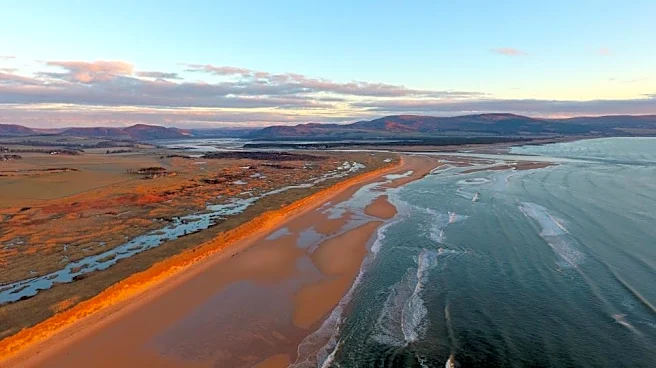









Scottish ministers have again rejected plans to build an 18-hole golf course at Coul Links, dealing what could be the final blow to a decades-long effort to develop one of the most coveted and controversial golf sites in the Highlands.
The proposed course near Dornoch, about 45 miles north of Inverness, had received planning permission from Highland Council in 2023, despite the land being part of a Site of Special Scientific Interest. Scottish ministers called in the decision the following year and have now rejected the application on ecological grounds.
It is the second time the Scottish government has refused plans for a golf course at Coul Links. A previous proposal involving developer Mike Keiser and architects Bill Coore and Ben Crenshaw
was rejected in 2020 after ministers concluded that the potential damage to the site's natural heritage outweighed the project's economic benefits.
This time, the group behind the project suggested there may not be a third attempt.
“The ministers’ decision to reject our application for planning permission is a real blow for our area’s economy and its unique environment and a slap in the face for local democracy,” Communities for Coul director Gordon Sutherland said.
Sutherland said the course would have created jobs and economic benefits for East Sutherland while helping restore and protect the Coul Links site.
“We do not envisage that this opportunity will present itself again,” he said.
Environmental groups that had fought the latest proposal welcomed the decision.
“We are relieved and uplifted at today’s decision by ministers which recognises the incredible importance of Coul Links, a view shared by thousands of people across the UK,” RSPB Scotland director Duncan Orr-Ewing said. “It is a very special place for nature and allowing this development would have damaged it beyond repair.”
The arguments are remarkably similar to those that surrounded Coul Links six years ago.
Keiser, the developer behind Bandon Dunes Golf Resort in Oregon and other destination golf projects, had teamed with entrepreneur Todd Warnock, landowner Edward Abel Smith and the Embo Trust on plans for a course less than two miles north of Royal Dornoch.
Coore and Crenshaw were enlisted to design the seaside layout on dunes in Embo, with plans submitted in 2017 after two years of work. The design was altered in an effort to reduce its environmental impact on the Loch Fleet Site of Special Scientific Interest.
The proposal had considerable support within the local golf community. Clubs including Royal Dornoch, Brora, Golspie, Tain, Skibo, Wick, Bonar Bridge and Fortrose & Rosemarkie backed the project. Highland councilors also approved it before Scottish ministers intervened.

But in February 2020, ministers denied planning permission, determining that the likely damage to the area's natural heritage was not outweighed by the project's economic benefits.
Keiser said at the time he would move on rather than continue fighting the decision.
“I’m moving on. I have so many other projects,” Keiser told Golfweek then. “God bless Dornoch.”
For Keiser, the frustration was that the very qualities that made Coul Links attractive as a golf site also made developing it extraordinarily difficult.
“The old links courses like Ballybunion and Dornoch couldn’t get approval today,” Keiser said at the time. “The best sites are dunes and they have been characterized as extremely sensitive and environmentally untouchable.”
Keiser said Coore considered Coul Links the best site they examined, but acknowledged it also may have been the most difficult place to attempt to build.
“The best site according to Bill, and we agreed, was Coul Links,” Keiser said. “It was the best site and the worst choice we could’ve made if we wanted to build any golf course.”
The latest proposal came from a different development group, but it ultimately met the same fate.
Scottish Wildlife Trust chief executive Jo Pike said the second rejection should reinforce the importance of environmental protections governing sensitive land.
“We’re pleased that Scottish Government ministers have listened to the public inquiry’s recommendation, and to the thousands of people who spoke up for nature at Coul Links,” Pike said.
For supporters, the decision ends another opportunity to create a potentially significant new links course in the shadow of Royal Dornoch. For opponents, it is confirmation that Coul Links is simply too environmentally sensitive to develop.
And after two proposals, two public inquiries and two rejections from Scottish ministers, Sutherland's comments suggest the long-running effort to build a golf course there finally may be over.
This article originally appeared on Golfweek: After years of debate, controversial Keiser golf course rejected again