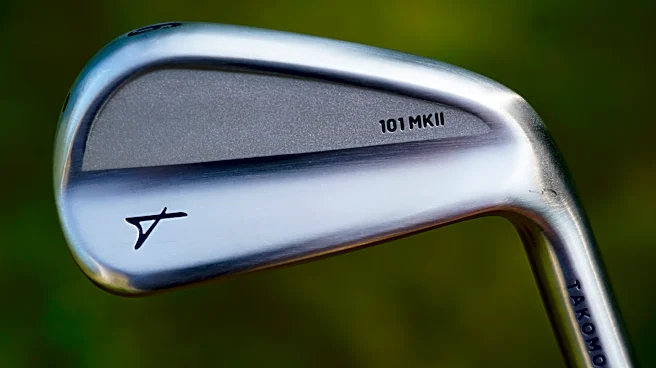


Gear: Takomo 101 MKII, 201 MKII and 201T MKII irons
Price: $579 (101 MKII, 5-GW), $649 (201 MKII, 4-PW), $679 (201T MKII, 4-PW)
Specs: Hollow-body construction with progressive weighting and variable-face-thickness technology. The 201T MKII has tungsten weighting in the 4-iron through 7-iron.
Who they’re for: The 101 MKII is designed for 15- to 30-handicap golfers who want distance and forgiveness. The 201 MKII is a players-distance iron for 5- to 15-handicap golfers who want more ball speed without sacrificing control, and the 201T MKII is for low-handicap golfers who prioritize precision, control and feedback but still want some hollow-body speed.
What you should know: Takomo has updated its hollow-body iron family with three models for 2026 that
progressively transition from game-improvement clubs (101 MKII) to speed-enhancing clubs for experienced players (201 MKII) to compact, feel-oriented irons that reward a repeatable swing (201T MKII).
The Deep Dive: After writing about golf equipment for roughly 20 years, I have seen a few miracles happen in fitting bays.
I have watched golfers gain distance without swinging faster, tighten dispersion patterns they thought were permanently wide and discover that the iron they assumed they needed was not remotely the best club for them. A good fitter and a launch monitor have a way of making guesses disappear and great results occasionally emerge from unlikely places.
That is why my first reaction to buying golf equipment from direct-to-consumer (DTC) brands without hitting it is simple: Buyer beware.
It is one thing to order a dozen golf balls, buy a pair of shoes or pick up a training aid after seeing it on social media. It is another to spend $600, $700 or more on irons you have never hit. That has made me cautious about Takomo and other DTC brands. The prices can be enticing, but lower cost does not automatically make a club a good fit.
With the new 101 MKII, 201 MKII and 201T MKII, however, Takomo, which is based in Finland, has created a clearly defined three-iron family that should make it easier for golfers to identify which model deserves their attention.
All three have hollow-body constructions and clean, understated cosmetics. From there, the designs progress from maximum assistance to greater precision and feedback.
Think of them as three vehicles built by the same luxury car company, so they share some technologies, but are made to perform differently.
Takomo 101 MKII

The 101 MKII is the luxury SUV. It is easy to drive, has plenty of power and is designed to deliver a comfortable, well-dampened ride. It is larger than the other two irons, but it is not massive.
Takomo positions the 101 MKII as a game-improvement iron. It has the longest blade of these three models, along with the most offset, which makes sense for a club designed to help golfers square the face more easily and hit straighter shots.
However, the topline is surprisingly thin for a game-improvement iron, and the overall shape is clean and free of distracting graphics. That’s great because golfers who need help do not necessarily want an iron that looks like it came with training wheels.

The sole is wide enough to help players with steep angles of attack keep the club from digging excessively. Takomo also added trailing-edge relief, which should help the sole move through the turf more efficiently after impact.
Inside the hollow body, the 5-iron through 8-iron have variable-thickness faces designed to maintain ball speed when contact shifts away from the center. The scoring irons have constant-thickness faces to promote more predictable distance control. Progressive weighting is also intended to make the long irons easier to launch while enhancing consistency in the short irons. That’s important, because players at this level, who want more distance, often need to stop the ball on the green using a steep angle of descent because they are not creating a lot of spin on their approach shots.

To that end, one of Takomo’s smartest decisions was removing the 4-iron from the standard 101 MKII set and replacing it with a gap wedge. Most golfers who fit into the 101 MKII’s target audience will be more effective with a hybrid or high-lofted fairway wood than a strongly lofted 4-iron. At the other end of the set, the 101 MKII pitching wedge has 43 degrees of loft, so including a 48-degree gap wedge helps create more functional spacing before a golfer transitions into specialty wedges.
The gap wedge also has a wide sole that could make it useful on chips, pitches and some bunker shots, especially for golfers who tend to dig.
Takomo 201 MKII

If the 101 MKII is a luxury SUV, the 201 MKII is the luxury sedan. It is smaller and more responsive, but it still offers plenty of power, comfort and forgiveness.
The 201 MKII is a players-distance iron designed for roughly 5- to 15-handicap golfers. It could be especially attractive to players who have outgrown traditional game-improvement irons but are not ready to give up the ball speed and stability provided by a hollow-body design.
The 201 MKII has a shorter blade length and visibly less offset than the 101 MKII. Interestingly, the sole appears to be nearly as wide and has similar trailing-edge relief. That combination could give golfers a more compact, accomplished-player look at address without sacrificing as much help through the turf.

The 4-iron through 7-iron have variable-thickness, machine-milled faces designed to help maintain speed across a larger portion of the hitting area. The weighting changes progressively through the set, helping the long irons launch higher while making the scoring irons more control-oriented.
Its lofts are slightly weaker than the 101 MKII, so the 201 MKII should produce more spin, so players who want to hit a draw or a fade should find it easier to do with the 201 MKII than the 101 MKII.
Takomo 201T MKII

The 201T MKII is the high-performance sedan. It is the most compact and focused of the three models, with a noticeably shorter blade, less offset and a sole that appears narrower. It is aimed at golfers ranging from scratch to approximately a 10-handicap, although consistent ball striking matters more than the number printed on a handicap card.
Takomo describes the 201T MKII as a players-precision iron and it is positioned between a traditional better-player’s cavity-back and a players-distance model, offering the clean appearance and feedback accomplished players tend to prefer while retaining some of the enhanced ball speed of a hollow-body construction.

The 4-iron through 7-iron combine variable-face-thickness technology with tungsten weighting, to help create a higher ball flight and more forgiveness in the long irons without making them larger. The 8-iron through pitching wedge transition to steel weighting and constant-thickness faces to emphasize precision and distance control.
Like a performance car with firmer suspension and less insulation between the driver and the road, the 201T MKII should provide more feedback at impact. For a skilled golfer, that can enhance the experience and reward precise contact. It also means poor strikes are less likely to slip by unnoticed.
Which Takomo MKII iron is right for you?
The differences among these irons are straightforward.
The 101 MKII emphasizes forgiveness, launch and distance. The 201 MKII blends power and assistance in a more compact shape. The 201T MKII shifts the emphasis toward precision, control and feedback.
That clarity is important for a direct-to-consumer company because golfers may not have an opportunity to hit all three models side-by-side before ordering.
Each set costs less than many irons from larger brands, and the clean cosmetics make Takomo’s value proposition easy to understand. The prices will attract attention from golfers who have learned about the brand and its clubs via YouTube and social media. A quick look at the company’s webpage and you’ll see endorsements from Grant Horvat, Bob Does Sports and other influencers and content creators.
But the laws of club fitting still apply. A beautiful iron at an appealing price is not a bargain if its lofts, lie angles, shaft or head design do not complement your swing. On the company’s website, you can buy irons that have custom shafts, lie angles, lengths and different grips for a small upcharge. A recent fitting session, even if it does not include Takomo irons, can provide useful data about shaft weight, flex, lie angle, launch, spin and descent angle.
A helpful head’s up: If you decide to purchase the clubs, don’t simply open the box and rip all the clubs out of their wrapping. Takomo’s return policy is very clear:
- Returns must be requested within 30 calendar days from the date your order was delivered.
- Products must be returned exactly as received. They need to be unused, undamaged and in original packaging.
- You may return stock products only. Customized products are not eligible for return, as they are built to your specifications.
- You may try the 7-iron for up to 30 days from the date of delivery.
- If you decide to return the set, all other irons must remain unused, in brand-new condition and with plastic covers intact on the club heads.
So, go ahead and hit the 7-iron, and only after you decide that you like it should you remove the wrapping and hit the rest of the clubs in the set, because after you do, the irons are non-refundable.
But, looking past that, if you know your specs and want to save some money, the Takomo 101 MKII, 201 MKII and 201T MKII appear to give golfers three logical, well-differentiated options.
The challenge is choosing the vehicle that fits your game before taking the keys.
This article originally appeared on Golfweek: Takomo’s new MKII irons offer three levels of speed and forgiveness